
GEO Explained: How to Rank Inside ChatGPT & Perplexity
Master Generative Engine Optimization (GEO) with proven strategies to make your brand a trusted, cited source across ChatGPT, Perplexity, and AI search.
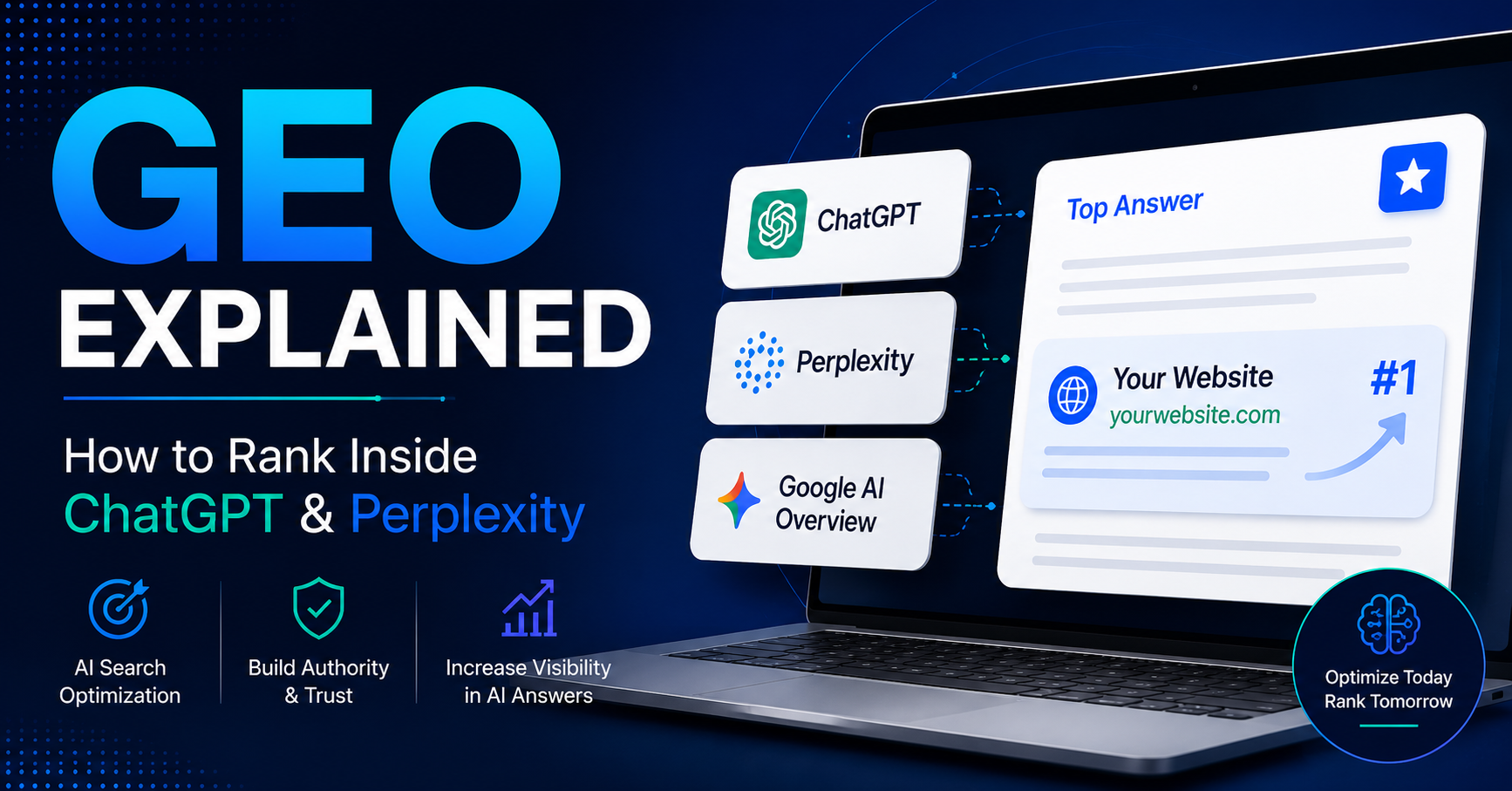
Artificial Intelligence is transforming how people search for information online. Instead of browsing through ten blue links on Google, users are now asking questions directly to AI tools like ChatGPT, Perplexity AI, Claude, Gemini, and Google AI Overview.
This shift has introduced a new concept known as GEO Explained, or Generative Engine Optimization (GEO). If your business wants to stay visible in the AI era, understanding GEO Explained is no longer optional—it's essential.
In this guide, we'll explain what GEO is, why it matters, and how you can optimize your website to rank inside AI-powered search engines.
What is GEO (Generative Engine Optimization)?
Generative Engine Optimization (GEO) is the process of optimizing your website and content so that AI-powered search engines can understand, trust, and recommend your information when answering user questions.
Unlike traditional SEO, where the goal is to rank on Google's search results page, GEO focuses on becoming a trusted source for AI-generated responses.
For example, when someone asks ChatGPT:
"What is the best digital marketing course in Jaipur?"
The AI doesn't simply display webpages—it generates a comprehensive answer using information from trusted sources across the web.
Your objective with GEO is to become one of those trusted sources.
Why GEO Matters More Than Ever
AI search adoption is growing rapidly.
Millions of users now rely on:
ChatGPT
Perplexity AI
Google AI Overview
Gemini
Claude
Microsoft Copilot
Instead of clicking multiple websites, users receive direct AI-generated answers.
If your website isn't optimized for AI, you may lose visibility even if your traditional SEO rankings are strong.
Businesses investing in GEO today are preparing for the future of search.
GEO vs Traditional SEO
Traditional SEO | GEO |
|---|---|
Optimizes for Google rankings | Optimizes for AI-generated answers |
Focuses on keywords | Focuses on topical authority |
Backlinks are critical | Trust and expertise matter more |
Rankings on SERPs | Citations inside AI responses |
Click-based traffic | AI referral and recommendation traffic |
How ChatGPT and Perplexity Choose Sources
AI models don't simply pick random websites.
They prioritize content that demonstrates:
Clear expertise
Accurate information
Well-structured content
Strong topical authority
Updated statistics
High-quality citations
Easy-to-understand language
If your content consistently answers user questions better than competitors, AI systems are more likely to reference it.
10 Proven GEO Strategies to Rank Inside ChatGPT & Perplexity
1. Answer Real User Questions
Create content around questions people actually ask.
Instead of writing:
"Digital Marketing Services"
Write:
What is Digital Marketing?
How does SEO work?
Is AI replacing SEO?
What is GEO?
Question-based content performs exceptionally well for AI search.
2. Build Topical Authority
Don't publish isolated blogs.
Create clusters around one topic.
Example:
GEO Explained
GEO vs SEO
GEO Checklist
GEO Tools
GEO Strategy
AI Search Optimization
How ChatGPT Finds Information
AI prefers websites that cover subjects comprehensively.
3. Use Clear Heading Structure
Organize your article using:
H1
H2
H3
This helps AI understand the hierarchy of information.
Example:
H2: What is GEO?
H3: Benefits
H3: Examples
H3: Best Practices
4. Write Conversational Content
AI understands natural language.
Avoid keyword stuffing.
Instead of writing:
"Best SEO Company Jaipur Best SEO Company Jaipur"
Write naturally:
"If you're looking for an SEO company in Jaipur, consider agencies that combine SEO with Generative Engine Optimization."
5. Add Statistics and Research
AI values factual information.
Include:
Industry reports
Research studies
Original insights
Updated statistics
The more trustworthy your content, the higher your credibility.
6. Optimize for Semantic Search
Instead of repeating one keyword, use related phrases like:
AI Search
Generative AI
Answer Engine Optimization
AI SEO
ChatGPT Optimization
Perplexity Ranking
This helps AI understand context.
7. Publish Fresh Content Regularly
AI favors websites that stay updated.
Regularly publish:
News
Case studies
Industry insights
Tutorials
AI trends
Fresh content signals ongoing expertise.
8. Improve Website Experience
A fast, mobile-friendly website with clean navigation makes it easier for AI systems and users to access your content.
Ensure your website has:
Fast loading speed
HTTPS security
Responsive design
Easy navigation
9. Earn Mentions Across the Web
AI trusts brands that appear consistently across multiple authoritative websites.
Focus on:
Guest blogging
Digital PR
Industry directories
Podcasts
Expert interviews
Brand mentions strengthen your authority.
10. Use Structured Data
Schema markup helps search engines better understand your content.
Implement:
FAQ Schema
Article Schema
Organization Schema
Breadcrumb Schema
Author Schema
Structured data improves your chances of appearing in AI-generated summaries.
Common GEO Mistakes to Avoid
Many websites fail to rank in AI search because they:
Publish thin content
Ignore topical authority
Overuse keywords
Skip structured data
Never update old articles
Lack author credibility
Write only for search engines instead of users
Avoiding these mistakes significantly improves your AI visibility.
The Future of Search is AI
Search behavior is changing rapidly.
People now ask complete questions instead of typing short keywords.
Businesses that optimize only for Google may miss opportunities to appear in AI-generated answers.
Combining SEO with GEO creates a future-proof digital marketing strategy that keeps your brand visible across both traditional and AI-powered search platforms.
Final Thoughts
Understanding GEO Explained is the first step toward succeeding in the era of AI search.
As platforms like ChatGPT, Perplexity, Gemini, and Google AI Overview become more popular, businesses must adapt their content strategies accordingly.
By creating authoritative, well-structured, user-focused content and following GEO best practices, you can increase your chances of being recommended by AI systems and stay ahead of the competition.
The future of search isn't just about ranking on Google—it's about becoming the trusted source AI chooses to cite.
FAQ
What does GEO stand for?
GEO stands for Generative Engine Optimization, the practice of optimizing content for AI-powered search engines like ChatGPT and Perplexity.
Is GEO replacing SEO?
No. GEO complements traditional SEO. Businesses should use both strategies together for maximum visibility.
Can ChatGPT rank websites?
ChatGPT doesn't rank websites like Google, but it recommends and cites trusted sources when generating answers.
How do I optimize for Perplexity AI?
Create authoritative, well-structured, fact-based content with topical authority, schema markup, and clear answers to user questions.
Why is GEO important?
As AI search grows, GEO helps businesses appear in AI-generated responses, increasing visibility and potential traffic.
Want this done for your business?
Get a free growth consultation
Tell us what you're working on and a senior strategist will map your next move.