How Can AI Help Small Business Owners?
Learn how AI can help small businesses save time, improve productivity, support customers, analyze data, and manage everyday tasks with practical use cases and simple steps.
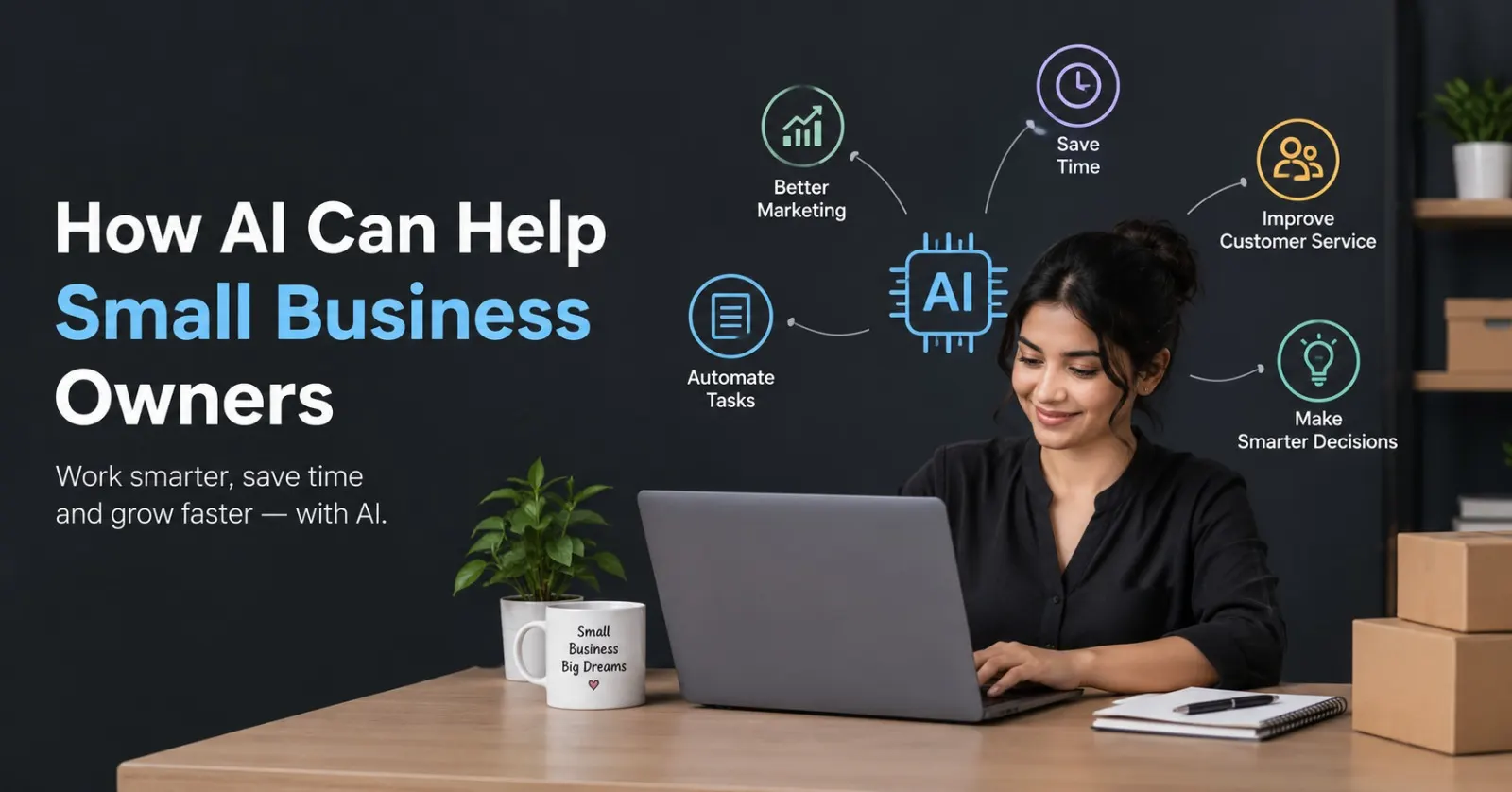
Introduction
Running a small business often means managing many tasks at the same time, from marketing and customer communication to reports, sales follow-ups, and daily operations. AI can help business owners handle some of this routine work more efficiently, giving them more time to focus on customers, employees, and business growth.This makes AI for small business useful for owners who want to improve everyday work without adding unnecessary complexity.
AI can support tasks such as creating content, answering common customer questions, organizing information, analyzing business data, and improving team workflows. However, the goal is not to automate everything. Small businesses should identify tasks where AI can provide real value, test them carefully, and keep human judgment involved where it is needed.
What Can AI Actually Do for a Small Business?
AI can help small businesses with everyday tasks that are repetitive, time-consuming, or require organizing information. It can support areas such as marketing, customer service, sales, administration, and data analysis. Common AI use cases for small business include content creation, customer support, lead organization, data analysis, and routine business operations.
For example, a small business can use AI to create content ideas, draft emails, summarize documents, answer common customer questions, organize leads, or review business data. The business owner or employee can then check the output and make the final decision.
The goal is not to use AI for everything. The best use of AI is to solve a specific business problem and make the work simpler, faster, or more manageable.
Key Takeaways
AI can help small businesses reduce time spent on repetitive tasks.
AI can support marketing, customer service, sales, administration, and business analysis.
Human review is still important for important, sensitive, or customer-facing work.
Businesses should consider privacy and security before sharing business or customer data with an AI system.
The best AI use case is usually connected to a clear and measurable business problem.
Small businesses can start with one process instead of trying to introduce AI everywhere.
AI should be measured based on useful business outcomes, not simply on how advanced the technology appears.
How Can AI Help Small Business Owners?
AI can help small business owners manage everyday work more easily and reduce the time spent on repetitive tasks. Instead of trying to automate the whole business, owners can use AI where it provides practical support.
For example, AI can help with marketing content, customer questions, sales follow-ups, document summaries, business data, and daily operations. This can make routine work faster and give owners more time to focus on customers, business growth, and important decisions.
The key is to start with one clear business problem, test how AI can help, and then measure whether it actually improves the process.
Save Time on Repetitive Tasks
Small businesses often spend a lot of time on routine tasks such as writing emails, preparing reports, summarizing meetings, and organizing information. AI can help with these tasks by creating drafts, summaries, and organized notes. AI automation for small businesses can be useful for repetitive workflows such as drafting emails, organizing information, and preparing routine reports.
For example, after a meeting, AI can turn notes into key points, action items, and follow-up tasks. This saves time while allowing the employee to review and make changes before using the final result.
Create and Improve Marketing Content
AI can help small businesses create marketing content more quickly and easily. It can generate content ideas, draft social media posts, emails, blog outlines, product descriptions, and headlines. For small businesses, AI for small business marketing can help with content ideas, social media drafts, email campaigns, and other routine marketing tasks. AI can also support Social Media Marketing by helping businesses create content ideas, captions, and post drafts.
For example, a business can give AI information about a new service and ask for social media post ideas. The team can then edit the content, add the brand's voice, check the facts, and publish the final version.
This makes AI a useful content support tool, while creativity, strategy, and final approval remain with the business.
Handle Common Customer Questions
Small businesses often receive the same questions about services, prices, business hours, bookings, delivery, or products. AI can help answer these common questions quickly through chatbots or automated support. AI for customer service can help businesses respond to common questions while allowing employees to handle complex or sensitive customer issues.
For example, an AI chatbot can provide basic information when a customer visits a website outside business hours. However, complex complaints or sensitive issues should still be handled by a human team member.
Qualify Leads and Support Sales Follow-Ups
AI can help small businesses organize leads and understand what potential customers are looking for. It can summarize enquiries, identify basic customer requirements, and help prepare follow-up messages.
For example, if a business receives many enquiries, AI can organize them based on the service needed and prepare a simple follow-up draft. The sales team can then review the information and decide how to respond.
Organize and Summarize Business Information
Small businesses deal with many documents, reports, meeting notes, customer feedback, and other information. AI can help organize this information and create short, easy-to-understand summaries.
For example, AI can turn long meeting notes into key points, action items, and important decisions. This saves time and makes it easier for business owners and teams to find and understand useful information.
Analyze Business Data and Support Decisions
AI can help small businesses understand their data by finding patterns, summarizing results, and highlighting useful information. It can be used to review sales, website performance, customer feedback, leads, or marketing results.
For example, AI can help identify which products are getting more sales or which marketing activities are generating more enquiries. However, business owners should review the data and use their own judgment before making important decisions.
Improve Everyday Business Operations
AI can help small businesses manage everyday operations more efficiently by reducing manual work and keeping routine processes organized. It can assist with scheduling, inventory updates, task management, order tracking, and preparing regular reports.AI for business operations can help organize routine workflows, track pending tasks, and reduce manual administrative work.
For example, a business can use AI to organize daily tasks, identify pending work, or summarize operational reports. This helps the team save time, reduce repetitive work, and focus more on customers and important business activities.
Support Productivity and Team Workflows
AI can help teams complete everyday work faster by organizing information, creating drafts, summarizing meetings, and helping employees find useful information. This can reduce time spent on routine tasks and make team workflows more organized. AI for productivity can help teams reduce the time spent on repetitive tasks and information management.
For example, after a team meeting, AI can summarize the discussion, list important decisions, and create follow-up tasks. Team members can then review the information, make any necessary changes, and continue their work with clearer priorities.
AI Use Cases for Small Businesses — Comparison Table
AI Use Case | How AI Can Help | Human Role |
|---|---|---|
Repetitive tasks | Drafts, summaries and information organization | Review and approval |
Marketing | Ideas, drafts and content improvement | Strategy and editing |
Customer support | Answers to common questions | Handle complex issues |
Sales | Lead organization and follow-up support | Sales decisions |
Data analysis | Summaries and pattern identification | Business interpretation |
Operations | Workflow and documentation support | Process management |
Team productivity | Notes, research and task organization | Final review and action |
How to Identify the Right AI Use Case for Your Business
The right AI use case is not always the most advanced one. Small businesses should first look at tasks that take a lot of time, happen regularly, or involve repetitive work. AI can then be tested to see whether it actually makes the process faster or easier.
For example, if a team spends hours every week creating reports, answering common questions, or organizing customer enquiries, these could be useful areas to test AI. Start with one clear task, measure the results, and expand only if AI provides real value.
Start With a Repetitive and Measurable Task
A good way to start using AI is to choose a task that your team does regularly and where the results can be measured. This makes it easier to see whether AI is actually saving time or improving the process.
For example, if an employee spends two hours each week preparing reports, AI could help create the first draft or summarize the data. The business can then compare the time and effort before and after using AI to see if the change is useful.
Check the Data and Human Input Required
Before using AI for a business task, check what information the AI needs and how much human review will still be required. Some tasks may involve sensitive customer or business data, while others may need human judgment to ensure the result is accurate.
For example, if AI is used to summarize customer enquiries, the team should make sure the information is handled safely and review the summary before taking action. This helps businesses use AI responsibly while keeping people involved where their judgment matters.
Estimate the Potential Time or Cost Savings
Before using AI for a task, estimate how much time, effort, or money it could save. This helps a business understand whether the AI solution is actually worth using and prevents spending resources on tools that provide little value.
For example, if a task currently takes 10 hours each month and AI could reduce it to 6 hours, the business can compare the four hours saved with the cost of the AI tool. This makes it easier to decide whether to continue, improve, or stop using the solution.
Start Small and Test Before Expanding
Small businesses do not need to use AI across every part of the business at once. It is better to start with one specific task, test the results, and understand what works before expanding to other areas.
For example, a business can first use AI to draft customer emails for one team. After checking the quality, time saved, and customer response, the business can decide whether to use AI for other communication or workflows..
AI Use Case Selection Checklist
Before choosing an AI use case, a small business can ask a few simple questions:
Is the task repetitive or time-consuming?
Can AI realistically improve or simplify the task?
What data or information will AI need?
Will a team member need to review the result?
How much time or cost could the business save?
Can the task be tested on a small scale first?
Can the results be measured clearly?
What Are the Limitations and Risks of Using AI?

AI can make many business tasks faster, but it is not always accurate or suitable for every situation. AI-generated information can contain mistakes, miss important context, or produce results that need human review before they are used.
Businesses should also consider data privacy, security, costs, and how much human involvement a task requires. For example, sensitive customer or business information should be handled carefully, and important decisions should not be made based only on AI-generated results. The goal is to use AI as a helpful tool while keeping people responsible for reviewing and making final decisions.
AI Accuracy and Human Review
AI can produce useful results quickly, but it can also make mistakes or provide incomplete information. Businesses should not assume that every AI-generated answer is correct, especially when the information affects customers, finances, legal matters, or important business decisions.
For example, if AI creates a customer response or summarizes business data, a team member should review the result before using it. Human review helps catch errors, add missing context, and make sure the final information is accurate and appropriate.
Data Privacy and Security
Small businesses should be careful about the information they share with AI tools. Customer details, passwords, financial information, confidential documents, and other sensitive business data should not be entered into an AI tool without understanding how the data is handled and protected.
Before using an AI tool, businesses should check its privacy and security practices and follow their own data protection policies. Using only the information needed for a task and keeping human oversight can help reduce unnecessary data risks.Businesses can also refer to the NIST AI Risk Management Framework for guidance on managing AI-related risks and using AI more responsibly.
Over-Automation and Loss of Human Context
Using AI for too many tasks can sometimes remove the human understanding that certain situations require. Not every customer question, business decision, or communication should be handled automatically.
For example, an AI system may provide a standard response to a customer complaint but miss the emotions or specific details behind the issue. A human team member can understand the situation, add context, and provide a more appropriate response. AI should support people, not remove human judgment where it matters.
How Much Does It Cost to Use AI in a Small Business?
The cost of using AI in a small business depends on the type of tool, features, number of users, and how often it is used. Some AI tools offer free plans or basic features, while advanced business tools may require monthly or usage-based payments.
Instead of choosing a tool based only on price, businesses should compare its cost with the time, effort, or other resources it could save. Starting with a simple and affordable tool can help a business test whether AI provides enough value before investing in more advanced solutions.
How Should a Small Business Get Started With AI?
Starting with AI does not have to be complicated.
Step 1: Identify a business problem
Find a repetitive or time-consuming task that causes a clear operational problem.
Step 2: Choose an appropriate AI use case
Businesses should choose AI tools for small businesses based on the task they need to improve, the data involved, ease of use, and the level of human review required.
Step 3: Check data and privacy requirements
Understand what information the AI system needs and whether that information can be used safely.
Step 4: Test on a small scale
Start with one workflow instead of changing the entire business process.
Step 5: Review the output
Check whether the AI-generated result is accurate, useful, and appropriate.
Step 6: Measure the result
Look at relevant measures such as time saved, response speed, productivity, quality, or customer experience.
Step 7: Improve the workflow
Adjust the instructions, process, human review, or tool based on what the test shows.
Step 8: Expand only when it makes sense
If the use case consistently provides value, consider applying the approach to similar processes.
Practical Framework —
Problem → AI Use Case → Test → Measure → Improve
A simple way for small businesses to adopt AI is to follow a Problem → AI Use Case → Test → Measure → Improve approach. Start by identifying a real business problem, such as spending too much time on repetitive tasks. Then choose an AI use case that can help solve that specific problem instead of using AI without a clear purpose.
Next, test the AI solution on a small scale and review the results. Measure factors such as time saved, quality, cost, or productivity, and then make improvements based on what you learn. If the solution provides real value, it can gradually be expanded to other suitable tasks.
Frequently Asked Questions About AI for Small Businesses
1. How can AI help a small business?
AI can help small businesses save time, automate repetitive tasks, create content, support customers, organize information, analyze data, and improve everyday workflows. The best use depends on the specific needs and processes of the business.
2. Is AI expensive for small businesses?
Not necessarily. Many AI tools offer free or affordable plans, while advanced tools may cost more depending on features and usage. Businesses should compare the cost of a tool with the time, effort, or resources it can save.
3. Can AI replace employees in a small business?
AI can automate or support some repetitive tasks, but it does not replace the need for human judgment in every situation. Employees can review AI outputs, handle complex issues, and make important decisions.
4. Is it safe for small businesses to use AI?
AI can be used responsibly, but businesses should be careful with sensitive information. Before using an AI tool, check its privacy and security practices and avoid sharing confidential data unnecessarily.
5. How should a small business start using AI?
Start with one clear and repetitive business task where the results can be measured. Test the AI solution on a small scale, review its output, measure the results, and expand its use only if it provides real value.
Conclusion
AI can help small businesses save time, improve productivity, support customers, create content, analyze information, and manage everyday work. But using more AI tools does not automatically mean better results. The real value comes from choosing the right use case for a specific business problem.
Start with one repetitive or time-consuming task, test how AI can help, and measure the results. Keep human review where it matters, protect business and customer data, and improve the process based on what you learn. If AI provides clear value, you can gradually expand it to other areas of the business.
The goal is simple: use AI where it solves a real problem and makes the business work better.
About the Author
Arena Infosolution is a digital growth partner specializing in AI, SEO, digital marketing, automation, and business growth. The team creates practical and easy-to-understand insights to help businesses use technology, improve their online presence, and make smarter digital decisions.
Want this done for your business?
Get a free growth consultation
Tell us what you're working on and a senior strategist will map your next move.