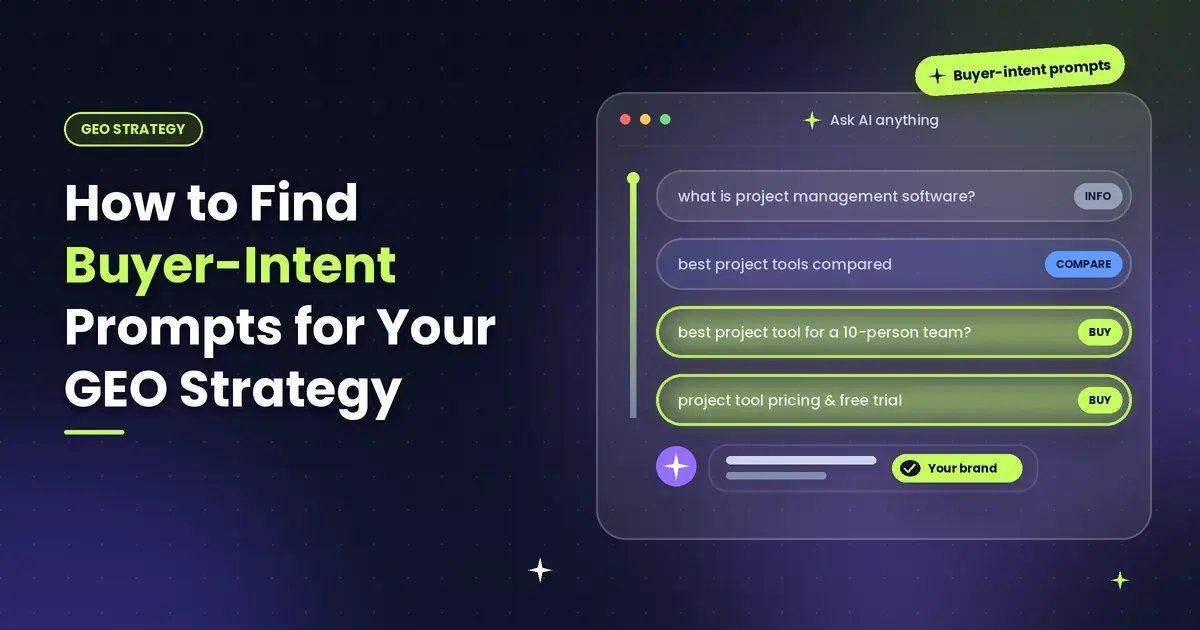
How to Find Buyer-Intent Prompts for Your GEO Strategy
Learn how to find buyer-intent prompts, understand customer search intent, use AI research tools, and create helpful content to improve your GEO strategy and connect with potential customers.
Introduction
Customer behaviour is changing as more people use AI-powered platforms such as ChatGPT, Perplexity, and Google AI Overviews to research products, compare services, and make purchasing decisions. Instead of searching with short keywords, users now ask detailed questions to find solutions that match their needs.
For businesses, this change creates new opportunities to understand potential customers. They need to identify not only what people search for but also why they are searching. This is where Buyer-Intent Prompts become important.
Buyer-intent prompts help businesses understand what potential customers want to know before making a purchasing decision. By studying these questions, businesses can identify customer expectations, understand buying behaviour, and create more relevant website content.
A well-planned GEO Strategy focuses on creating helpful, relevant, and trustworthy content for AI-powered search experiences. By researching customer questions, businesses can develop useful blogs, service pages, comparison guides, and FAQs.
In this blog, we will explore how to find buyer-intent prompts, understand customer search intent, use research tools, and turn customer questions into an effective GEO content strategy.
Effective Buyer Intent Research helps businesses understand Customer Search Intent and discover relevant AI Search Prompts. These insights support a strong GEO Strategy and help businesses develop a useful GEO Content Strategy. By answering relevant customer questions, businesses can improve their chances of gaining AI Search Visibility.
TABLE OF CONTENTS
What is a Buyer-Intent Prompt?
Why Buyer-Intent Prompts Matter for GEO
Signs That a Prompt Shows Buying Interest
How to Find Buyer-Intent Prompts for Your GEO Strategy
How to Prioritise the Right Buyer-Intent Prompts
Best Tools for Buyer-Intent Research
How to Create GEO Content Around Buyer-Intent Prompts
Common Mistakes to Avoid When Finding Buyer-Intent Prompts
How to Measure the Success of Your GEO Strategy
Frequently Asked Questions
Conclusion
About the Author
What is a Buyer-Intent Prompt?
A buyer-intent prompt is a question that shows a potential customer's interest in researching, comparing, or purchasing a product or service.
Buyer-intent prompts help businesses understand customer needs, identify purchasing interests, and create relevant content for their GEO strategy.
For example, consider someone planning to purchase a laptop. Their questions may change as they move closer to making a decision.
What is a laptop?
Which laptop is suitable for students?
Which laptop is better for programming?
What is the best laptop under ₹60,000?
Where can I buy a laptop with a warranty?
The first question shows general curiosity, while the later questions indicate more specific purchasing requirements.
Understanding these differences helps businesses discover relevant buyer-intent prompts and create content that answers customer questions.
Difference Between Regular Keywords and Buyer-Intent Prompts
Traditional keywords are generally short words or phrases that describe a topic. Buyer-intent prompts provide more context about what users want to know before making a purchase.
Regular Keyword | Buyer-Intent Prompt |
|---|---|
Website design | Which website design service is suitable for a small business? |
Digital marketing course | Which digital marketing course offers practical training? |
Laptop price | Which laptop is best for students under ₹60,000? |
SEO services | How do I choose a reliable SEO agency? |
Both keywords and prompts are useful for SEO and GEO research. However, buyer-intent prompts provide additional insights into customer needs and purchasing decisions.
2. Why Buyer-Intent Prompts Matter for GEO
Generative Engine Optimization (GEO) focuses on making website content useful, understandable, and relevant for AI-powered search experiences.
Researching buyer-intent prompts helps businesses understand the questions people ask before selecting a product or service. This information can guide content planning and help businesses answer genuine customer concerns.
Understand the Customer's Buying Journey
Customers usually collect information before spending money. They may compare prices, check features, read reviews, and look for trustworthy providers.
For example, someone searching for an SEO agency may first understand SEO services, then compare different agencies, and finally enquire about pricing.
Understanding this journey helps businesses create content for different stages of customer decision-making.
Discover New Content Opportunities
A business may already publish general blogs about its products or services. However, it may not have content answering specific questions about pricing, benefits, comparisons, or service features.
Buyer-intent research helps identify these missing topics and provides new ideas for website content.
Improve AI Search Visibility
AI-powered platforms generate responses using information from different sources. Helpful, relevant, and trustworthy content may become a useful source for these answers.
Businesses can improve their content by answering specific customer questions and providing clear information about their products and services. However, no prompt or content format guarantees AI mentions or citations.
Build Customer Trust
Customers want accurate information before choosing a business.
Content that explains services honestly, provides practical examples, and answers common concerns can help people make informed decisions.
A strong GEO strategy should focus on providing genuine value rather than simply repeating keywords.
3. Signs That a Prompt Shows Buying Interest
Not every question indicates that someone is ready to purchase. Some users are learning about a topic, while others are comparing available options.
You can identify possible buying interest by looking at the language and context of a question.
Comparison-Based Questions
Words such as best, better, versus, and compare often suggest that users are evaluating different options.
Examples:
Which CRM software is best for small businesses?
Which digital marketing course is better for beginners?
What is the difference between two SEO tools?
These questions can become useful topics for comparison articles.
Pricing and Budget Questions
People often ask about costs when they are checking whether a product or service fits their budget.
Examples:
How much does website development cost?
What is the monthly price of accounting software?
Which SEO service is affordable for small businesses?
Businesses can answer these questions through pricing guides and service pages.
Review and Recommendation Questions
Customers may look for recommendations before making a final decision.
Examples:
What should I check before hiring an SEO agency?
Which project management tool is suitable for a small team?
Which digital marketing institute offers practical training?
These questions indicate that users are evaluating quality, experience, and reliability.
Action-Based Questions
Questions containing words such as buy, book, register, and hire may indicate a stronger intention to take action.
Examples:
How can I register for a training course?
Where can I book a website consultation?
How do I hire a digital marketing agency?
These prompts can help businesses create relevant landing pages and enquiry-focused content.
4. How to Find Buyer-Intent Prompts for Your GEO Strategy
Finding relevant prompts requires more than entering a keyword into an AI tool. Businesses should explore different research sources to understand what potential customers actually want.
Before researching buyer-intent prompts, businesses should understand the basics of SEO, as it helps them identify relevant keywords, understand search behaviour, and create useful website content.
Here are seven practical methods.
1. Start With Your Main Product or Service
First, identify the products or services your business offers. Then think about the questions customers may ask before choosing them.
For example, an SEO agency can begin with topics such as:
SEO pricing
SEO packages
SEO results
SEO reporting
SEO agency selection
These topics provide a starting point for discovering more detailed customer questions.
2. Use AI Tools to Generate Prompt Ideas
AI platforms such as ChatGPT and Perplexity can help generate possible customer questions based on a business category, product, or target audience.
For example, you can enter this prompt:
"Act as a small business owner looking for SEO services. Generate 15 questions I might ask before hiring an SEO agency. Include questions about pricing, services, reporting, experience, and expected results."
The generated questions can help you discover new content ideas.
However, AI-generated suggestions should be treated as brainstorming ideas. They do not automatically prove that real customers search for those questions.
3. Explore Google Autocomplete
Google Autocomplete provides suggestions while users type a search query. These suggestions can help businesses discover related searches and possible customer questions.
For example, type "best SEO agency for..." into Google and review the suggestions.
You may discover searches related to:
Small businesses
Local companies
E-commerce websites
Startups
Affordable SEO services
Use these ideas to create a list of relevant topics for your GEO strategy.
4. Study the People Also Ask Section
Google's People Also Ask section displays questions related to a user's search.
For example, when researching SEO services for small businesses, you may find questions about:
How much do SEO services cost?
How do I choose an SEO agency?
What services should an SEO agency provide?
How long does SEO take to show results?
These questions can become useful blog headings, FAQ topics, and content ideas.
5. Listen to Customer Questions
Existing customer conversations are an important source of buyer-intent prompts.
Speak with sales teams, customer support employees, and business owners to understand which questions customers ask most frequently.
For example, people contacting a website design company may ask:
Will my website work on mobile phones?
Is website maintenance included?
Can I update the website myself?
How long will website development take?
These questions come directly from customer concerns and can help businesses create more relevant service pages.
6. Analyse Competitor Websites
Competitor research helps businesses understand what information other companies provide to potential customers.
Review their:
Service pages
Blog articles
Pricing information
Comparison guides
Customer FAQs
Case studies
Look for questions that are missing or not explained clearly.
For example, if competitor websites explain website design services but do not clearly discuss maintenance costs, you could create a detailed guide about website maintenance pricing.
Always create original content instead of copying competitor pages.
7. Explore Customer Reviews and Online Discussions
Customer reviews and online communities often reveal the problems people face while selecting products or services.
Platforms such as Reddit and Quora can help you understand common customer concerns.
For example, people discussing accounting software may ask:
Is it easy for beginners?
Does it support GST invoicing?
Can it generate financial reports?
Is customer support available?
Look for repeated questions and verify the information before using it in your content strategy.
5. How to Prioritise the Right Buyer-Intent Prompts
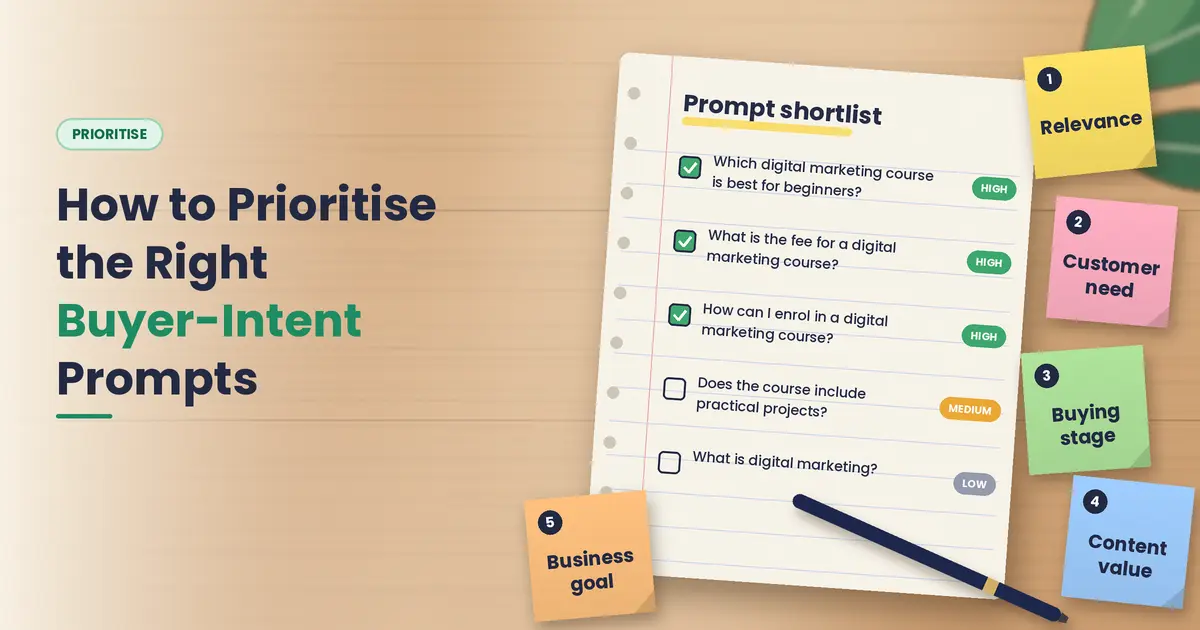
After collecting buyer-intent prompts, businesses may have many customer questions to consider. However, not every question is equally valuable. Some prompts help users understand a topic, while others show that they are comparing services or preparing to make a purchase.
Businesses should prioritise prompts based on their relevance, customer needs, search intent, and potential to generate leads. This helps them focus on questions that are more likely to attract the right audience and support business goals.
Practical Example: Buyer-Intent Prompt Research
Suppose a digital marketing institute wants to attract students interested in professional training. It can organise customer questions according to their search intent and identify suitable content opportunities.
Buyer-Intent Prompt | Search Intent | Content Opportunity |
|---|---|---|
What is digital marketing? | Informational | Educational blog |
Which digital marketing course is best for beginners? | Commercial | Course comparison guide |
What is the fee for a digital marketing course? | Commercial | Course pricing page |
Does a digital marketing course include practical projects? | Commercial | Course details page |
How can I enrol in a digital marketing course? | Transactional | Enrolment landing page |
This example shows that different buyer-intent prompts represent different stages of the customer journey. Some users are looking for basic information, while others are comparing courses or are ready to enrol.
Businesses should focus on prompts that match their actual services and customer requirements rather than choosing questions only because they seem popular.
6. Best Tools for Buyer-Intent Research
Different tools can help businesses discover customer questions, research keywords, and understand search behaviour.
Tool | Main Purpose | How It Helps |
|---|---|---|
ChatGPT | AI research | Generates possible customer questions |
Perplexity | AI-powered research | Explores topics and sources |
Google Search | Search research | Finds autocomplete and related questions |
Google Keyword Planner | Keyword research | Provides keyword ideas and estimates |
Semrush | SEO research | Analyses keywords and competitors |
Ahrefs | SEO research | Finds keyword and content opportunities |
Google Trends | Trend analysis | Compares interest in topics |
Customer research | Reveals real discussions and concerns |
Google Trends is useful for comparing how interest in a topic changes over time, exploring related topics, and deciding which customer questions deserve content first. It shows relative interest, not exact search volume.
No single tool provides a complete picture of buyer intent. Combining AI research, customer feedback, and keyword analysis can create a more useful prompt list.
7. How to Create GEO Content Around Buyer-Intent Prompts
After identifying and prioritising relevant buyer-intent prompts, the next step is to turn them into useful website content. Businesses should create content that answers customer questions, addresses their needs, and provides accurate information.
Follow these steps:
Step 1: Select a Specific Customer Question
Choose a relevant prompt that matches your business, products, services, and target audience. Focus on questions that potential customers are likely to ask before making a purchase or choosing a service.
Example:
"How much does SEO cost for a small business?"
Step 2: Understand the Customer's Requirements
Identify what information the customer expects from the answer. Understanding their requirements helps you create relevant content that addresses their actual concerns.
For an SEO pricing question, the customer may be interested in:
Monthly service fees
SEO packages
Keyword research
Technical SEO
Website reporting
Step 3: Choose the Right Content Format
Select a content format that matches the customer's question and search intent. The right format makes information easier to understand and helps readers find relevant answers.
General questions can become educational blogs.
Pricing questions can become cost guides.
Comparison questions can become comparison articles.
Service-related questions can be answered through service pages.
Common questions can be included in FAQs.
Step 4: Provide a Direct Answer
Start your content with a clear and relevant answer to the main question. Then explain the topic using descriptive headings, short paragraphs, practical examples, and tables where useful.
Avoid unnecessary technical language, vague explanations, and unsupported claims.
Step 5: Add Relevant Business Information
Include accurate details about your business, products, services, experience, and areas of operation. Explain what makes your offerings useful and how they address customer needs.
This information helps readers understand your business and gives AI platforms additional context about your brand.
Step 6: Review and Update Your Content
Review your published content to ensure that it answers the original customer question accurately and completely.
Update outdated information, pricing, service details, examples, and references whenever necessary. Regular content updates help maintain accuracy, relevance, and usefulness.
8. Common Mistakes to Avoid When Finding Buyer-Intent Prompts
Businesses should avoid these mistakes while developing their GEO strategy.
Focusing Only on Popular Keywords: High search volume does not always indicate strong buying interest. Include specific questions and customer problems in your research.
Ignoring Customer Feedback: Real customer questions can reveal useful content opportunities that keyword research tools may not clearly identify.
Using Unverified AI Suggestions: AI-generated prompts are useful for brainstorming, but they should be checked against real customer needs and available research.
Creating Repetitive Content: Publishing separate articles for very similar questions can lead to unnecessary repetition. Group related prompts when one detailed page can answer them properly.
Making Unsupported Claims: Avoid promising guaranteed AI citations, search rankings, or sales.
Forgetting to Update Content: Outdated prices, service details, and examples can reduce the usefulness of a website. Review important pages regularly.
9. How to Measure the Success of Your GEO Strategy
Publishing content is not the final step of a GEO strategy. Businesses should regularly monitor their content performance to understand whether their efforts are improving AI visibility, attracting relevant visitors, and supporting business goals.
Here are some important areas to track.
AI Brand Mentions
Monitor how often your business name appears in AI-generated answers when users search for relevant products, services, or industry-related information. This helps businesses understand how visible their brand is across AI platforms like ChatGPT and Perplexity.
AI Citations and References
Check whether AI platforms use your website content, blogs, or articles as sources when generating answers. Tracking these references helps businesses understand which content provides useful and relevant information to AI platforms.
Organic Website Traffic
Monitor how many visitors reach your website through unpaid search results. Use Google Search Console and Google Analytics 4 (GA4) to track clicks, impressions, organic traffic, and visitor behaviour.
Qualified Leads
Measure whether your GEO strategy attracts potential customers who are genuinely interested in your products or services. Focus on meaningful customer actions such as:
Contact form submissions
Course enquiries
Consultation requests
Product enquiries
Registrations
Conversion Performance
Evaluate whether website visitors complete valuable actions after discovering your content. Track conversions such as submitting enquiry forms, booking consultations, purchasing products, or registering for services.
Content Performance
Analyze which blogs, articles, and landing pages attract relevant visitors and generate engagement. Identify high-performing content and improve pages that need better information, relevant examples, or answers to customer questions.
AI-generated answers can change between searches and platforms. Therefore, businesses should test a consistent set of prompts regularly and record brand mentions, citations, and visibility changes over time.
Key Takeaways
Understand how buyer-intent prompts reveal customer purchasing interests.
Discover customer questions through AI platforms and search engines.
Identify commercial and transactional search intent.
Use keyword research tools to find relevant AI search prompts.
Organise prompts according to customer needs and buying stages.
Create helpful content to support your GEO strategy.
Measure AI search visibility, website traffic, and qualified leads.10. Frequently Asked Questions
Frequently Asked Questions (FAQs)
1. What Are Buyer-Intent Prompts?
Buyer-intent prompts are questions that show a person's interest in researching, comparing, or purchasing a product or service. They help businesses understand customer requirements before a buying decision.
2. Why Are Buyer-Intent Prompts Important for GEO?
They help businesses identify relevant customer questions and create useful content around those questions. This supports a customer-focused GEO strategy.
3. How Can I Find Buyer-Intent Prompts for My Business?
You can find them through ChatGPT, Perplexity, Google Autocomplete, People Also Ask, competitor websites, customer reviews, and online communities.
4. Which AI Tools Can Help With Buyer-Intent Research?
ChatGPT and Perplexity can help generate and explore possible customer questions. Their suggestions should be validated using customer feedback and other research sources.
5. What Is the Difference Between Search Intent and Buyer Intent?
Search intent describes the purpose behind a search, such as learning or comparing. Buyer intent focuses on signals that a person may be considering a purchase.
6. Can Buyer-Intent Prompts Improve AI Search Visibility?
They can help businesses plan content around relevant customer questions. However, using buyer-intent prompts does not guarantee that an AI platform will mention or cite a website.
7. How Many Buyer-Intent Prompts Should a Business Target?
There is no fixed number. Start with a manageable list of relevant questions, organise them according to customer needs, and prioritise the prompts that offer the most business value.
8. How Often Should Businesses Update Their Buyer-Intent Prompts?
Businesses should review their prompt lists regularly, especially when customer requirements, products, services, or industry trends change.
Conclusion
Finding buyer-intent prompts is an important part of understanding how customers research and select products or services. It helps businesses move beyond general keywords and focus on the questions that influence purchasing decisions.
Start by understanding your target audience, exploring customer questions, using research tools, and analysing competitor content. Then organise the prompts according to customer needs and create useful content around them.
A successful GEO strategy is not about collecting the largest number of prompts. It is about answering the right questions with accurate, original, and helpful information.
When businesses focus on customer needs, they can build trust, create better website content, and improve their opportunities to appear in relevant AI-powered search experiences.
About the Author
Arena Infosolution team shares practical knowledge about Search Engine Optimization (SEO), Generative Engine Optimization (GEO), digital marketing, and online business growth. Our aim is to help learners and businesses understand changing digital trends and develop effective online strategies.
Want this done for your business?
Get a free growth consultation
Tell us what you're working on and a senior strategist will map your next move.