What Is SEO? A Beginner’s Guide to Search Engine Optimization
Learn what SEO is, how it works, its main types, and why search engine optimization is important for improving organic visibility and website traffic.
Understand SEO Without the Confusion
When you search for something on Google, you usually click one of the results appearing near the top. But have you ever wondered why some websites appear before others? Why does one page receive thousands of visitors while another page covering a similar topic gets very little traffic? One of the major factors that can influence this visibility is Search Engine Optimization (SEO).
For anyone new to digital marketing, this SEO for beginners guide explains why some websites rank higher than others and how search engines determine which results to show.
What's Inside :
What is SEO and how does it work?
Main types of SEO
Why SEO is important for businesses?
Introduction
For anyone starting their digital marketing journey, understanding SEO for beginners is an important first step. Learning the search engine optimization basics and core SEO fundamentals can help you understand how websites become more visible in search results and attract relevant visitors. But have you ever wondered why some websites appear before others? Why does one page receive thousands of visitors while another page covering a similar topic gets very little traffic? One of the major factors that can influence this visibility is Search Engine Optimization (SEO).
SEO is the process of improving a website and its content so that search engines can better understand what each page is about and connect it with relevant searches. It involves more than simply adding keywords to a webpage. SEO can include improving website content, optimizing page elements, building credibility through external sources, improving technical performance, and making a business easier to discover in local searches.
For businesses, SEO can be an important part of building a long-term online presence. When people search for products, services, answers, or information related to a business, appearing in relevant search results can help bring more qualified visitors to the website. Unlike paid advertising, where businesses pay to display advertisements, organic search visibility is built through the quality, relevance, and overall optimization of a website.
SEO also involves different areas that work together. On-page SEO focuses on the content and elements of individual webpages, while off-page SEO focuses on activities that build a website's authority and credibility outside the website. Technical SEO deals with the technical aspects that help search engines access and understand a website, and local SEO helps businesses improve their visibility for location-based searches.
SEO is not something that can usually be completed once and forgotten. Search engines continue to update their systems, competitors publish new content, and users' search behavior changes over time. This is why businesses need to continuously review, improve, and update their SEO efforts.
In this guide, you'll learn what SEO is, how it works, the main types of SEO, why SEO is important for businesses, practical ways to improve search visibility, and what to keep in mind when building a long-term SEO strategy.
What Is SEO and How Does It Work?
To understand how search engines rank websites, it is important to know that search engines evaluate many signals before deciding which pages may be relevant and useful for a particular search query.. SEO stands for Search Engine Optimization. It refers to the process of optimizing a website and its content to improve its visibility in unpaid or organic search engine results.
Search Engine Optimization (SEO) is the process of improving a website so that search engines can better understand its content and show relevant pages to people searching for related information, products, or services. When a user enters a query on a search engine, the search engine evaluates many signals to determine which results are most relevant and useful for that search.
SEO is not simply about adding keywords to a webpage. It involves improving different parts of a website, including its content, page structure, technical performance, internal linking, external authority, and local presence. The overall goal is to create a website that is useful for visitors while making it easier for search engines to discover, understand, and evaluate its pages.
For example, imagine a digital marketing institute in Jaipur that wants to reach students searching for digital marketing courses. The institute can create useful course-related content, optimize its webpages, improve its website's technical performance, build relevant external references, and strengthen its local presence. Together, these activities can help the website become more visible for relevant searches.
SEO generally involves:
Understanding search intent — identifying what users are actually looking for.
Creating useful content — providing clear, relevant, and valuable information.
Optimizing webpages — improving titles, headings, URLs, images, internal links, and other page elements.
Improving technical performance — making the website accessible, crawlable, mobile-friendly, and technically sound.
Building authority — earning relevant mentions and links from other websites.
Improving local visibility — helping location-based businesses appear in relevant local searches.
In simple words, SEO helps connect the right website with the right user at the right time through organic search.
What Are the Main Types of SEO?
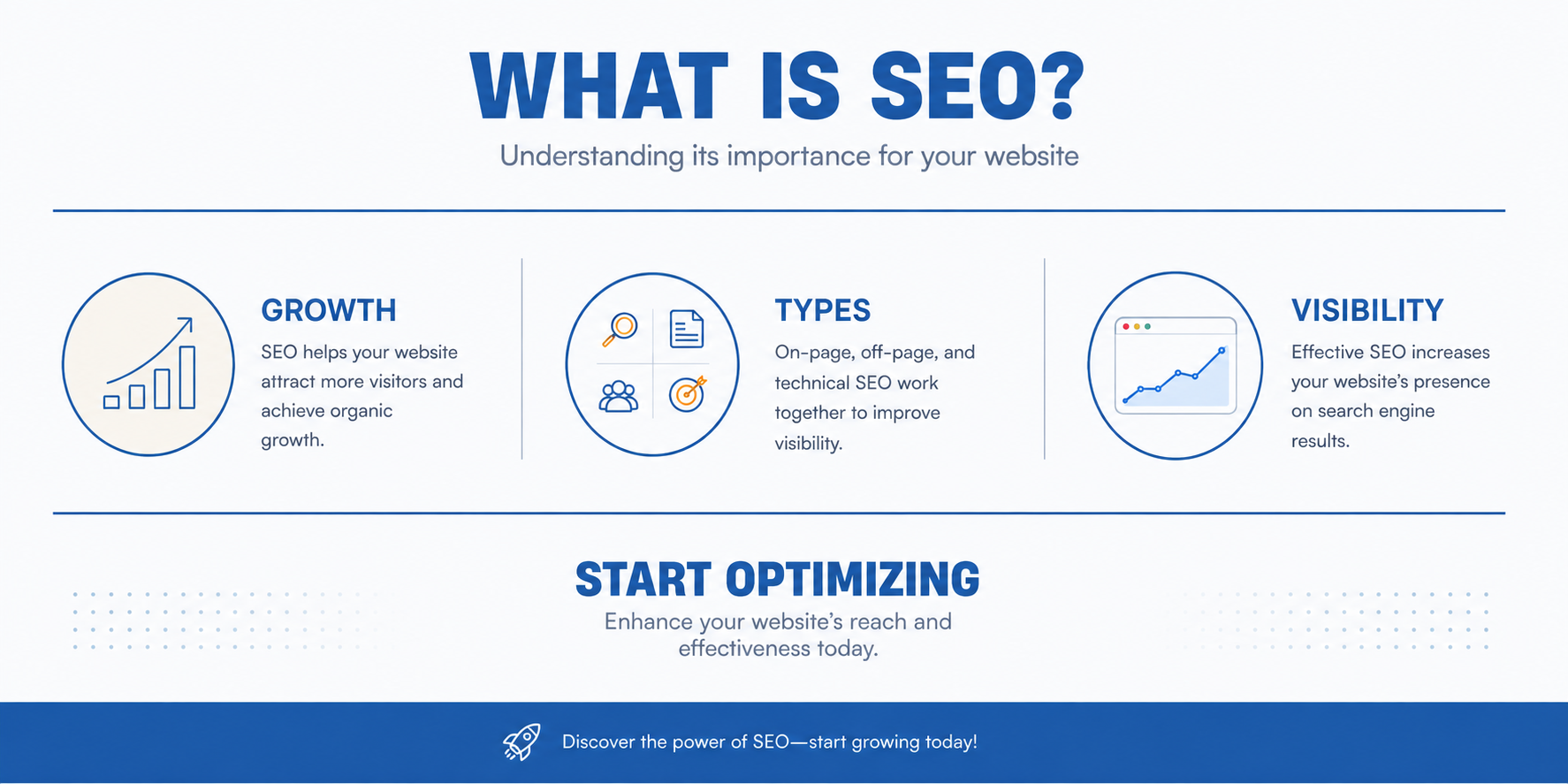
The main types of SEO include on-page SEO, off-page SEO, technical SEO, and local SEO. Each focuses on a different part of improving a website's search visibility.
1. On-Page SEO
On-page SEO focuses on optimizing the content and elements that are directly present on a webpage. The purpose is to help search engines understand the topic of a page while also making the content useful and easy to navigate for visitors.
It includes several elements such as keyword usage, title tags, meta descriptions, headings, URLs, image alt text, internal links, content structure, and the overall quality and relevance of the content.
For example, if a webpage is about “eggless cakes in Jaipur,” the content should clearly explain the products, answer questions a potential customer may have, and use relevant terms naturally rather than repeatedly inserting the same keyword. Clear headings, descriptive URLs, useful images, and relevant internal links can also make the page easier for both users and search engines to understand.
What does On-Page SEO include?
Keyword optimization: Using relevant search terms naturally in appropriate parts of the page.
Title tags: Creating a clear and descriptive title that communicates what the page is about.
Meta descriptions: Writing a useful summary that can encourage users to choose your result.
Headings: Using H1, H2, and other headings to organize information logically.
URL optimization: Keeping URLs descriptive, readable, and relevant to the page topic.
Image optimization: Using descriptive file names and relevant alt text for images.
Internal linking: Connecting related pages on the same website to help users discover more information.
Content quality: Providing original, useful, accurate, and relevant information that satisfies the user's search intent.
Practical Example
Suppose a bakery in Jaipur wants to attract customers searching for “eggless cake in Jaipur.” The bakery can create a dedicated webpage explaining its eggless cakes, naturally use the relevant search terms, write a descriptive page title and URL, add optimized images with useful alt text, link to related cake pages, and provide helpful information about flavors, ordering, and delivery.
These activities are examples of on-page SEO because they improve elements directly on the website.
2. Off-Page SEO
Off-page SEO focuses on activities outside the website that can improve its authority, credibility, and online presence.
While on-page SEO focuses on improving your own webpages, off-page SEO is about building signals and relationships beyond your website. These can include quality backlinks, brand mentions, digital PR, relevant business listings, guest contributions, and content promotion.
One of the best-known aspects of off-page SEO is link building. When a relevant and trustworthy website links to your content, it can act as a signal that your website is worth exploring. However, the goal should be to earn relevant and genuine links rather than collecting a large number of low-quality or unrelated backlinks.
Off-page SEO is also broader than backlinks. A business can build its online reputation by being mentioned by relevant publications, participating in industry communities, promoting useful resources, and maintaining accurate business information across appropriate platforms.
Common Ways to Do Off-Page SEO
1. Link Building:
Earn relevant backlinks from trustworthy websites through useful resources, original research, digital PR, partnerships, or other legitimate methods.
2. Guest Posting:
Contribute genuinely useful articles to relevant websites and publications. The main purpose should be providing value to their audience while building industry visibility and credibility.
3. Digital PR:
Promote newsworthy stories, research, expert opinions, or business developments that may earn coverage and mentions from online publications.
4. Business Listings & Citations:
Maintain accurate business information such as the business name, address, phone number, and website on relevant directories and platforms.
5. Brand Mentions:
Build awareness so that relevant websites, publications, communities, and users naturally mention your brand.
6. Content Promotion:
Share useful articles, guides, research, or other resources through relevant platforms and communities to increase their reach and potential for earning genuine references.
Practical Example
Suppose a Jaipur food blog publishes an article about “Best Local Bakeries in Jaipur” and naturally includes a link to a bakery's website. If the publication is relevant and trustworthy, that backlink can help the bakery build online authority and referral visibility.
Similarly, if a local newspaper features the bakery because of a unique product or business story and mentions its website, that is another example of building external visibility.
These activities happen outside the bakery's own website, which is why they fall under off-page SEO.
Expert Tip: Don't focus on getting as many backlinks as possible. A smaller number of relevant, trustworthy references can be more valuable than a large number of unrelated or low-quality links.
3. Technical SEO
Technical SEO focuses on the technical foundation of a website, including crawlability, indexing, website speed, mobile optimization, and site structure.
A website can have excellent content, but technical problems can still make it difficult for search engines to access important pages or for users to navigate the site effectively.
Technical SEO can involve website speed, mobile usability, HTTPS, crawlability, indexing, XML sitemaps, site architecture, redirects, structured data, broken links, and other technical issues.
What Does Technical SEO Include?
Website Speed:
Improving loading performance can create a better experience for visitors, particularly on slower connections or mobile devices.
Responsive Design:
A website should work properly across different screen sizes and devices.
Crawlability:
Search engine crawlers need to be able to access important pages and follow relevant links across the website.
Indexing:
Important pages should be technically accessible and eligible to be included in a search engine's index.
XML Sitemap:
An XML sitemap can help search engines discover important URLs on a website.
HTTPS:
HTTPS helps protect information exchanged between a website and its visitors and is an important part of website security.
Site Architecture:
A logical structure helps users navigate the website and helps search engines understand how different pages relate to one another.
Structured Data:
Structured data can help search engines better understand certain types of content and may make pages eligible for enhanced search features when applicable.
Practical Example
Suppose an online store takes several seconds to load, has broken links, and some important product pages cannot be properly accessed by search engine crawlers.
Simply adding more keywords to those product pages will not solve the underlying problem.
The business would first need to investigate the technical issues, improve loading performance, fix broken links, make important pages accessible to crawlers, check its sitemap, and ensure the website works properly on mobile devices.
These improvements are examples of technical SEO because they focus on the website's technical structure and accessibility.
4. Local SEO
Local SEO helps businesses improve their visibility when people search for products or services in a specific location.
It is particularly important for businesses that serve customers within a particular city, neighborhood, region, or physical service area. Local searches often include location-based terms such as “near me,” a city name, or a specific neighborhood.
For example, someone searching for “digital marketing institute in Jaipur” has a different search intent from someone simply searching for “digital marketing.” They are specifically looking for an option in Jaipur.
Local SEO helps businesses provide accurate and useful information about where they operate, what they offer, how customers can contact them, and what other customers say about them.
What Does Local SEO Include?
Google Business Profile:
Keeping the business profile complete and accurate with information such as business category, services, contact details, photos, and operating information.
Accurate Business Information:
Maintaining consistent and correct business details across relevant platforms.
Customer Reviews:
Encouraging genuine customers to share honest reviews and responding professionally to feedback.
Local Content:
Creating useful content that addresses the needs and questions of customers in the areas the business serves.
Local Citations:
Maintaining accurate business information on relevant local directories and platforms.
Location-Relevant Pages:
For businesses serving multiple locations, creating genuinely useful location-specific pages where they provide meaningful information rather than simply changing the city name on identical content.
Practical Example
Suppose a digital marketing institute wants to attract students in Jaipur.
It can optimize its Google Business Profile, provide accurate contact information, collect genuine student reviews, create useful content about digital marketing education in Jaipur, and maintain consistent business information across relevant platforms.
If someone searches “digital marketing institute in Jaipur” or “digital marketing course near me,” these local optimization efforts can help the business become more discoverable to relevant local audiences.
This is an example of local SEO because the strategy is focused specifically on reaching customers in a particular geographic area.
Type of SEO | Main Focus | Examples |
|---|---|---|
On-Page SEO | Content and webpage optimization | Keywords, headings, titles, internal links |
Off-Page SEO | Website authority and reputation | Backlinks, brand mentions, digital PR |
Technical SEO | Website performance and accessibility | Site speed, crawling, indexing, mobile-friendliness |
Local SEO | Visibility in local searches | Google Business Profile, reviews, local citations |
In practice, a successful SEO strategy combines all four types of SEO.
Why Is SEO Important?
A well-planned SEO strategy can improve organic search visibility and strengthen website search visibility, helping businesses become easier to discover when potential customers search for relevant products, services, or information.
Increases Organic Visibility: SEO helps your website appear more prominently in search results when people search for relevant products, services, or information.
Drives Relevant Website Traffic: By targeting the right keywords and search intent, SEO can attract users who are genuinely interested in what your website offers.
Builds Trust and Credibility: Useful content, quality backlinks, a secure website, and a strong user experience can help establish your website as a credible source.
Improves User Experience: SEO encourages faster loading speeds, mobile-friendly pages, clear navigation, and helpful content, making the website easier for visitors to use.
Supports Long-Term Growth: Well-optimized content can continue generating organic traffic over time, although SEO requires regular monitoring and improvements.
Cost-Effective Marketing: Unlike paid advertising, organic search traffic does not require you to pay for every click, making SEO a valuable long-term marketing channel.
Helps Reach Local Customers: Local SEO helps businesses appear for location-based searches such as “digital marketing institute in Jaipur” or “bakery near me.”
Provides a Competitive Advantage: A strong SEO strategy can help your website compete for visibility when potential customers search for products or services in your industry.
E.g., Increase organic traffic improve brand trust generate more leads better user experience long term growth.
There are many SEO ranking factors that can influence search engine ranking, including helpful content, website structure, relevance, user experience, and other signals that help search engines understand a webpage.
Ready to grow with AI-powered marketing?
Book a free 30-minute strategy call with the Arena Infosolution team.
Summary
SEO (Search Engine Optimization) improves a website’s visibility in organic search results. It includes on-page, off-page, technical, and local SEO to improve content relevance, website performance, authority, and local visibility. Effective SEO helps search engines understand your website, attracts relevant organic traffic, and supports long-term online growth.
SEO is a long term strategy so consistent optimization delivers better results than quick fixes.
Key takeaways
SEO improves organic visibility: It helps websites rank higher in relevant search results and attract potential visitors without relying entirely on paid advertising.
SEO has different types: On-page SEO, off-page SEO, technical SEO, and local SEO work together to improve a website’s content, authority, performance, and local visibility.
SEO supports long-term growth: A strong SEO strategy can generate relevant organic traffic, build credibility, improve user experience, and strengthen a website’s online presence over time.
SEO is an ongoing process, not a one-time activity: Search trends, competitors, algorithms, and user behaviour keep changing, so websites need regular content updates, technical checks, and continuous optimization.
Frequently asked questions
What is SEO in simple words?
SEO, or Search Engine Optimization, is the process of improving a website so it can appear more prominently in organic search results. It involves creating useful content, using relevant keywords, improving website performance, and helping search engines understand and index the site's pages.
What are the main types of SEO?
The four main types are on-page SEO, off-page SEO, technical SEO, and local SEO. On-page SEO improves content and webpage elements, off-page SEO builds authority through external signals such as backlinks, while technical SEO improves crawling, indexing, speed, mobile usability, and website structure.
How long does SEO take to show results?
SEO results usually take time because rankings depend on factors such as competition, website condition, content quality, and search demand. Some improvements may appear relatively quickly, while meaningful growth often develops over several months. Consistent optimization is more important than expecting immediate results.
Is SEO free or paid?
SEO mainly focuses on improving organic (unpaid) search visibility, so you do not pay search engines for clicks or rankings. However, SEO itself may involve costs for SEO professionals, content creation, website development, or SEO tools. Unlike paid advertising, SEO focuses on earning visibility naturally over time rather than paying for each click.
Can I do SEO myself, or do I need an SEO expert?
Yes, beginners can handle basic SEO tasks such as keyword research, content optimization, internal linking, and improving page titles and meta descriptions. However, complex technical issues, competitive industries, or large websites may require help from an experienced SEO professional.
If you're new to SEO, start by learning On-Page SEO first before moving to Technical and Off-Page SEO.
Ready to grow with AI-powered marketing?
Book a free 30-minute strategy call with the Arena Infosolution team.
Get a free growth consultation
Tell us what you're working on and a senior strategist will map your next move.