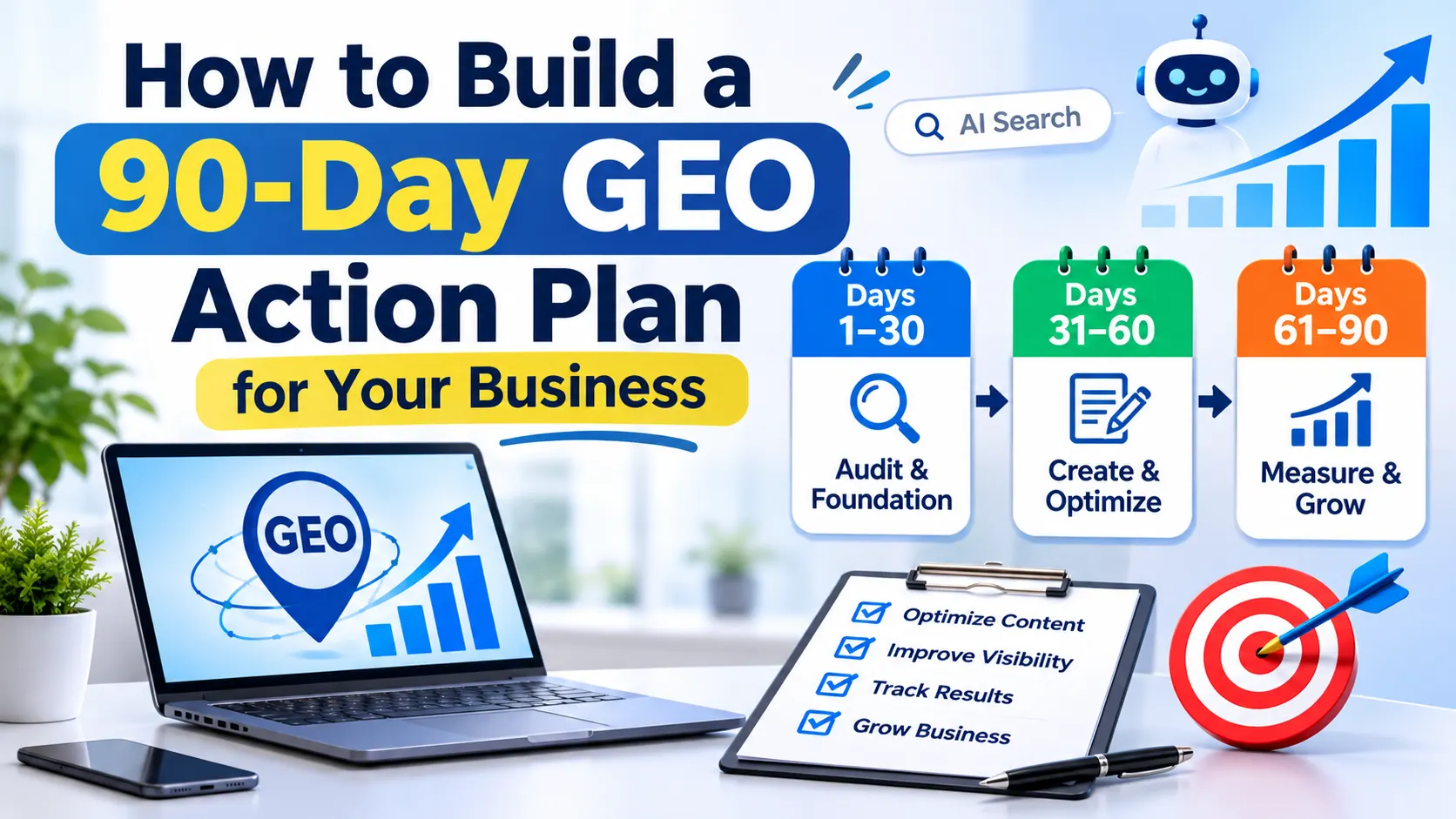
How to Build a 90-Day GEO Action Plan for Your Business
Discover a practical 90-day GEO action plan for your business. Learn how to improve website content, technical SEO, brand authority, and AI search visibility.
Introduction
Today, people are using AI-powered platforms like ChatGPT, Google AI Overviews, and Microsoft Copilot to find information, compare services, and make business decisions. Instead of visiting several websites, users can now get direct answers from AI search tools. This change is creating new opportunities for businesses to improve their online visibility.
A 90-Day GEO Action Plan helps businesses prepare their websites for this changing search environment. It provides a clear roadmap to improve website content, technical SEO, brand information, and online authority. Rather than making random changes, businesses can follow a step-by-step process and focus on the improvements that matter most.
In this blog, you will learn how to build a practical 90-day GEO Strategy for your business. We will cover the first 30 days, the next 30 days, and the final 30 days, with useful examples, expert tips, and a checklist to help you get started.
Key takeaways
A 90-day GEO plan helps businesses organize their AI search optimization activities.
The first 30 days focus on website audits and technical SEO.
Days 31–60 focus on content quality and brand information.
Days 61–90 focus on authority building and performance tracking.
Regular monitoring helps businesses identify areas that need improvement.
Table of Contents
What Is a 90-Day GEO Action Plan?
Why Does Your Business Need a GEO Action Plan?
How Does GEO Help Businesses in AI Search?
What Should You Check Before Starting?
Days 1–30: Build Your GEO Foundation
Days 31–60: Improve Content and Brand Visibility
Days 61–90: Strengthen Authority and Measure Results
Important GEO Activities for Your Business
How to Measure GEO Performance
Common GEO Mistakes to Avoid
Practical Example: A 90-Day GEO Plan
90-Day GEO Action Plan Checklist
Frequently Asked Questions
Conclusion
What Is a 90-Day GEO Action Plan?
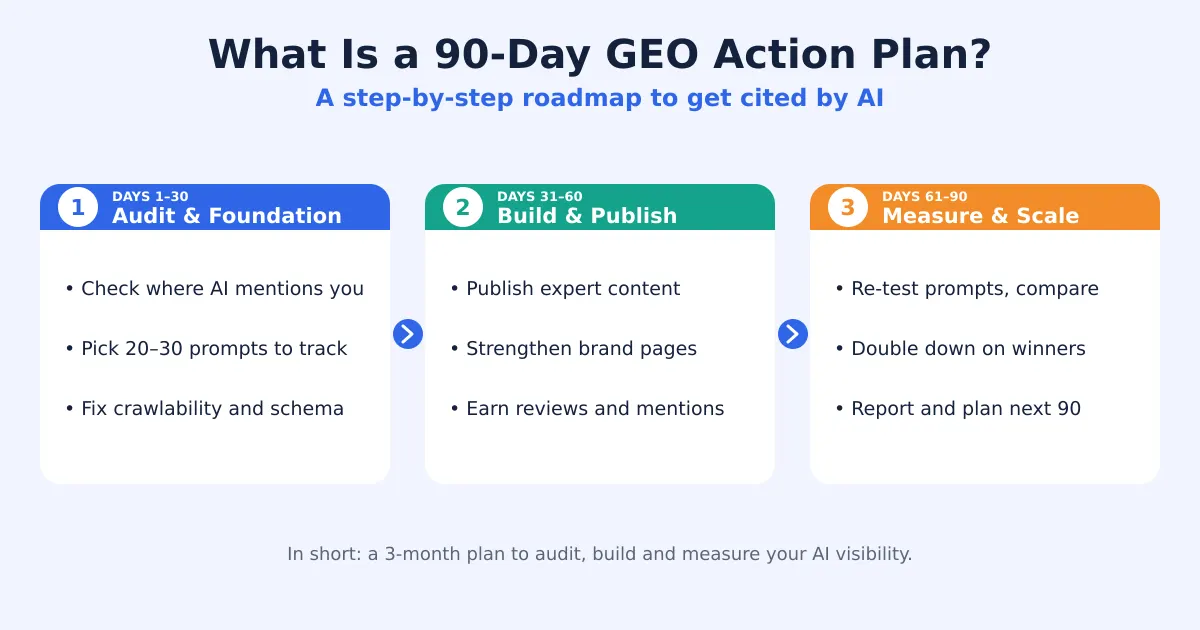
A 90-Day GEO Action Plan is a three-month strategy that helps businesses improve their website content, technical SEO, brand information, and online visibility in AI-powered search results. It divides GEO activities into three stages: building a strong foundation, improving content and brand visibility, and measuring performance.
A Three-Month GEO Plan helps businesses divide their optimization activities into manageable tasks. It provides a clear direction for improving website content, technical SEO, and AI search visibility.
Instead of trying to improve everything at once, a business divides its work into three stages:
Days 1–30: Audit the website and fix important issues.
Days 31–60: Improve content and brand information.
Days 61–90: Build authority and measure performance.
For example, imagine you run a digital marketing agency. You want your business to appear when someone asks an AI tool, "Which digital marketing agency provides SEO and GEO services?"
To work towards this goal, you need clear service pages, helpful blog content, accurate business information, and a technically accessible website.
A 90-day plan helps you organize these activities and track your progress.
Why Does Your Business Need a GEO Action Plan?
A GEO action plan gives your business a clear direction. It helps you focus on important improvements instead of making random changes to your website.
Here are four important benefits.
1. Improve AI Search Visibility
People are using AI-powered tools to ask questions, compare services, and research products. Helpful and well-organized website information can improve your chances of being discovered or referenced in relevant AI-generated answers.
2. Make Your Website Easier to Understand
AI-powered search systems need to understand what your business offers, who it serves, and which topics your website covers.
Clear service descriptions, useful headings, and consistent business details help explain your business.
3. Build Brand Trust
Customers want to choose businesses they can trust. Helpful content, genuine customer experiences, expert knowledge, and accurate business information can support your brand's credibility.
4. Improve Your Existing SEO Strategy
GEO does not replace traditional SEO. Technical SEO, useful content, internal links, and proper indexing remain important foundations for online visibility.
A 90-day plan helps you organize these activities and check whether your improvements are working.
How Does GEO Help Businesses in AI Search?
Generative Engine Optimization focuses on making business information useful, clear, and accessible to AI-powered search experiences.
For example, a user may ask:
"Which agency can help a small business improve its SEO and AI search visibility?"
An AI platform may look for information about digital marketing agencies, their services, experience, website content, and other relevant sources.
Your business can improve its chances of being considered by working on these areas:
GEO Area | What Your Business Should Do |
|---|---|
Website Content | Publish helpful and accurate information |
Technical SEO | Make important pages accessible |
Brand Information | Keep business details clear and consistent |
Online Authority | Build genuine industry relationships |
User Experience | Make your website easy to use |
Performance Tracking | Monitor traffic and visibility |
Remember, following GEO practices does not guarantee that an AI platform will mention your business. The goal is to build a stronger online presence and make your information easier to discover and understand.
What Should You Check Before Starting?
Before starting your GEO strategy, understand your website's current condition. This will help you identify what is working and what needs improvement.
Review Your Website Content
Check your homepage, service pages, blog posts, and important landing pages.
Ask yourself:
Does each page clearly explain its topic?
Does the content answer customer questions?
Are the facts accurate and updated?
Does the content provide useful examples?
Is the information easy to read?
Check Your Technical SEO
Review important technical areas such as:
Robots.txt settings
XML sitemap
Indexing status
Broken links
Mobile usability
Page loading experience
Internal linking structure
Review Your Brand Information
Check whether your business name, address, phone number, services, and company description are consistent across your website and important business profiles.
Check Your Current Visibility
Search for your business name and important service-related questions on relevant search and AI platforms.
Record whether your business appears, which competitors are mentioned, and which sources are referenced.
[Expert Tip] Create a simple spreadsheet before making changes. Record your important pages, current traffic, indexing status, brand details, and AI visibility observations. You can compare these details again after 90 days.
5. Days 1–30: Build Your GEO Foundation
The GEO Implementation Timeline starts with a complete website audit. During the first 30 days, businesses should identify technical issues, review website content, and improve their website structure.
The first 30 days should focus on understanding your website and fixing important problems. Before publishing many new blogs, make sure your website has a strong foundation.
Week 1: Perform a Website Audit
Start by reviewing your website's important pages and technical condition.
Check:
Content quality
Website structure
Indexing and crawling
Broken links
Internal links
Brand information
Mobile experience
Prepare a list of problems and arrange them according to their importance.
Week 2: Fix Technical SEO Issues
After the audit, start fixing problems that may prevent search engines from accessing or understanding your website. Website owners can also review OpenAI's official crawler documentation to understand how OAI-SearchBot and GPTBot work and how website owners can manage crawler access through robots.txt.
For example:
Fix broken links.
Check important pages for accidental noindex tags.
Review robots.txt rules.
Update your XML sitemap.
Improve mobile usability.
Check page loading issues.
Make sure important content is available as readable text.
Also, review whether relevant search crawlers can access the pages you want to make discoverable. For example, OpenAI documents OAI-SearchBot as a crawler used for search discovery in ChatGPT.
Week 3: Improve Website Structure
A clear website structure helps visitors find information easily.
Organize your website into useful sections such as:
Home
About Us
Services
Blog
Case Studies
Contact Us
Use descriptive headings and connect related pages through internal links.
For example, a blog about SEO can link to your SEO service page. This helps readers move from educational content to relevant business information.
Week 4: Research Customer Questions
Think about the questions customers ask before choosing a product or service.
For a digital marketing agency, these questions may include:
What is SEO and how does it work?
What is Generative Engine Optimization?
How can a business improve AI search visibility?
How much does SEO cost?
How can a business choose the right GEO agency?
Use these questions to prepare your content plan.
[Example] If customers regularly ask how GEO works, create a beginner-friendly guide explaining its meaning, benefits, process, and practical examples.
6. Days 31–60: Improve Content and Brand Visibility
During the second month, focus on creating helpful content and making your business information clearer.
Week 5: Improve Existing Website Content
Review your homepage, service pages, and important blog posts.
Improve them by:
Writing clear introductions.
Explaining services in simple language.
Adding useful examples.
Updating old information.
Answering common customer questions.
Removing repeated or unnecessary content.
Do not rewrite every page just to add keywords. Focus on making the information more useful.
Week 6: Publish Helpful Blog Content
Create content around topics your audience wants to understand.
For example, a digital marketing agency can publish blogs about:
SEO basics for beginners
SEO vs. GEO
How AI search works
Website optimization tips
How to choose a GEO agency
Each blog should answer a clear question and provide useful information. Add practical examples and trustworthy references where relevant.
Week 7: Improve Brand Information
Your business information should clearly explain who you are and what you offer.
Review these details:
Business name
Company description
Services
Contact information
Location
About Us page
Team information
Customer reviews
For a local business, keep important details updated on its website and relevant business profiles.
Expert tip
Use the same official business name and accurate contact details across your website and important profiles. Avoid publishing different descriptions that create confusion about your services.
Week 8: Strengthen Internal Links and External References
Connect related pages on your website using meaningful internal links.
For example, a blog about GEO strategy can link to:
Your GEO services page
Your SEO services page
A related article about AEO
Your website audit guide
You can also refer to reliable external sources when explaining technical or industry-related information.
External references should support your claims and help readers find trustworthy information.
7. Days 61–90: Strengthen Authority and Measure Results
The final 30 days should focus on improving your website's credibility, checking visibility, and understanding the results of your work.
Week 9: Build Genuine Industry Authority
Your business should provide useful information beyond its own website.
You can work on:
Guest posting on relevant websites
Sharing expert opinions
Participating in industry discussions
Publishing original case studies
Building relationships with relevant websites
Collecting genuine customer reviews
For example, a digital marketing agency can contribute an article about technical SEO to a relevant marketing website.
Focus on useful contributions rather than collecting random backlinks.
Week 10: Improve Important Content
Review your most important pages and add information that makes them more useful and trustworthy.
You can include:
Real business examples
Original research
Practical case studies
Expert insights
Updated statistics with reliable sources
Clear explanations of your services
Avoid making unsupported claims or publishing information only to attract AI search traffic.
Week 11: Check AI Search Visibility
Test questions related to your products, services, industry, and customer needs on relevant AI search platforms.
For example:
Which agencies provide GEO services?
How can a small business improve AI search visibility?
What should a business check before hiring an SEO agency?
Record:
Whether your brand is mentioned
Whether your website is cited
Which pages are referenced
Which competitors appear
What information is missing from your website
Repeat similar checks over time because AI-generated answers can change.
Week 12: Review Performance and Prepare the Next Plan
At the end of 90 days, compare your current results with your starting data.
Review website traffic, organic search performance, page engagement, conversions, and available AI visibility data.
Identify which activities worked well and which areas need more attention. Then prepare your next 90-day plan.
8. Important GEO Activities for Your Business
A GEO Monthly Action Plan helps businesses review their progress regularly. It includes content updates, technical SEO checks, brand information reviews, and AI search visibility monitoring.
Some activities should continue throughout all three months. They are not one-time tasks.
GEO Activity | What to Do | Frequency |
|---|---|---|
Technical SEO | Check indexing and crawling issues | Monthly |
Content Optimization | Update important pages | Monthly |
Blog Publishing | Publish useful articles | As per content plan |
Brand Information | Review business details | Monthly |
Internal Linking | Connect related pages | During updates |
Industry Outreach | Build genuine relationships | Ongoing |
AI Visibility Checks | Test relevant questions | Monthly |
Performance Tracking | Review traffic and conversions | Monthly |
A business does not need to complete every activity at the same time. Give priority to tasks that solve important problems and help your customers.
9. How to Measure GEO Performance
After implementing your plan, measure whether your website is improving. Do not depend on only one metric. Review different indicators to understand the bigger picture.
Important GEO Performance Metrics
Metric | What It Tells You |
|---|---|
AI Brand Mentions | Whether your business appears in AI answers |
AI Citations | Whether AI answers reference your website |
Cited Pages | Which website pages are referenced |
Organic Traffic | Visitors arriving from organic search |
Search Impressions | How often pages appear in search results |
Conversions | Whether visitors become leads or customers |
Engagement | How visitors interact with your website |
Tools You Can Use
1. Google Search Console: Monitor search impressions, clicks, indexing, and website search performance.
2. Bing Webmaster Tools: Review available AI Performance reporting for citations in supported AI-generated answers.
3. Website Analytics: Use an analytics platform such as Google Analytics to understand traffic, engagement, and conversions.
4. Manual AI Search Testing: Ask relevant questions on AI search platforms and record whether your brand or website appears.
Keep your questions consistent when comparing results over time.
Significant: An increase in AI mentions does not automatically mean an increase in sales. Always connect visibility data with website visits, enquiries, and business results.
10. Common GEO Mistakes to Avoid
Many businesses make mistakes when starting their GEO strategy. Avoiding these mistakes can help you use your time and resources more effectively.
1. Expecting Immediate Results
GEO is not a one-day activity. Improving content, website quality, and brand information takes time.
Solution: Follow your 90-day plan and review progress regularly.
2. Publishing Low-Quality Content
Publishing many articles does not automatically improve AI visibility.
Solution: Focus on useful, original, and accurate content that answers real customer questions.
3. Ignoring Technical SEO
Helpful content may not perform well if important pages cannot be accessed or indexed.
Solution: Review crawling, indexing, website structure, and page experience.
4. Using Irrelevant Backlinks
Getting links from unrelated websites only to increase backlink numbers is not a good long-term strategy.
Solution: Focus on genuine industry relationships and relevant references.
5. Ignoring Brand Information
If your website does not clearly explain your business and services, visitors may find it difficult to understand your offering.
Solution: Keep your About Us page, service pages, and important business profiles accurate.
6. Not Measuring Performance
Without tracking, you cannot understand which activities are helping your business.
Solution: Maintain a monthly performance report and compare it with your starting data.
11. Practical Example: A 90-Day GEO Plan for a Digital Marketing Agency
Imagine a digital marketing agency wants to improve its visibility in AI-powered search platforms. The agency offers SEO, website development, content marketing, and GEO services.
It decides to follow a 90-day GEO action plan.
Month 1: Website Foundation
The agency checks its website and finds several problems:
Some service pages have limited information.
A few internal links are missing.
Old blog posts need updates.
Business descriptions are not consistent.
The agency fixes important technical issues, improves its website structure, and prepares a list of customer questions.
Month 2: Content and Brand Improvement
The agency updates its SEO and GEO service pages. It publishes helpful articles about GEO, AEO, and AI search optimization.
It also improves its About Us page, adds relevant internal links, and reviews its business profiles.
Month 3: Authority and Performance
The agency contributes useful articles to relevant industry websites and develops original case studies.
It tests business-related questions on AI search platforms and records brand mentions and website citations.
Finally, it compares its results with the first month's data and prepares the next action plan.
Example Progress Report
Area | Starting Point | After 90 Days |
|---|---|---|
Website Audit | Not completed | Completed |
Service Pages | Basic information | Improved descriptions |
Blog Content | Old and limited | Updated and expanded |
Internal Links | Needs improvement | Important links added |
Brand Information | Inconsistent | Reviewed and updated |
AI Visibility | Not tracked | Regular checks started |
This is an illustrative example, not a guaranteed result. Every business will have different starting conditions and outcomes.
12. 90-Day GEO Action Plan Checklist
Use this checklist to track your work during the three-month period.
First 30 Days: Foundation
Audit your website.
Review important website pages.
Check robots.txt and XML sitemap.
Review indexing and crawling issues.
Fix broken links and technical problems.
Improve website structure.
Research customer questions.
Prepare a list of content topics.
Days 31–60: Content and Brand
Update important service pages.
Improve existing blog content.
Publish helpful and original articles.
Add useful examples and expert insights.
Review business information.
Improve internal linking.
Add relevant external references.
Update important business profiles.
Days 61–90: Authority and Measurement
Build relevant industry relationships.
Contribute useful guest posts where appropriate.
Publish original case studies.
Test relevant questions on AI search platforms.
Record brand mentions and website citations.
Review organic search performance.
Check website leads and conversions.
Prepare the next 90-day plan.
Frequently Asked Questions (FAQs)
1. What is a 90-day GEO action plan?
A 90-day GEO action plan is a three-month strategy for improving a website's readiness for AI-powered search. It includes technical SEO improvements, content optimization, brand information, authority building, and performance tracking. It helps businesses organize their GEO activities into clear steps.
2. Can a small business follow a 90-day GEO plan?
Yes, small businesses can follow a GEO plan according to their budget, time, and available resources. They can begin with important website pages, useful content, accurate business details, and basic technical improvements. A business does not need a large marketing team to start improving its online presence.
3. What should I do in the first 30 days of GEO?
During the first 30 days, focus on understanding your website's current condition. Review technical SEO, indexing, content quality, internal links, and brand information. Fix important issues and prepare a list of customer questions for your future content strategy.
4. How many blogs should I publish in 90 days?
There is no fixed number of blogs that every business must publish. The right number depends on your industry, audience, content quality, and available resources. It is better to publish useful and well-researched articles than many repetitive posts.
5. Does GEO replace traditional SEO?
No, GEO does not replace traditional SEO. Search engine optimization remains an important foundation for making website content accessible and useful. GEO adds a focus on how business information may be discovered, understood, mentioned, or cited in AI-powered search experiences.
6. How can I check whether my business appears in AI search results?
You can test relevant business and service-related questions on AI search platforms. Record whether your business is mentioned, whether your website is cited, and which pages are referenced. You can also use available reporting tools, such as Bing Webmaster Tools AI Performance, to review supported citation activity.
7. Which tools are useful for a GEO strategy?
Useful tools include Google Search Console for search performance and indexing, Bing Webmaster Tools for supported AI citation reporting, and website analytics tools for traffic and conversions. You can also use manual AI search testing to understand how your business appears in relevant answers.
Conclusion
Building a 90-day GEO action plan helps businesses improve their online presence in a clear and organized way. Instead of making random website changes, divide your work into three stages: building a strong technical foundation, improving content and brand information, and strengthening authority while measuring performance.
Start by understanding your website's current condition. Fix important technical issues, create useful content, explain your services clearly, and build genuine industry relationships. Then review your website traffic, search performance, AI mentions, citations, and business enquiries.
Start with small improvements, follow your 90-day plan, and keep improving your strategy based on real results.
About the author
Arena Infosolution shares educational insights about digital marketing, SEO, Answer Engine Optimization (AEO), and Generative Engine Optimization (GEO). Its content helps businesses understand online visibility, improve their websites, and learn practical digital marketing strategies.
Want this done for your business?
Get a free growth consultation
Tell us what you're working on and a senior strategist will map your next move.