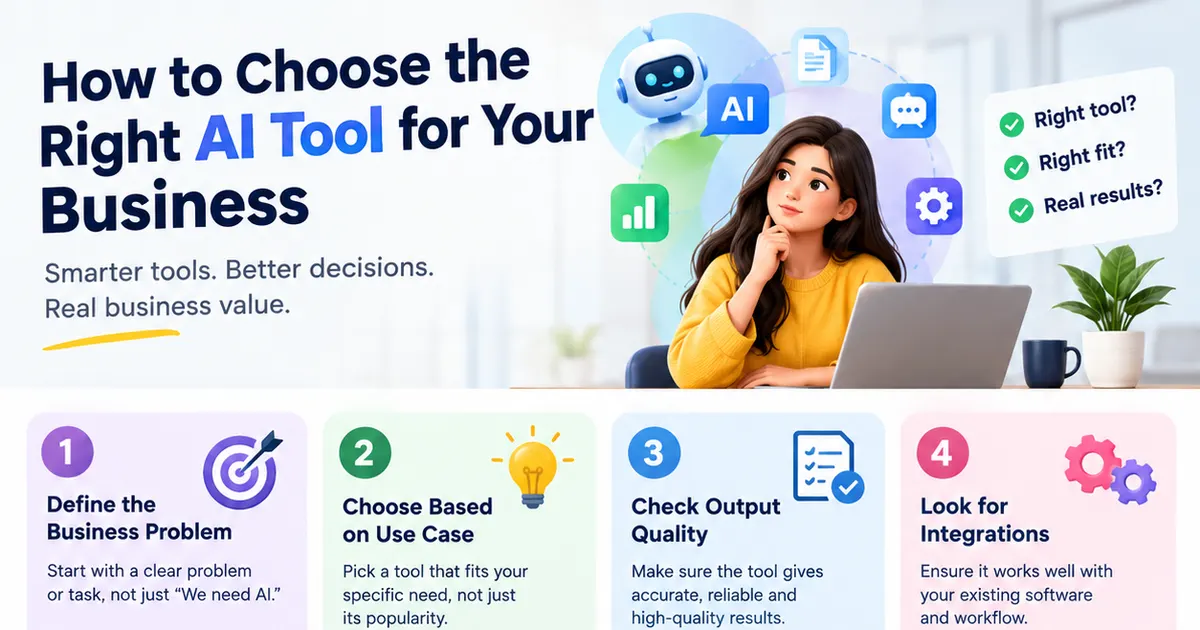
How to Choose the Right AI Tools for Your Business
Learn how to choose the right AI tool for your business by evaluating use case, quality, cost, security, integrations, scalability, and ROI.
Introduction
Artificial Intelligence is becoming an important part of modern business operations. From content creation and data analysis to customer support and automation, businesses are using AI tools to improve productivity and simplify everyday tasks.
However, choosing the right AI tool is not always easy. Every business has different goals, workflows, budgets, and technical requirements. A tool that works well for one company may not deliver the same results for another.
The key is to understand your business needs, evaluate relevant tools, and test their performance before investing. This guide explains how to choose AI tools that fit your business requirements and deliver measurable value.
What Is the Right Way to Choose AI Tools for Your Business?
Choosing the right AI tools for your business means identifying your specific needs, evaluating available solutions, and selecting tools that fit your workflows, budget, and goals. The focus should be on solving real business problems, improving efficiency, and delivering measurable results rather than following popular trends.
Why Choosing the Right AI Tool Is Harder Than It Looks
Choosing the right AI tool can be difficult because every business has different goals, budgets, and needs. A popular tool may not always be the best fit. Businesses need to consider factors like features, cost, ease of use, security, and how well the tool fits into their existing workflow.
Why businesses are adopting AI tools
The growing number of AI tools available
Why one AI tool cannot fit every business
Problems caused by choosing the wrong tool
Importance of evaluating tools based on business needs
Briefly explain what the article will help readers understand
A clear process for choosing AI tools for business can help companies avoid unnecessary costs and poor technology decisions.
Key takeaways
First, identify the specific business problem you want AI to solve.
Choose tools based on your goals, budget, and team requirements.
Compare features, ease of use, security, and integrations before choosing.
Test an AI tool with real business tasks before making a long-term commitment.
Consider scalability and ROI as your business grows.
Avoid choosing a tool only because it is popular or has more features.
What Should You Define Before Looking for an AI Tool?
Before comparing AI tools, businesses should first understand what they actually need from the technology. Starting with a list of popular AI tools can create confusion because many products offer similar or overlapping features.
Businesses should also consider their available budget and implementation timeline. A tool may appear affordable initially but become expensive when additional users, usage limits, integrations, training, or setup requirements are included.
Defining these requirements before searching makes the selection process more focused. Instead of asking, "Which AI tool is best?", businesses can ask a more useful question: "Which AI tool is best for this specific business problem?"
Identify the Business Problem or Task

A vague requirement such as "We need AI" does not provide enough information to choose an appropriate solution. A more useful requirement would be "We want to reduce the time our customer support team spends answering repetitive questions."
This distinction is important because different problems require different types of AI solutions.
For example:
A marketing team may need help creating content or analyzing campaign data.
A sales team may need support with lead qualification or customer communication.
A customer service team may need an AI chatbot.
An HR team may want to automate repetitive administrative tasks.
A business analyst may need AI-powered data analysis.
A development team may benefit from an AI coding assistant.
An AI chatbot for business can help customer service teams handle repetitive questions and provide faster responses.
Businesses should also examine how frequently the problem occurs and how much time or money it currently consumes. A task performed for several hours every week may provide a stronger opportunity for automation than an occasional task.
The goal is not simply to find something that uses AI. The goal is to identify where AI can create meaningful business value.
Define What Success Should Look Like
Once the problem has been identified, the next step is to define how the business will know whether the AI tool is actually delivering value.
Without measurable goals, it can be difficult to determine whether the investment was worthwhile. Businesses should establish a baseline and define specific outcomes before implementation.
For example, a customer service team might aim to reduce average response time by 30%. A marketing team might want to reduce content production time by 50%. A sales team could focus on improving lead qualification or reducing the time spent entering customer information manually.
Useful measures may include:
Time saved
Cost savings
Productivity improvement
Conversion rate
Error rate
Customer satisfaction
Response time
Number of tasks automated
The goal should be realistic and connected to the original business problem. A measurable objective makes it easier to test the tool, compare results, and calculate ROI later.
Decide Which Type of AI Tool You Actually Need
Not every AI tool is designed for the same purpose. Businesses should first identify the type of solution they need before comparing individual products.
AI Tool Type | Common Business Use |
|---|---|
AI Writing Tools | Content and copywriting |
AI Chatbots | Customer support |
AI Meeting Tools | Notes and summaries |
AI Analytics Tools | Data analysis |
AI Design Tools | Images and creative assets |
AI Automation Tools | Repetitive workflows |
AI Sales Tools | Lead qualification |
AI Coding Tools | Software development |
This classification helps narrow the search. For example, a company looking to automate customer questions should focus on AI chatbot or customer-support solutions rather than comparing general writing tools.
The right category also depends on how the business works. Some companies may need one specialized tool, while others may benefit from a combination of AI tools connected through an existing workflow.
Different AI solutions for businesses can support areas such as marketing, customer service, sales, analytics, automation, and software development.
AI tools for small business can help smaller teams improve productivity, automate repetitive tasks, and support customer service without requiring a large technology team.
Key Factors to Consider When Choosing an AI Tool
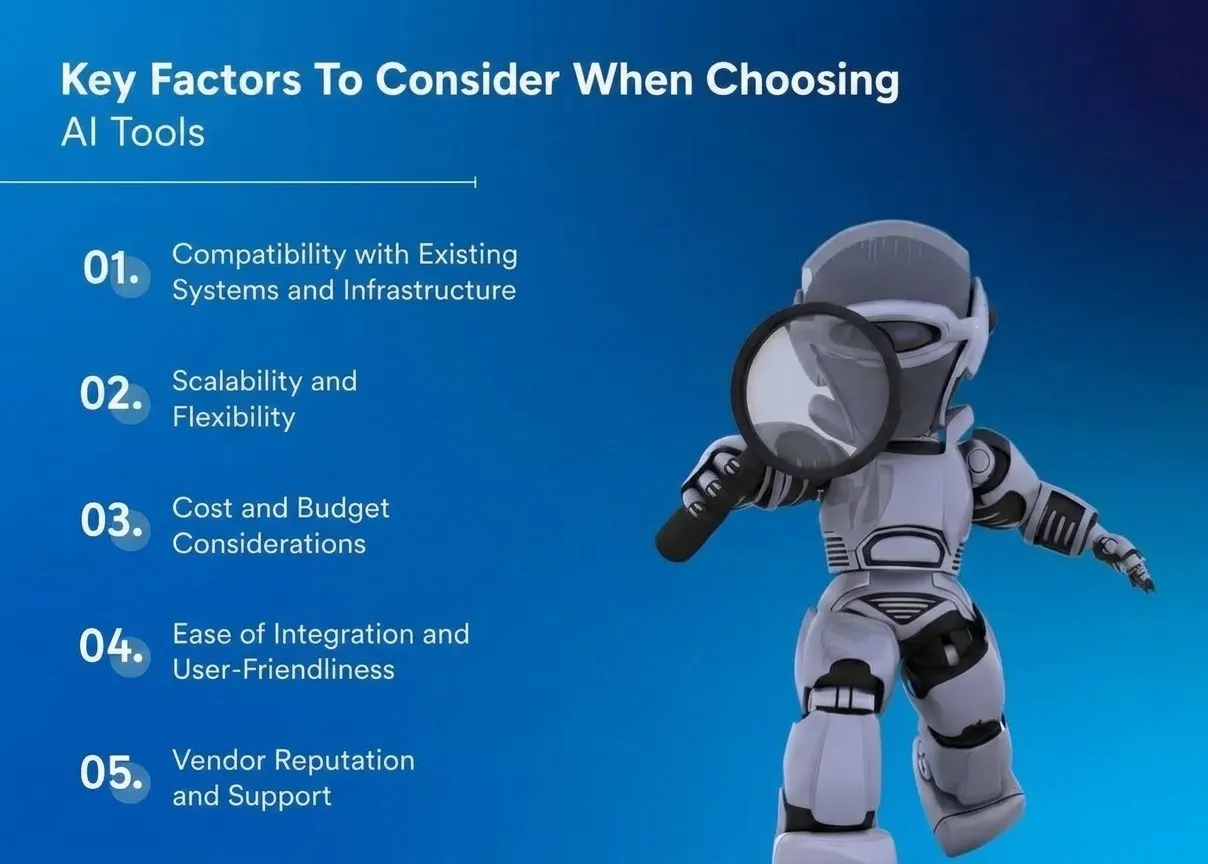
After defining the business requirement and identifying the type of AI solution needed, businesses should evaluate shortlisted tools using consistent criteria.
Looking only at price or the number of features can result in a poor decision. A useful evaluation should consider how well the tool fits the workflow, the quality of its output, how easily employees can use it, how securely it handles information, and whether its cost makes sense for the expected value.
This type of AI tool evaluation helps businesses compare different solutions using the same criteria.
Business Use Case and Workflow Fit
An AI tool should fit the actual way a business operates.
Before choosing a solution, businesses should determine whether the tool addresses the original problem and whether employees can realistically incorporate it into their existing workflow.
For example, suppose a sales team spends several hours every week manually summarizing customer conversations. An AI meeting assistant may help automate summaries and reduce administrative work.
However, if the real problem is poor lead quality, a meeting assistant may not solve the underlying issue. The business would need a solution better suited to lead qualification or sales analysis.
Businesses should therefore map the current workflow and identify where the AI marketing automation will be introduced.
A simple model is:
Current Process → AI Tool → Improved Process
The important question is whether the process becomes faster, easier, more accurate, or more productive after introducing the tool.
Output Quality and Reliability
The quality of an AI tool should be evaluated based on the results it produces, not simply how quickly it produces them.
Businesses should test whether the tool produces accurate, consistent, and useful outputs for real tasks. Depending on the use case, errors can have different consequences. An incorrect marketing draft may be easy to edit, while inaccurate business data or customer information could create much bigger problems.
Businesses should evaluate:
Accuracy
Consistency
Reliability
Errors
Hallucinations
Human review requirements
Performance across different tasks
A useful test is to provide the tool with several realistic examples instead of relying on a single demonstration.
Fast output does not always mean useful output. If employees spend more time correcting AI-generated results than completing the task manually, the expected productivity benefit may disappear.
Ease of Use and Team Adoption
Even a highly capable AI tool may provide limited value if employees find it difficult to use.
Businesses should consider the user interface, learning curve, onboarding process, and training requirements. The tool should be accessible to the employees who are expected to use it.
Team adoption is especially important when an AI solution changes an existing workflow. Employees need to understand how the tool supports their work and when human judgment is still required.
A simple tool that employees consistently use can create more practical value than a technically advanced tool that the team avoids.
Businesses can test usability by allowing a small group of employees to use the tool during a pilot period and collecting feedback before making a wider investment.
Integration With Your Existing Tools
Most businesses already use multiple software platforms. An AI tool therefore needs to work effectively with the existing technology environment.
Depending on the business, this could include:
CRM systems
Google Workspace
Microsoft 365
Slack or Microsoft Teams
Project management platforms
Websites
E-commerce platforms
APIs
Automation platforms
Before purchasing an AI tool, check whether it provides native integrations, API access, or other practical connection methods.
Businesses should also consider how much technical work is required to set up the integration. A tool may offer an integration but still require significant development or maintenance.
Good integration can reduce duplicate data entry and help employees use AI without constantly switching between different systems.
Pricing and Total Cost of Ownership
The cheapest AI tool is not always the most cost-effective option.
Businesses should look beyond the advertised subscription price and consider the total cost of implementing and using the tool.
A simple way to think about it is:
Total Cost = Subscription + Setup + Training + Integration + Maintenance + Additional Usage
Some tools may charge per user, while others may use usage-based pricing. Enterprise plans may also introduce additional costs.
Before purchasing, businesses should check:
Free and paid plans
Per-user pricing
Usage limits
Additional usage charges
Setup costs
Training requirements
Integration costs
Enterprise pricing
A tool with a higher subscription cost may still provide better value if it saves significant employee time or reduces operational costs.
Data Privacy and Security
AI tools may process business information, customer data, internal documents, or other sensitive content. This makes data privacy and security important parts of the selection process.
Before using an AI tool, businesses should understand:
What data the tool collects
How the data is stored
How long data is retained
Whether submitted information is used for model training
What security controls are available
Who can access the information
What compliance requirements apply
AI tool security should be evaluated carefully before businesses use AI systems to process customer data or confidential information.
Businesses should also understand what employees are allowed to enter into the tool.
For example, an organization may have policies restricting employees from entering confidential customer information or internal documents into third-party AI systems.
Security should not be treated as an afterthought. Businesses can also refer to the NIST AI Risk Management Framework for guidance on managing AI risks and promoting trustworthy AI systems.
Scalability and Long-Term Fit
An AI tool should not only meet today's requirements but should also remain useful as the business grows.
A small team may initially need only a few user accounts, but the requirement could change as more employees begin using the system.
Businesses should consider:
Increasing numbers of users
Increasing data volume
Pricing as usage grows
Enterprise features
API availability
Automation capabilities
Vendor reliability
Future business requirements
The goal is not to predict every future requirement. Instead, businesses should avoid choosing a tool that becomes difficult or excessively expensive to use as the organization grows.
AI Tool Evaluation Criteria
Use the following criteria to evaluate shortlisted AI tools consistently:
Criteria | What to Check | Why It Matters | Score |
|---|---|---|---|
Use Case Fit | Does it solve the problem? | Business value | /5 |
Output Quality | Accuracy and consistency | Reliability | /5 |
Ease of Use | Learning curve | Team adoption | /5 |
Integration | Existing software compatibility | Workflow efficiency | /5 |
Pricing | Total cost | Budget control | /5 |
Security | Data protection | Risk management | /5 |
Scalability | Future growth | Long-term value | /5 |
How to Compare Different AI Tools
A structured AI tool selection process helps businesses choose a solution based on their actual requirements.
A consistent AI tool comparison makes it easier to identify which solution provides the best overall value.
Once several AI tools have been shortlisted, businesses should compare them using the same requirements and testing process. Comparing tools based only on website features or promotional claims can make the decision difficult. A structured comparison allows businesses to understand which tool performs best for their specific needs.
Create a Shortlist Based on Your Requirements
Shortlist 3–5 relevant tools
Identify must-have features
Separate must-have and nice-to-have features
Apply budget limits
Check integration requirements
Check security requirements
Test Tools Using the Same Real Business Tasks
This should be a very practical section.
For example, if a business needs an AI content tool:
Use the same task and same input with:
Tool A
Tool B
Tool C
Compare:
Output quality
Accuracy
Speed
Editing required
Ease of use
Cost
Same input → Fair comparison
Compare the Results Before Making a Decision
Introduce a simple scoring system:
5 = Excellent
4 = Good
3 = Average
2 = Weak
1 = Poor
You can also introduce weighted scoring.
Factor | Weight |
|---|---|
Output Quality | 30% |
Integration | 20% |
Security | 20% |
Ease of Use | 15% |
Pricing | 15% |
This makes the final decision more objective.
AI Tool Selection Checklist
Business problem clearly defined
Success metrics identified
Required AI tool category identified
Real business tasks tested
Output quality checked
Integration verified
Pricing evaluated
Hidden costs checked
Data security reviewed
Team usability tested
Scalability considered
ROI estimated
Free trial or pilot completed
How to Test an AI Tool Before Paying for It
Before investing in an AI tool, test it with real business requirements. A simple testing process can help you understand whether the tool is actually useful.
Step 1: Define One Real Business Task
Choose a task your team regularly performs and check whether AI can improve it.
Step 2: Prepare Standard Inputs
Use the same type of information you normally work with to get realistic results.
Step 3: Test Multiple Tools
Compare a few relevant AI tools using the same task and inputs.
Step 4: Check Quality and Time
See how accurate the output is and how much time the tool saves.
Step 5: Check Errors
Identify mistakes and see how much human editing is required.
Step 6: Calculate the Cost
Compare the tool's price with the time and resources it could save.
Step 7: Get Team Feedback
Ask employees whether the tool is easy to use and actually helpful.
Step 8: Run a Small Pilot
Use the tool on a limited project before making a full commitment.
Step 9: Make the Decision
Choose the tool only if it provides useful results, fits your workflow, and offers reasonable value for money.
How to Measure the ROI of an AI Tool
Buying an AI tool should be treated as a business investment rather than simply another software expense. Measuring return on investment helps businesses determine whether the tool is actually creating financial or operational value.
Then formula.
Then ₹20,000 / ₹80,000 example.
Then explain:
Time savings
Labour cost
Revenue
Productivity
Errors
Customer response
Practical Framework — From Business Problem to AI Tool Selection
1. Identify the Problem
2. Define the Goal
3. Identify the AI Tool Category
4. Set Budget & Requirements
5. Shortlist Tools
6. Test With Real Tasks
7. Compare Results
8. Check Security & Integration
9. Calculate ROI
10. Start Small and Scale
This framework helps businesses move from identifying a specific problem to selecting and testing an appropriate AI solution. It also reduces the risk of purchasing a tool before its value, security, cost, and workflow fit have been evaluated.
This can become one of the strongest practical elements of the article.
Common Mistakes Businesses Make When Choosing AI Tools
Choosing a popular tool without evaluating business needs
Focusing on features instead of actual value
Not defining the problem clearly
Not properly testing the free trial
Looking only at subscription price
Ignoring security and privacy
Ignoring team adoption
Not checking integrations
Not verifying output accuracy
Not calculating ROI
Buying a tool because of AI trends or hype
When You Should Not Buy an AI Tool
Not every business problem requires an AI solution. In some situations, purchasing an AI tool can add unnecessary cost or complexity instead of improving the existing process.
Explain that a business should reconsider buying an AI tool when:
The business problem is not clearly defined
The existing process already works efficiently
Expected benefits are very small
The output requires too much manual correction
Security concerns are unresolved
Employees are unlikely to use it
The total cost is higher than the expected benefit
The tool is being purchased only because it is trending
Frequently Asked Questions
What factors should businesses consider when choosing an AI tool?
Businesses should consider several factors, including features, accuracy, ease of use, pricing, data security, integrations, and scalability. The right tool should address a specific business need, fit existing workflows, and provide measurable value rather than simply offering advanced features.
How can a business choose the right AI tool?
Start by identifying the business problem you want to solve, such as reducing manual work, improving customer support, or analysing data. Then compare tools based on their capabilities, compatibility with existing systems, budget, and ease of implementation. Testing shortlisted options with real tasks can help you make a more informed decision.
How many AI tools should a business evaluate before making a decision?
Comparing three to five relevant AI tools is usually a practical starting point. This gives businesses enough options to assess differences in features, performance, pricing, and usability. Focusing on tools that address the same business requirement also makes comparisons more meaningful.
Are free AI tools sufficient for business use?
Free AI tools can be suitable for basic tasks, experimentation, and testing potential use cases. However, businesses with regular or more demanding requirements may benefit from paid plans that offer higher usage limits, advanced features, team collaboration, and dedicated support. The choice should depend on actual business needs and available budget.
How should businesses test an AI tool before investing?
Businesses should test shortlisted tools through a small pilot using real business tasks rather than relying only on product demonstrations. Evaluate output accuracy, consistency, time savings, ease of use, and integration with existing workflows. This helps identify limitations and understand whether the tool delivers enough value to justify its cost.
How can businesses measure the ROI of an AI tool?
Businesses can measure AI ROI by comparing the financial benefits of using a tool with its total implementation and operating costs. Benefits may include reduced manual work, lower operational expenses, faster processes, and improved productivity. Costs should include subscriptions, setup, employee training, and maintenance. Reviewing these factors over a defined period helps determine whether the investment is worthwhile.
Are AI tools safe for handling business data?
AI tools differ in how they collect, process, store, and protect business information. Before using a tool, businesses should review its privacy policy, data retention practices, access controls, and security measures. Sensitive customer or company information should only be shared after confirming that the tool meets relevant security and compliance requirements.
Can small businesses benefit from AI tools?
Yes. Small businesses can use AI tools to simplify everyday operations without necessarily requiring large technology budgets. Common applications include customer support, content creation, marketing research, data analysis, and routine task automation. Starting with one specific business challenge can help small teams identify practical benefits before expanding AI adoption.
Conclusion
Choosing the right AI tool is about solving real business problems, not following trends. Businesses should evaluate tools based on their goals, workflow compatibility, output quality, security, and overall cost.
Before making a major investment, test shortlisted tools through a small pilot and measure their actual business value.
The best AI tool isn't the most popular one; it's the one that delivers measurable results for your business.
Ready to grow with AI-powered marketing?
Book a free 30-minute strategy call with the Arena Infosolution team.
About the author
The Arena Infosolution Team shares practical insights on AI, digital transformation, automation, and business technology to help businesses understand emerging trends and make informed decisions.
Businesses exploring AI solutions or technology services can learn more about Arena Infosolution.
Get a free growth consultation
Tell us what you're working on and a senior strategist will map your next move.