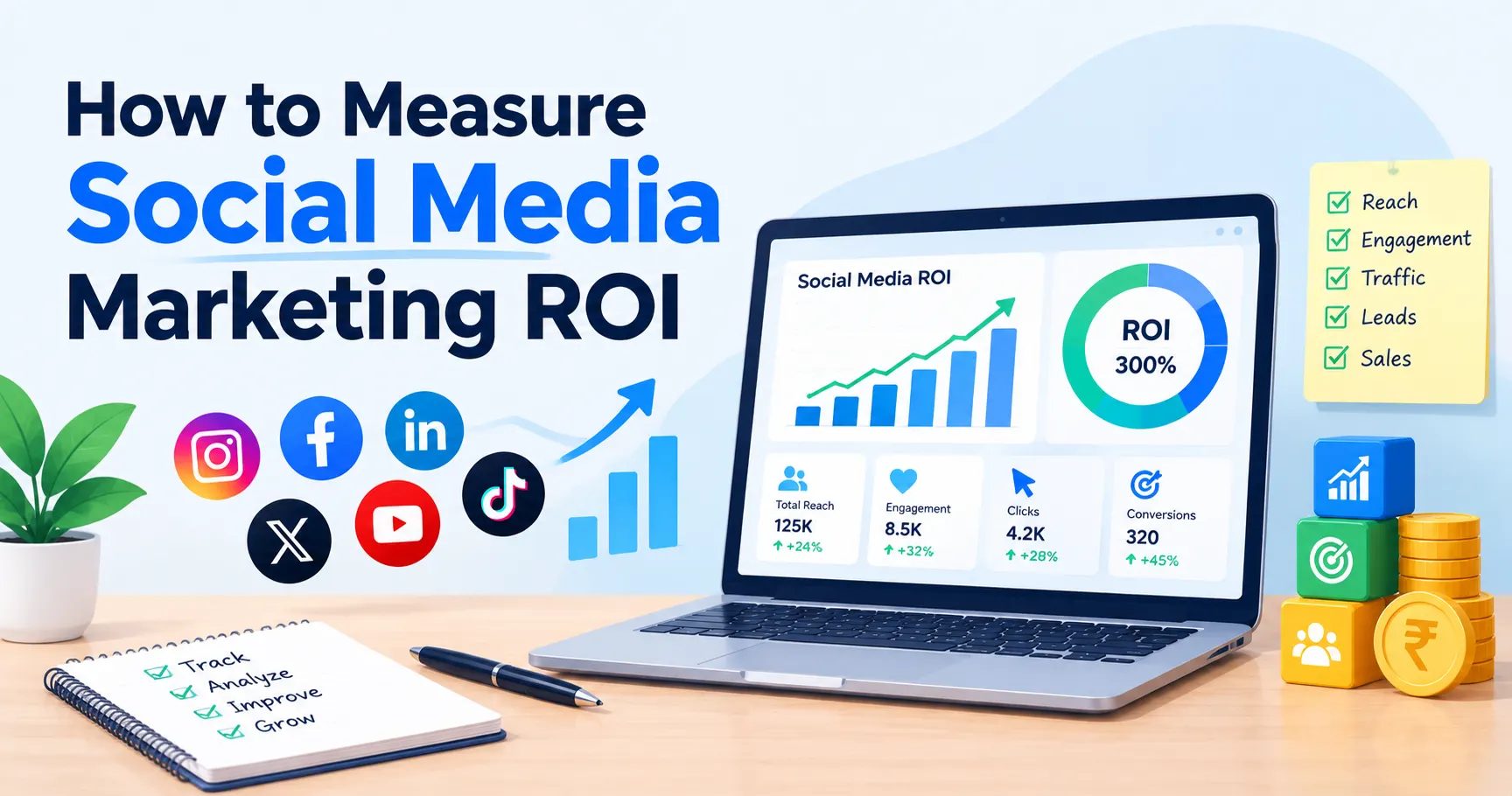
How to Measure Social Media Marketing ROI
Learn how to measure social media marketing ROI using the right metrics, ROI formulas, conversion tracking, campaign costs, and practical examples to understand how social media contributes to business results.
Introduction
Social media has become an important marketing channel for businesses to build awareness, engage with their target audience, generate leads, and drive sales. However, simply getting likes, comments, shares, or followers does not always show whether social media efforts are contributing to actual business growth.
Social media marketing ROI helps businesses connect their social media activities with measurable results such as website traffic, leads, conversions, customers, and revenue. By measuring these results against the investment made, businesses can better understand the financial impact of their social media campaigns.
Tracking ROI also helps businesses identify which campaigns and platforms are performing well, where marketing costs may be increasing, and which areas need improvement. This makes it easier to make informed decisions about future social media campaigns and budgets.
TABLE OF CONTENTS
What Is Social Media Marketing ROI?
Why Is Measuring Social Media ROI Important?
How to Calculate Social Media Marketing ROI
What Costs Should You Include When Measuring ROI?
Which Social Media Metrics Should You Track?
How to Measure ROI Across Different Social Media Platforms
How to Track Social Media Conversions
Organic vs Paid Social Media ROI
A Simple Social Media ROI Example
Common Mistakes When Measuring Social Media ROI
How to Improve Social Media Marketing ROI
Social Media ROI Measurement Checklist
Frequently Asked Questions
Conclusion
Key takeaways
Social media ROI compares the value generated from social media with the investment required to achieve those results.
ROI should be connected to business outcomes such as leads, customers, conversions and revenue.
Businesses should consider relevant advertising, content, management and other campaign costs when measuring ROI.
Metrics such as CTR, conversion rate, CPL, CAC, revenue and ROAS can help evaluate campaign performance.
Proper conversion tracking and attribution are important for understanding which social media activities contribute to business results.
What Is Social Media Marketing ROI?
Social media marketing ROI measures the return a business generates from its social media investment compared with the cost of that investment.
Social media investment is not always limited to advertising spend. Depending on the campaign, it can include content creation, social media management, design, software, influencer partnerships and other related expenses.
The return can also vary depending on the business objective.
For an e-commerce business, the return may be directly measured through online sales and revenue.
This means there is no single metric that works for every business.
Metric | What It Measures | Example |
|---|---|---|
Revenue | Money generated from sales | ₹1,00,000 in sales |
ROI | Return compared with total investment | Profit/return relative to investment |
ROAS | Revenue generated compared with advertising spend | ₹4 revenue for every ₹1 in ad spend |
CPL | Cost required to generate one lead | ₹500 per lead |
CAC | Cost required to acquire one customer | ₹2,000 per customer |
Understanding these differences helps businesses avoid drawing the wrong conclusion from campaign data.
Why Is Measuring Social Media ROI Important?
Social media can generate a large amount of activity, but activity alone does not necessarily represent business value.
A campaign may receive thousands of impressions but generate very few enquiries. Another campaign may reach fewer people but generate more qualified leads.
Measuring ROI helps businesses look beyond surface-level engagement and understand what their social media efforts are contributing to business objectives.
1. Understand Business Results
ROI measurement helps connect social media campaigns with measurable outcomes.
Instead of only asking:
“How many people saw the post?”
a business can also ask:
“How many people took a valuable action after seeing it?”
That action could be a website visit, form submission, purchase, booking or enquiry.
2. Make Better Budget Decisions
When businesses understand the cost and return of different campaigns, they can make more informed decisions about where to allocate future marketing resources.
3. Identify High-Performing Campaigns
Comparing campaigns can show which audiences, offers, creatives or messages are producing stronger results.
4. Find Areas That Need Improvement
If a campaign receives clicks but few conversions, the problem may be related to the landing page, offer, audience, tracking or buying process rather than the social media advertisement itself.
5. Connect Marketing With Business Goals
A clear ROI measurement process helps marketing teams communicate results in terms that are meaningful to the wider business.
How to Calculate Social Media Marketing ROI
The basic ROI formula is:
Social Media ROI Formula
ROI = (Return − Investment) ÷ Investment × 100
For example, suppose a business invests ₹20,000 in a social media campaign and generates ₹80,000 in attributable revenue.
The calculation would be:
ROI = (₹80,000 − ₹20,000) ÷ ₹20,000 × 100
ROI = 300%
This simplified calculation shows the return after subtracting the stated investment from the revenue.
However, businesses should be careful when using revenue as the return measure. Revenue is not the same as profit because product costs, fulfilment, salaries, taxes and other business expenses may also affect actual profitability.
What You Need Before Calculating ROI
To calculate ROI meaningfully, collect:
Total social media investment
Campaign or channel costs
Number of conversions
Number of customers
Revenue generated
The more accurately these inputs are tracked, the more useful the ROI calculation becomes.
What Costs Should You Include When Measuring ROI?
One common mistake is to calculate social media ROI using only advertising spend.
For paid campaigns, ad spend is obviously an important cost. But a broader ROI calculation may also need to consider other resources used to create and manage the campaign.
Understanding social media campaign costs helps businesses calculate the total investment more accurately.
Common Social Media Marketing Costs
Cost | Example | |
|---|---|---|
Advertising | Meta, LinkedIn or other paid social campaigns | |
Content Creation | Posts, reels, videos and graphics | |
Design | Creative design and editing | |
Management | Social media manager or agency costs | |
Tools | Scheduling and analytics software | |
Influencer Marketing | Paid creator collaborations | |
Production | Photography, video production or other campaign assets |
Not every business needs to include every cost in every calculation.
The important thing is to define a consistent measurement method.
For example, if a business wants to evaluate a specific paid advertising campaign, it may first calculate advertising efficiency using ad spend. If it wants to understand the broader business return from the entire social media Programme, it may include content and management costs as well.
Which Social Media Metrics Should You Track?
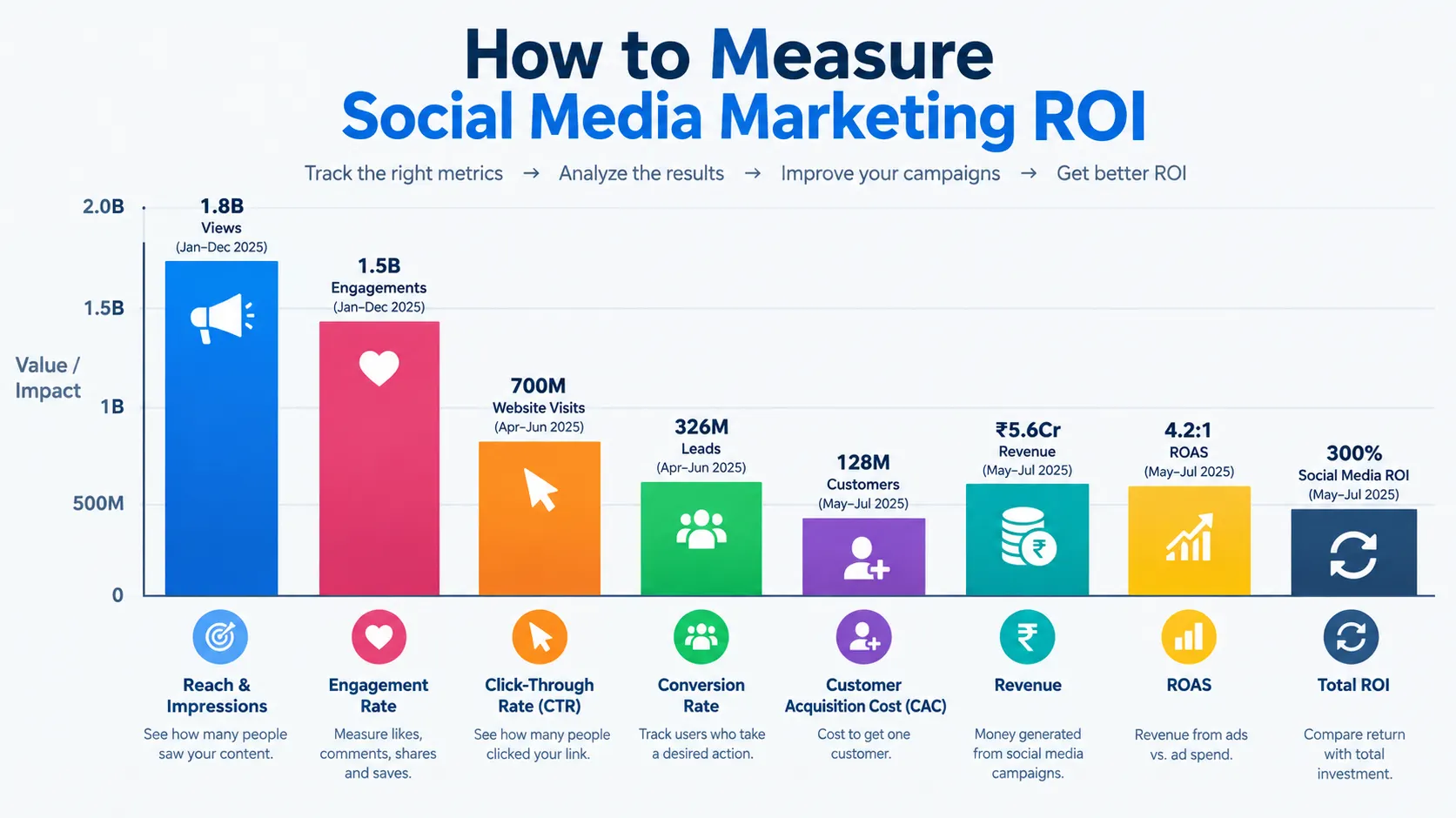
Different social media metrics answer different questions about how your campaigns and content are performing. Some metrics help you understand how many people are seeing your content, while others show how users are engaging, clicking, converting, or becoming customers. A useful measurement system should connect each metric with a specific business objective instead of focusing only on likes or followers. By tracking the right combination of reach, engagement, click-through rate, conversion rate, cost per lead, customer acquisition cost, revenue, and ROAS, businesses can get a clearer view of whether their social media efforts are contributing to meaningful business results.
Reach and Impressions
Reach tells you how many unique users were exposed to your content, while impressions represent the number of times content was displayed.
These metrics are useful when the goal is awareness, but they do not directly tell you how much revenue a campaign generated.
Engagement Rate
Engagement can include actions such as:
Likes
Comments
Shares
Saves
Other interactions
Engagement can help businesses understand how audiences respond to content.
However, high engagement does not automatically mean high ROI
Click-Through Rate
CTR = Clicks ÷ Impressions × 100
CTR can help measure how effectively an advertisement or post encourages users to visit a destination such as a website or landing page.
Conversion Rate
Conversion rate measures the percentage of users who complete a desired action.
For example:
Conversion Rate = Conversions ÷ Relevant Visitors or Clicks × 100
The exact calculation should match the conversion being measured.
Cost Per Lead
CPL = Total Campaign Cost ÷ Number of Leads
If a campaign costs ₹20,000 and generates 40 leads:
CPL = ₹20,000 ÷ 40 = ₹500
This tells the business the average campaign cost associated with each lead.
Customer Acquisition Cost
CAC looks at the cost associated with acquiring customers.
CAC = Total Acquisition Cost ÷ Number of New Customers
CAC can be especially useful when evaluating whether customer acquisition costs are sustainable relative to customer value.
Revenue
Revenue is one of the most important metrics when social media is directly connected to sales.
Businesses should track revenue associated with social media campaigns using appropriate analytics and attribution methods.
ROAS
ROAS = Revenue Attributed to Advertising ÷ Advertising Spend
For example:
If advertising spend is ₹20,000 and attributed revenue is ₹80,000:
ROAS = ₹80,000 ÷ ₹20,000 = 4
This can be written as 4:1 ROAS.
ROAS focuses specifically on advertising revenue compared with advertising spend, while ROI can account for a broader investment and return calculation.
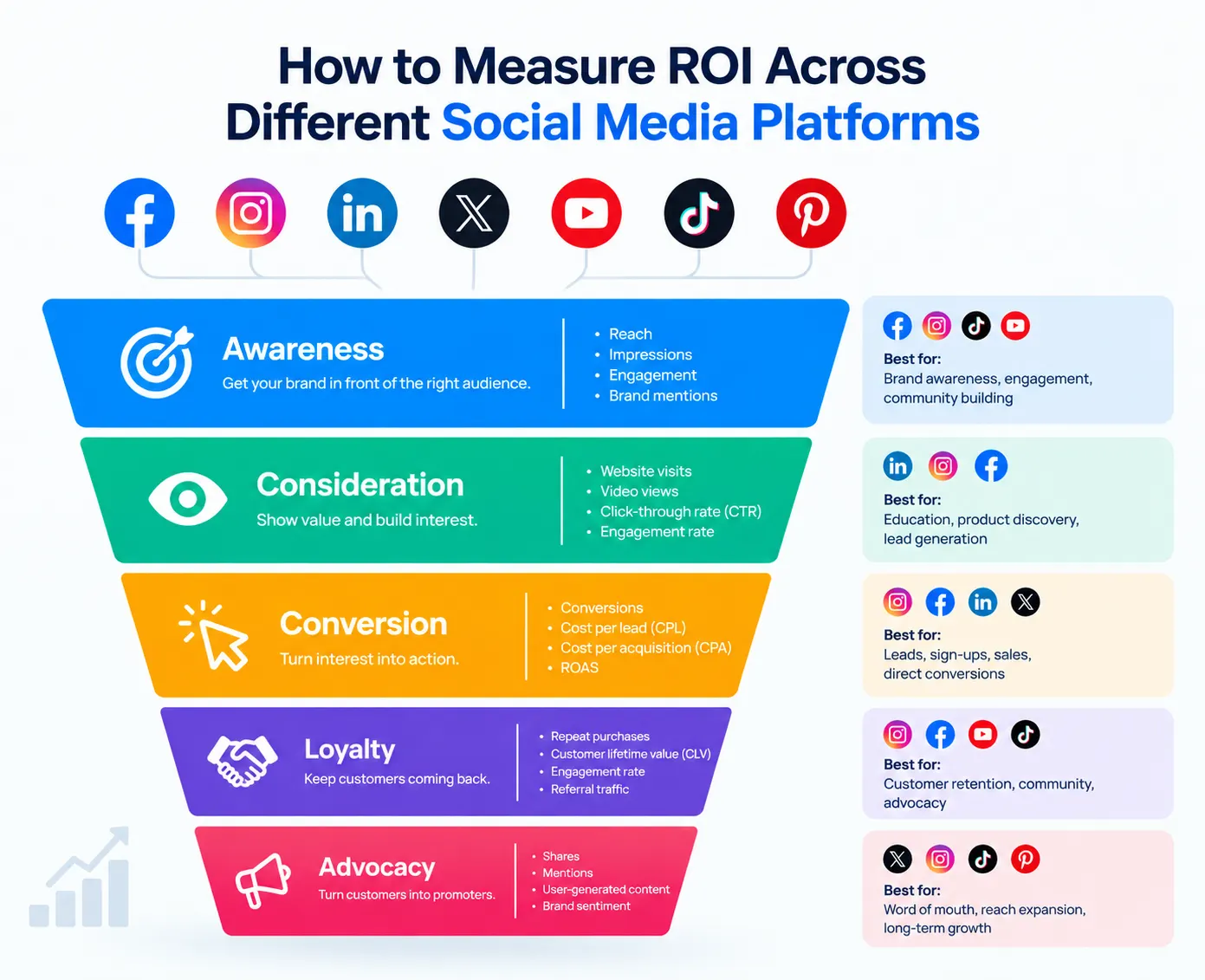
How to Measure ROI Across Different Social Media Platforms
Different social media platforms can support different marketing goals, so the way you measure their performance should also reflect the objective of each campaign. For example, one platform may be used mainly to generate awareness and engagement, while another may focus more on website traffic, leads, conversions, or sales. Instead of comparing every platform using the same metric, businesses should track the metrics that are most relevant to their specific goals and customer journey.
Facebook and Instagram
Businesses can measure:
Ad spend
Reach
Clicks
Website traffic
Leads
Purchases
Cost per result
Attributed revenue
For e-commerce businesses, purchase and revenue data can be particularly useful.
For service businesses, lead generation and qualified enquiries may be more relevant.
LinkedIn can be particularly relevant for B2B marketing.
Businesses may track:
Website visits
Lead form submissions
Qualified leads
Sales opportunities
Cost per lead
Customer conversions
A low number of leads does not necessarily mean poor performance if those leads have high business value. This is why lead quality should be considered alongside lead volume.
YouTube
For YouTube campaigns, businesses can look at:
Views
Engagement
Website traffic
Leads
Conversions
Revenue
Video campaigns may also contribute to customer journeys where a user sees content before interacting with the business through another channel.
This makes attribution an important part of measurement.
How to Track Social Media Conversions
A strong ROI measurement process should include social media conversion tracking so businesses can connect social media activity with leads, customers, and revenue. Businesses need to understand what happens after a user interacts with a social media post or advertisement, such as visiting the website, viewing a landing page, submitting a form, making a purchase, or becoming a customer. Tracking these actions helps connect social media campaigns with actual business outcomes and makes it easier to understand which activities are contributing to conversions and revenue. Tools such as Google Analytics, conversion tracking, and UTM parameters can help identify where traffic and conversions are coming from.
A simple customer journey can look like:
Step 1: Define the Conversion
First decide what counts as a valuable action.
Examples include:
Purchase
Contact form submission
Phone enquiry
Demo request
Booking
Newsletter signup
Lead form submission
Step 2: Set Up Analytics
Use an analytics system to understand how users arrive on your website and what actions they complete.
Step 3: Use UTM Parameters
UTM parameters can help identify where website traffic came from. Google's Campaign URL Builder can be used to create trackable campaign URLs.
For example, campaign URLs can identify:
Source
Medium
Campaign
Content
This makes it easier to distinguish traffic from different social platforms and campaigns.
Step 4: Track Important Events
Track the actions that matter to your business rather than measuring every interaction equally.
Step 5: Connect Conversions With Revenue
If possible, connect completed conversions with actual sales or customer value.
This gives businesses a clearer understanding of whether social media traffic is producing business outcomes.
Step 6: Review Attribution
A customer may interact with several marketing channels before making a purchase.
For example:
Social Media → Google Search → Website → Purchase
In such a case, social media may have contributed to the customer's journey even though another channel was involved later.
Businesses should therefore understand the attribution model and limitations of the data they use.
Organic vs Paid Social Media ROI
Paid and organic social media should not always be evaluated in exactly the same way.
Area | Organic Social Media | Paid Social Media |
|---|---|---|
Main activity | Unpaid content | Paid advertising |
Direct cost | Usually lower | Advertising spend |
Main goals | Awareness, engagement, community | Leads, sales, conversions |
Key metrics | Reach, engagement, traffic | CTR, CPL, CAC, ROAS |
Measurement | Content and business outcomes | Campaign costs and business outcomes |
Measuring Organic Social Media
Organic social media can still require significant investment.
Businesses may spend money on:
Content creation
Photography
Video production
Social media management
Design
Employee time
Therefore, organic social media ROI can be evaluated by comparing these costs with measurable outcomes such as enquiries, conversions, website traffic or customer value.
Measuring Paid Social Media
Paid campaigns generally provide more direct spending information.
Businesses can compare:
Ad Spend → Clicks → Leads → Customers → Revenue
This makes it easier to calculate metrics such as CPL, CAC and ROAS.
Tracking ad spend, conversions, customers, and revenue can help businesses evaluate paid social media ROI more clearly.
A Simple Social Media ROI Example
Consider a business running a social media campaign for one month.
The business spends:
Advertising: ₹25,000
Content and design: ₹10,000
Campaign management: ₹15,000
Total Investment
₹25,000 + ₹10,000 + ₹15,000 = ₹50,000
The campaign generates ₹1,50,000 in attributable revenue.
Using the simplified ROI formula:
ROI = (₹1,50,000 − ₹50,000) ÷ ₹50,000 × 100
ROI = 200%
This means the campaign generated ₹1,00,000 above the stated ₹50,000 investment in this simplified calculation.
However, businesses should remember that revenue does not represent final profit. Product costs, fulfilment, salaries and other expenses can affect profitability.
What If the Campaign Generated Leads Instead?
Suppose a service business spends ₹30,000 and generates 60 leads.
CPL = ₹30,000 ÷ 60 = ₹500
If 10 of those leads become customers:
Lead-to-Customer Rate = 10 ÷ 60 × 100 = 16.67%
If each customer generates ₹8,000 in revenue:
Customer Revenue = 10 × ₹8,000 = ₹80,000
The business can then compare this customer revenue with the relevant acquisition investment.
This example shows why businesses should not stop at measuring clicks or leads. The journey from lead → customer → revenue can provide much more useful information.
Common Mistakes When Measuring Social Media ROI
1. Measuring Only Likes and Followers
Followers and engagement can be useful indicators, but they do not automatically show business return.
2. Ignoring Campaign Costs
If a business spends money on content, management and advertising but calculates ROI using only one of those costs, the result may not represent the full investment.
3. Not Tracking Conversions
Without conversion tracking, businesses may know how many users clicked but not how many completed a valuable action.
4. Optimising for Clicks Instead of Business Results
A campaign can generate inexpensive clicks without generating customers.
The business objective should determine which metrics receive the most attention.
5. Confusing ROAS With ROI
ROAS compares attributed advertising revenue with ad spend. ROI can use a broader definition of investment and return.
How to Improve Social Media Marketing ROI
Once businesses start measuring their social media performance, the next step is to use the data to improve future campaigns and make better marketing decisions. By reviewing metrics such as conversions, cost per lead, customer acquisition cost, revenue, and ROAS, businesses can identify what is working and where changes may be needed. This information can help businesses refine their targeting, improve ad creatives and landing pages, adjust budgets, and focus more on performance marketing strategies that are generating valuable results. Regular testing and optimization can also help improve campaign efficiency over time and make better use of the available marketing investment.
1. Set Clear Business Goals
Decide whether the campaign is designed for:
Awareness
Website traffic
Leads
Sales
App installs
Customer retention
The goal should determine the metrics you track.
2. Target the Right Audience
Better audience targeting can help reduce wasted advertising spend and improve the relevance of campaigns.
3. Test Different Creative Formats
Test different:
Images
Videos
Headlines
Offers
Calls to action
Content formats
Then compare the results.
4. Improve Landing Pages
If users click an advertisement but do not convert, the problem may be on the landing page.
Check:
Page speed
Message clarity
Offer
Trust signals
Form length
Mobile experience
Call to action
5. Track Conversions Correctly
A campaign cannot be evaluated accurately if important conversions are missing from the tracking system.
6. Compare Campaign Performance
Look for patterns across:
Audiences
Creatives
Campaigns
Platforms
Offers
Landing pages
7. Focus on Valuable Customers
The lowest cost per lead is not always the same as the highest business value.
Where possible, measure the quality and eventual value of customers generated through social media.
8. Review and Optimise Regularly
Social media performance can change as audiences, creative fatigue, competition and market conditions change.
Regular reviews can help businesses make data-informed adjustments instead of relying on assumptions.
Social Media ROI Measurement Checklist
Before reviewing a social media campaign, use this checklist:
Your checklist
I have defined the main business goal.
I know how much was invested in the campaign.
Relevant advertising costs are recorded.
Content and management costs have been considered where appropriate.
Conversion tracking is configured.
Campaign URLs use appropriate tracking parameters.
Leads and sales are being recorded.
Revenue can be connected with relevant conversions where possible.
I am tracking important KPIs.
I understand the difference between ROI and ROAS.
I have considered lead or customer quality.
The goal is not to track every available metric. The goal is to track the metrics that help answer important business questions.
Frequently asked questions
What is social media marketing ROI?
Businesses can also use a structured social media marketing strategy to set clear goals, reach relevant audiences, and measure campaign performance.
How do you calculate social media ROI?
A basic formula is:
ROI = (Return − Investment) ÷ Investment × 100
The exact definition of return and investment should be consistent with the business objective and measurement method.
Is ROAS the same as social media ROI?
No. ROAS compares revenue attributed to advertising with advertising spend. ROI can consider a broader definition of investment and return.
Can organic social media ROI be measured?
Yes. Organic social media ROI can be measured through website traffic, leads, conversions, and customers, along with relevant content and management costs.
How can a small business measure social media ROI?
A small business can measure social media ROI by tracking costs, conversions, leads or sales, and comparing the results with its investment.
How long should you measure social media ROI?
It depends on the campaign and buying cycle. Short campaigns can be reviewed quickly, while longer customer journeys may need more time.
Why are social media clicks not enough to measure ROI?
Clicks show user interaction, but not whether users became leads, customers, or generated revenue. ROI should connect clicks with actual business results.
Conclusion
Measuring social media marketing ROI is about understanding what a business receives from the resources it invests in social media.
Likes, followers, reach and impressions can provide useful information about audience activity, but they are only part of the picture. A stronger measurement process connects social media campaigns with clicks, leads, conversions, customers and revenue.
Social media ROI measurement is not about finding one perfect metric. It is about building a consistent process that helps your business understand performance and make better marketing decisions over time.
Businesses looking to improve their digital marketing and social media performance can also explore practical services and insights from Arena Infosolution as part of their broader marketing strategy.
Ready to grow with AI-powered marketing?
Book a free 30-minute strategy call with the Arena Infosolution team.
About the Author
Arena Infosolution is a digital marketing team that creates practical content around social media marketing, performance marketing, branding and online business growth. The team focuses on helping businesses understand digital marketing strategies and use measurable approaches to improve their online presence and marketing performance.
Get a free growth consultation
Tell us what you're working on and a senior strategist will map your next move.