"Performance Marketing : How Businesses Get Measurable Results Online"
Performance marketing is a results-driven digital marketing strategy that helps businesses achieve measurable growth through data-driven campaigns. This comprehensive guide explores how performance marketing works, its key channels, essential KPIs, conversion tracking, best practices, common challenges, and emerging trends to help businesses optimize marketing spend, improve ROI, and drive sustainable online success.
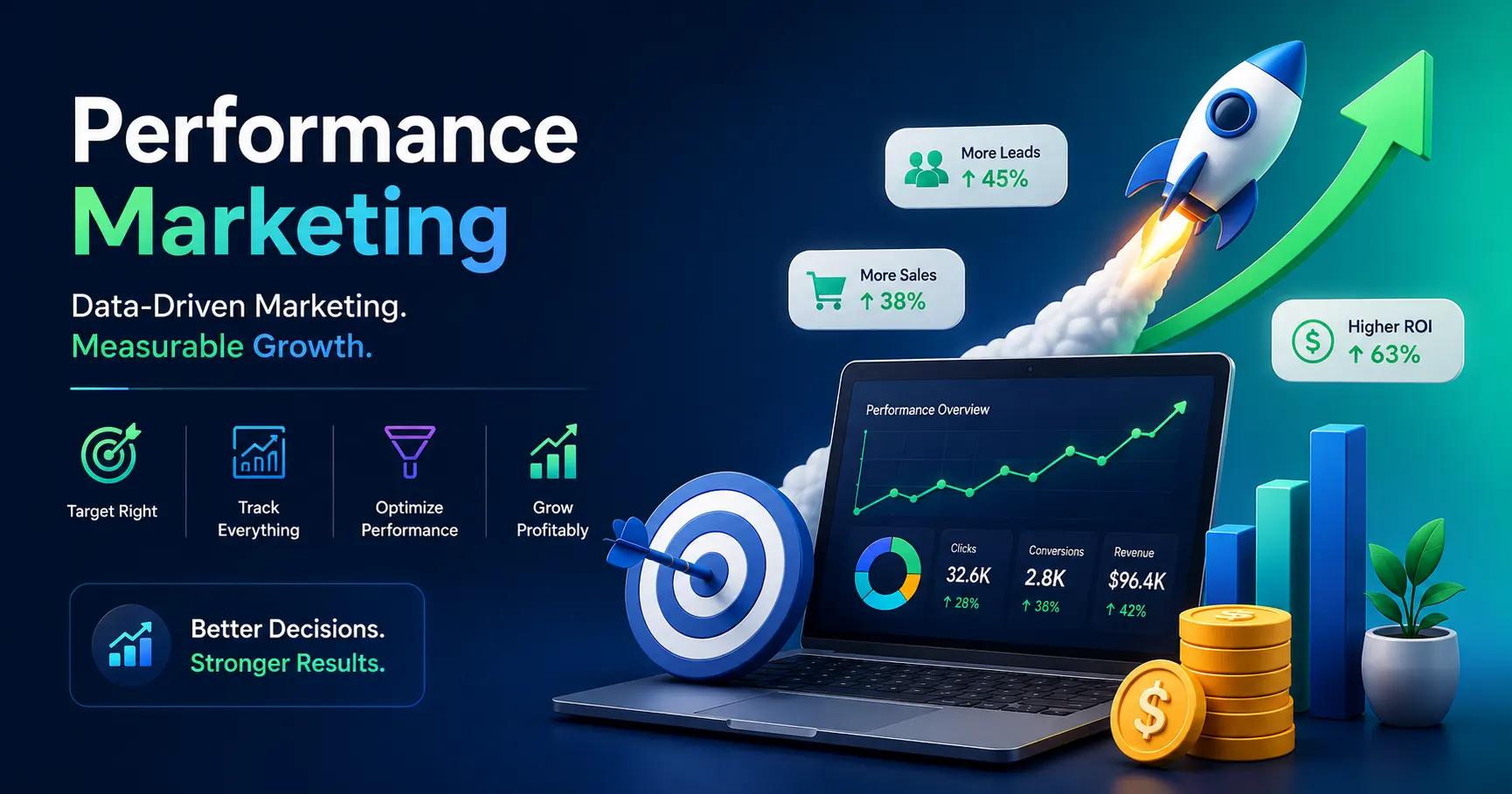
Turn Marketing Spend into Measurable Business Growth
Discover how performance marketing helps businesses attract the right audience, generate quality leads, and maximize return on investment through data-driven digital campaigns. By the end of this guide, you'll understand the strategies, channels, and metrics needed to create high-performing campaigns that deliver measurable business results.
Introduction
The digital marketing era has evolved dramatically over the last decade. Today, organizations of all sizes seek strategies that provide measurable results, maximize return on investment (ROI), and enable data-driven decision-making.
Unlike traditional marketing, where success is often measured by impressions or reach, performance marketing focuses on specific business objectives such as website traffic, lead generation, app downloads, sales, and customer acquisitions.
In this guide , you'll learn what performance marketing is, how it works, why it matters, the major marketing channels involved, and how businesses can use it to achieve sustainable growth in today's competitive digital marketplace.
AI summary
Performance marketing is a results-driven digital marketing strategy where businesses pay only for measurable actions such as clicks, leads, conversions, or sales. By leveraging channels like search engines, social media, affiliate marketing, and email marketing, businesses can track campaign performance, optimize advertising spend, improve return on investment (ROI), and achieve sustainable, data-driven business growth.
What's inside
What is Performance Marketing ?
Why Performance Marketing Is Different from Traditional Marketing ?
Why Performance Marketing Matters for Businesses ?
How Performance Marketing Works ?
Essential Performance Marketing Metrics & KPIs
Benefits of Performance Marketing
Common Challenges in Performance Marketing
Best Practices for Successful Campaigns
The Role of Conversion Tracking in Performance Marketing
Common tools used for Conversion Tracking
Future Trends in Performance Marketing
FAQs
Key Takeaways
Conclusion
What is Performance Marketing ?
Performance Marketing is a digital marketing strategy in which advertisers pay marketing partners or advertising platforms only when a predefined action is completed.
These actions may include :
Purchasing a product
Filling out a lead generation form
Installing a mobile application
Signing up for a newsletter
Clicking an advertisement
Booking a consultation
Registering for an event
This results-oriented approach ensures that marketing investments are directly tied to measurable business outcomes rather than estimated exposure or audience reach.
For example, a travel company promotes its holiday packages through search engines and social media. Instead of paying only for ad exposure, it uses performance marketing to pay for measurable actions such as brochure downloads, trip inquiries, or booking requests. Tracking these conversions helps the company understand which campaigns attract the most interested travelers and improve future marketing performance..
Why Performance Marketing is Different from Traditional Marketing ?
Feature | Performance Marketing | Traditional Marketing |
|---|---|---|
Payment Model | Pay for measurable results | Pay for ad placement |
Performance Tracking | Real-time Tracking | Limited |
ROI Measurement | Easy and Accurate | Difficult |
Audience Targeting | Highly Targeted | Broad |
Campaign Optimization | Continuous Optimization | Limited after Launch |
Budget Flexibility | Flexible and Scalable | Fixed |
Common Channels | Google Ads, Social Media, E-mail, Affiliate Marketing | TV, Radio, Newspapers |
Traditional marketing channels such as newspapers, magazines, television commercials, radio advertisements, and billboards often make it difficult to determine whether an advertisement directly influenced customer behavior.
Imagine placing a billboard on a busy highway. Thousands of people may see it every day, but there's no reliable way to determine :
Who has noticed the advertisement
How many potential customers became interested
How many purchases resulted directly from the campaign
Performance marketing solves this challenge by providing measurable data for every campaign.
Instead of relying on assumptions, marketers can monitor :
Number of Impressions
Click-Through-Rate (CTR)
Website Traffic
Conversion Rate
Cost Per Click (CPC)
Cost Per Acquisition (CPA)
Return On Ad Spend (ROAS)
Customer Lifetime Value (CLV)
This transparency enables businesses to optimize campaigns based on actual performance rather than guesswork.
Why Performance Marketing Matters for Businesses ?
Modern consumers interact with brands across multiple digital platforms before making purchasing decisions. They may discover a company through Google Search, engage with social media content, read product reviews, watch YouTube videos, compare prices, and finally complete a purchase online.
Performance marketing helps businesses remain visible throughout this customer journey while ensuring every marketing activity contributes to measurable goals.
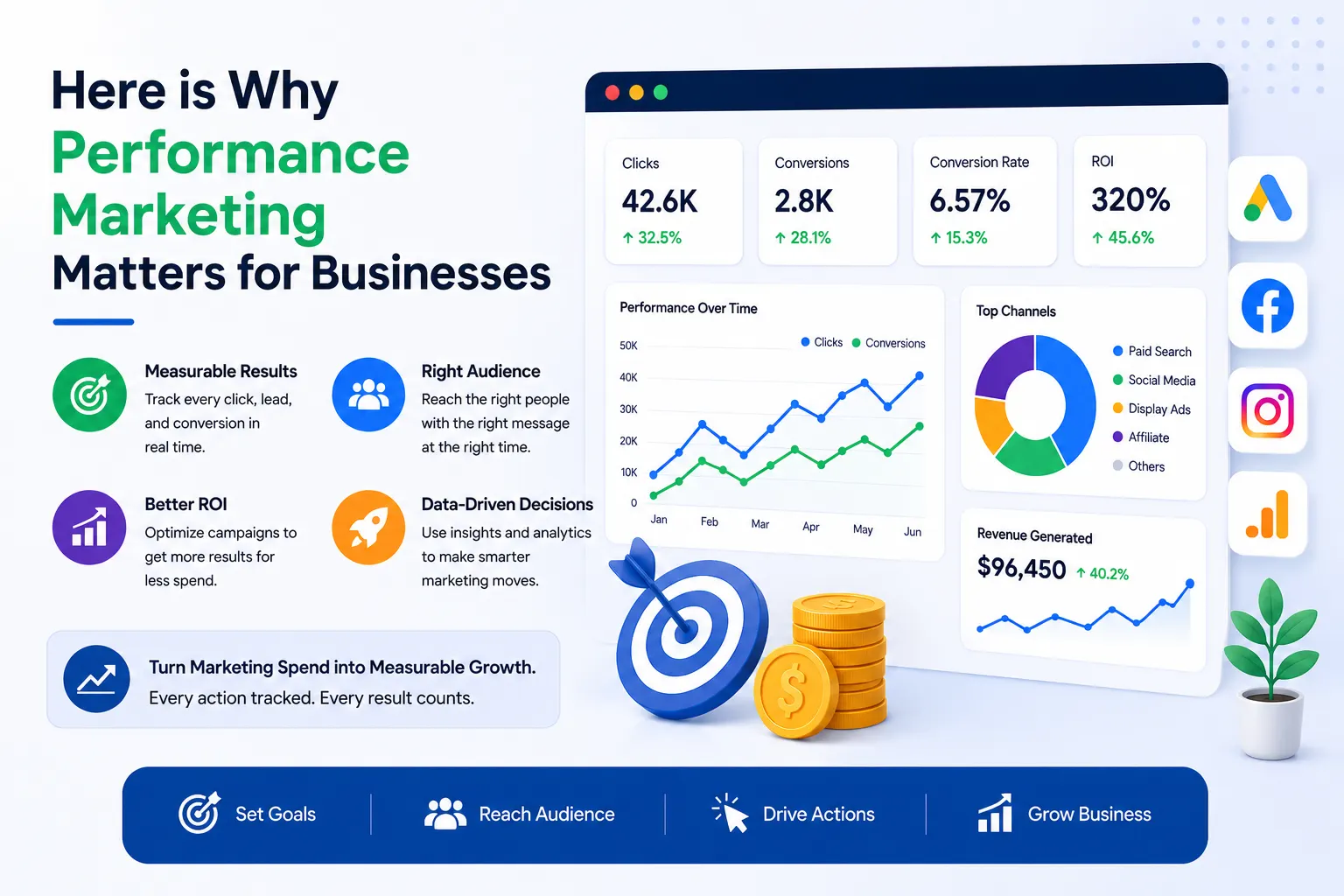
Following are the primary reasons , businesses invest in Performance Marketing :
Measurable Results :
Every click, impression, lead, and conversion can be tracked using analytics tools.
Businesses no longer have to wonder whether their marketing campaigns are working because performance data is available in real time.
Better Return on Investment (ROI) :
Since advertisers pay for measurable actions instead of estimated exposure, marketing budgets are allocated more efficiently.
Precise Audience Targeting :
Performance marketing platforms allow businesses to reach audiences based on :
Age
Gender
Geographic Location
Interests
Occupation
Shopping Behavior
Device Usage
Online Activity
Purchase Intent
This precision minimizes wasted advertising spend and improves campaign effectiveness.
Real-Time Optimization :
One of the greatest advantages of digital performance marketing is flexibility.
Unlike traditional advertising campaigns that cannot easily be changed once launched, digital campaigns can be optimized continuously by adjusting :
Headlines
Ad Copy
Images
Videos
Landing Pages
Audience Segments
Budget
Keywords
Bidding Strategies
These improvements help maximize conversions while lowering acquisition costs.
Data-Driven Decision Making :
Performance marketing eliminates assumptions by replacing opinions with data.
Businesses can answer critical questions such as :
Which campaign generates the most revenue ?
Which platform produces the highest-quality leads ?
Which audience converts best ?
Which keywords drive purchases ?
Which advertisements perform better ?
The answers guide future marketing decisions and improve long-term performance.
How Performance Marketing Works ?
Performance Marketing follows a systematic process that combines audience research, advertising, analytics, and continuous optimization.
Define Business Objectives
Every successful campaign begins with a clear objective.
Common goals are as follows :
Increasing website traffic
Generating qualified leads
Boosting online sales
Promoting mobile app downloads
Building e-mail subscribers
Improving brand engagement
Without a defined objective, campaign performance cannot be measured accurately.
Identify the Target Audience
Understanding your audience is essential for campaign success.
Businesses analyze customer demographics and behaviors to determine :
Who is more likely to buy ?
What problems are they trying to solve ?
Which platforms do they use ?
What motivates their purchasing decisions ?
Audience research enables marketers to create highly personalized campaigns that resonate with potential customers.
Driving Measurable Business Growth
Performance marketing enables businesses to connect every marketing activity to a measurable outcome. Rather than focusing only on impressions or brand visibility, businesses track actions that directly contribute to growth and revenue. For example:
Generate qualified leads through targeted advertising campaigns.
Increase website traffic from audiences with high purchase intent.
Improve conversion rates by optimizing landing pages and ad creatives.
Reduce customer acquisition costs through continuous campaign optimization.
Measure campaign performance using KPIs such as CTR, CPA, ROAS, and ROI.
Scale successful campaigns by investing more in high-performing channels.
By monitoring these measurable outcomes, businesses can make informed decisions, optimize marketing budgets, and achieve sustainable growth with greater confidence.
Launch Campaigns
Once objectives, audiences, and channels are established, businesses create and launch campaigns. A campaign typically includes :
Compelling Headlines
Persuasive Ad Copy
High-quality Visuals
Clear CTA
Optimized Landing Pages
Tracking Pixels & Analytics
The goal is to guide users toward completing the desired action efficiently.
Track Performance
After launch, marketers monitor campaign performance using analytics tools such as Google Analytics, Google Ads, Meta Ads Manager, and other marketing dashboards.
Various Key Metrics of Performance Marketing as follows :
Impressions
Clicks
Click-Through-Rate (CTR)
Conversion Rate
Cost Per Click (CPC)
Cost Per Acquisition (CPA)
Return On Ad Spend (ROAS)
Revenue Generated
These insights reveal which campaigns are performing well and where improvements are needed.
Optimize and Scale
Performance marketing is an ongoing process rather than a one-time activity.
Based on campaign data, marketers continuously optimize :
Target Audiences
Keywords
Ad Creatives
Bidding Strategies
Landing Page Experience
Budget Allocation
Successful campaigns are scaled to reach more potential customers, while ineffective campaigns are refined or discontinued.
Essential Performance Marketing Metrics and KPIs
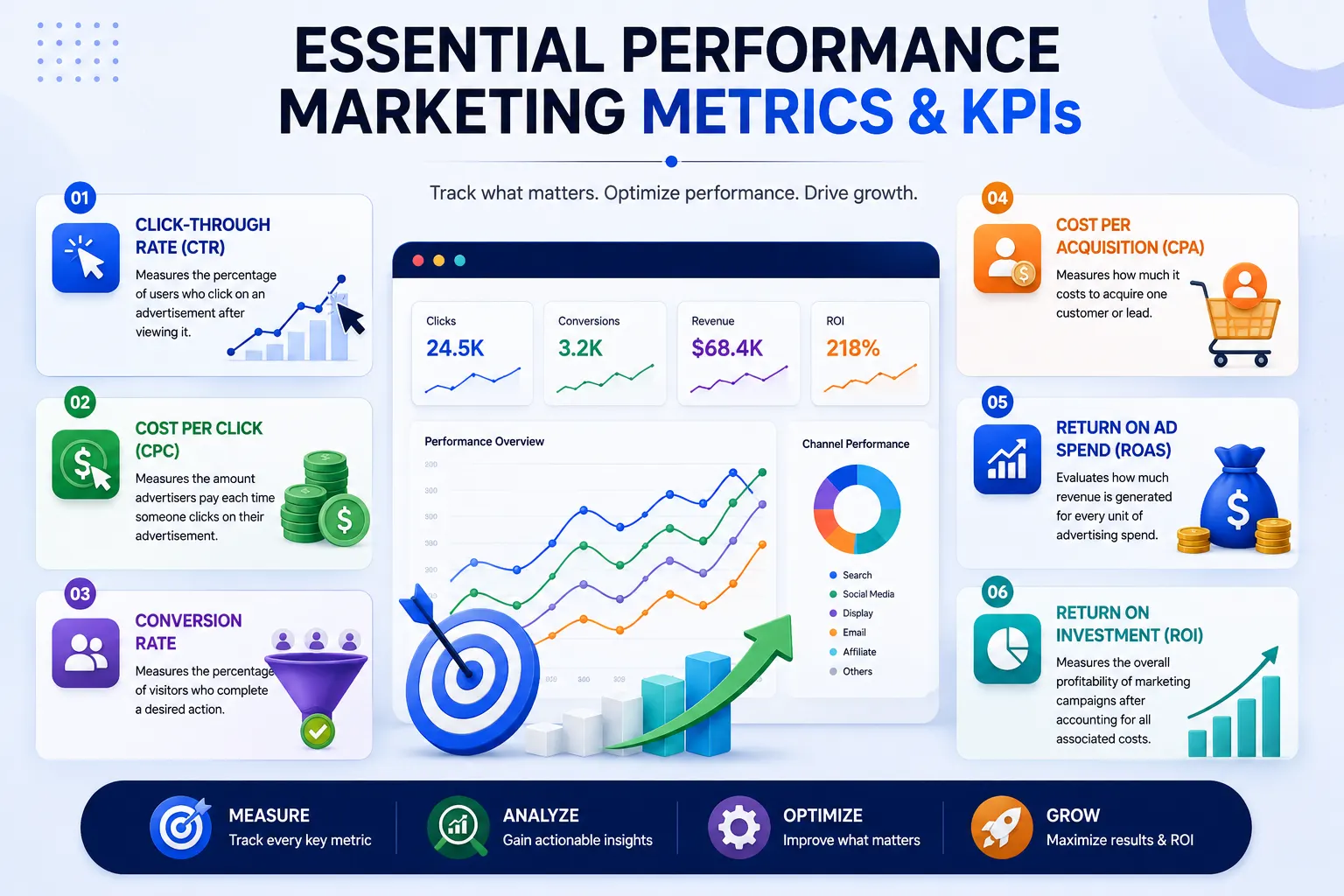
Performance marketing relies on measurable data. Tracking the right Key Performance Indicators (KPIs) helps marketers understand campaign effectiveness, identify opportunities for improvement, and maximize return on investment.
Following are the most important metrics every marketer should monitor :
Click-Through Rate (CTR)
CTR measures the percentage of users who click on an advertisement after viewing it.
Formula : CTR = (Clicks / Impressions) × 100
A high CTR generally indicates that your advertisement is relevant, engaging, and reaching the right audience.
Cost Per Click (CPC)
CPC measures the amount advertisers pay each time someone clicks on their advertisement.
Formula : CPC = Ad Spend / Clicks
Lower CPC combined with higher conversion rates usually indicates an efficient advertising campaign.
Conversion Rate
The conversion rate measures the percentage of visitors who complete a desired action.
Formula : CR = (Conversions / Visitors) x 100
Examples can include :
Purchasing a product
Filling out a contact form
Downloading an eBook
Registering for a webinar
Booking a consultation
Improving conversion rates often involves optimizing landing pages, improving user experience, and strengthening calls-to-action.
Cost Per Acquisition (CPA)
CPA measures how much it costs to acquire one customer or lead.
Formula : CPA = Ad Spend / Conversions
A lower CPA means businesses are acquiring customers more efficiently while maximizing marketing budgets.
Return on Ad Spend (ROAS)
ROAS evaluates how much revenue is generated for every unit of advertising spend.
Formula : ROAS = (Revenue from Ads / Ad Spend) x 100
For example :
If a business spends ₹20,000 on advertising and generates ₹100,000 in revenue , What will be the ROAS ?
ROAS = 5 : 1
Return on Investment (ROI)
ROI measures the overall profitability of marketing campaigns after accounting for all associated costs.
Formula : ROI = (Profit / Investment) x 100
Unlike ROAS, ROI includes additional expenses such as salaries, software subscriptions, creative production, and operational costs. Businesses use ROI to evaluate long-term marketing success and strategic decision-making.
Benefits of Performance Marketing
Organizations across industries continue to invest in performance marketing because it delivers measurable, scalable, and cost-effective results.
Following are the Benefits of Performance Marketing :
Measurable Campaign Performance
Every interaction from ad impressions to completed purchases can be tracked using analytics platforms. This transparency enables businesses to identify what works, eliminate underperforming campaigns, and invest confidently in high-performing strategies.
Data-Driven Budget Optimization
Performance marketing uses real-time data to help businesses optimize their advertising budgets. Instead of relying on estimates, marketers can monitor campaign performance and invest in strategies that generate the highest returns.
Marketers can :
Increase budgets for successful campaigns
Pause underperforming ads
Adjust bids instantly
Allocate spending based on business priorities
This flexibility helps maximize every marketing investment.
Highly Targeted Advertising
Rather than reaching a broad audience, businesses can target users based on :
Age
Gender
Location
Interests
Online behavior
Purchase intent
Device type
Previous Website interactions
Precise targeting improves campaign relevance and increases conversion rates.
Faster Optimization
Unlike traditional advertising campaigns, digital campaigns can be optimized in real time.
Marketers can quickly adjust :
Headlines
Images
Videos
Audience Segments
Keywords
Landing Pages
Bidding Strategies
Continuous optimization leads to better campaign performance and lower acquisition costs.
Scalability
Performance marketing campaigns can grow alongside business objectives.
When campaigns produce consistent positive returns, businesses can confidently increase budgets and expand into new markets without sacrificing efficiency.
Implementing these strategies effectively often requires the right expertise and technology. Arena Infosolution helps businesses develop performance marketing campaigns that focus on measurable growth, better ROI, and continuous optimization.
Common Challenges in Performance Marketing
Performance Marketing offers significant benefits, businesses should also understand the challenges involved.
Rising Advertising Costs :
Competition for popular keywords and audiences continues to increase, making customer acquisition more expensive in many industries.
Privacy and Data Regulations :
Changes in privacy laws, cookie restrictions, and platform tracking policies require marketers to adopt new measurement strategies while protecting user data.
Ad Fatigue :
Users exposed to the same advertisements repeatedly may stop engaging with them. Refreshing creatives, testing new messaging, and rotating visuals regularly can help maintain campaign effectiveness.
Attribution Complexity :
Customers often interact with multiple channels before making a purchase. Determining which marketing touchpoint deserves credit for a conversion can be challenging, requiring advanced attribution models and analytics tools.
Best Practices for Successful Performance Marketing Campaigns
Performance Marketing is not just about launching advertisements—it is about creating campaigns that consistently deliver measurable business results. Successful marketers continuously test, analyze, and optimize every aspect of their campaigns to improve performance and maximize return on investment (ROI).
Stated below , are some proven best practices that businesses should follow :
Define Clear Goals Before Launching Campaigns
Every campaign should begin with a well-defined objective. Without clear goals, it becomes difficult to measure success or identify areas for improvement.
Common campaign objectives include :
Increasing website traffic
Generating qualified leads
Driving online sales
Growing e-mail subscribers
Boosting app downloads
Improving customer retention
Using the SMART framework (Specific, Measurable, Achievable, Relevant, and Time-bound) helps businesses create focused campaigns with measurable outcomes.
Know your Target Audience
One of the biggest reasons campaigns fail is poor audience targeting. Successful performance marketers invest time in understanding their audience by analyzing :
Demographics
Interests
Online behavior
Pain points
Purchase intent
Preferred digital platforms
Creating customer personas helps businesses deliver highly personalized campaigns that resonate with the right audience.
Optimize Landing Pages
Driving traffic is only half the job. If visitors land on a confusing or slow website, conversions will suffer. A high-converting landing page should include :
A compelling headline
Clear Value Proposition
Mobile-friendly design
Fast loading speed
Strong call-to-action (CTA)
Customer testimonials or trust badges
A seamless user experience increases the likelihood that visitors will complete the desired action.
Test Everything
Performance marketing is driven by experimentation. Instead of assuming which campaign will perform best, marketers use A/B testing to compare different elements.
You can test the following things :
Headlines
Ad Copy
Images and Videos
CTA Buttons
Landing Pages
Audience Segments
Ad Placements
Monitor Campaign Performance Regularly
Successful campaigns are continuously monitored rather than left running unattended.
Review metrics such as :
CTR
CPC
CPA
Conversion Rate
ROI
ROAS
Regular performance analysis allows marketers to identify trends, fix issues quickly, and make informed optimization decisions.
Focus on Customer Experience
Today's consumers expect smooth and personalized digital experiences.
Businesses should ensure :
Mobile responsiveness
Easy website navigation
Secure checkout process
Fast page speed
Personalized messaging
Consistent brand experience across channels
A positive customer experience improves both conversion rates and long-term customer loyalty.
The Role of Conversion Tracking in Performance Marketing
Conversion tracking is one of the most important components of Performance Marketing because it helps businesses measure whether their marketing campaigns are achieving their intended goals. Conversion tracking provides accurate data on user actions, enabling marketers to evaluate campaign performance and make informed decisions.
A conversion occurs when a user completes a desired action after interacting with a marketing campaign. Depending on the business objective, a conversion can include :
Purchasing a product
Filling out a contact or lead generation form
Signing up for a newsletter
Downloading an eBook or mobile app
Booking a consultation or demo
Registering for a webinar or event
By tracking these actions, businesses gain valuable insights into which campaigns, advertisements, keywords, and audience segments are driving the best results.
Common tools used for Conversion Tracking
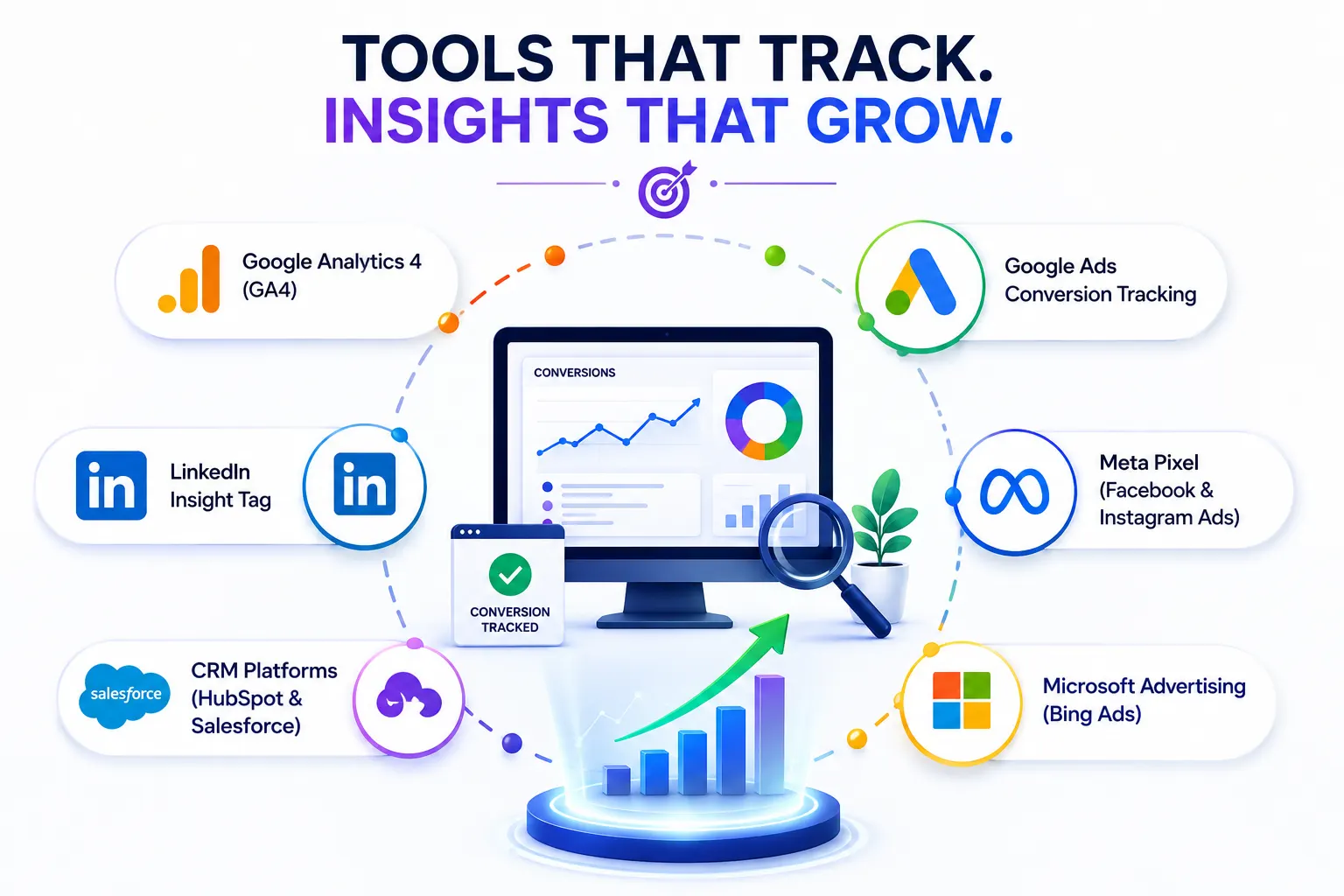
Businesses use various analytics and advertising platforms to monitor conversions across digital channels, including:
Google Analytics 4 (GA4)
Google Ads Conversion Tracking
Meta Pixel (Facebook & Instagram Ads)
LinkedIn Insight Tag
Microsoft Advertising (Bing Ads)
CRM platforms such as HubSpot and Salesforce
These platforms provide standardized methods for measuring user behavior and campaign performance. Detailed implementation guidance is available through the official documentation from Google Analytics, Google Ads, and Meta Business.
Future Trends in Performance Marketing
As technology evolves, performance marketing continues to become smarter, more automated, and more personalized.
Following are the trends which are going to shape Performance Marketing future :
Artificial Intelligence (AI)
AI is transforming campaign management by helping marketers :
Predict customer behavior
Automate bidding strategies
Generate ad creatives
Personalize customer experiences
Optimize campaigns faster
Businesses that embrace AI-powered tools can make better decisions while saving time.
First-Party Data
With growing privacy regulations and the decline of third-party cookies, businesses are increasingly relying on first-party data collected through websites, apps, CRM systems, and customer interactions. This enables more accurate targeting while respecting user privacy.
Marketing Automation
Automation platforms streamline repetitive tasks such as :
Email campaigns
Lead nurturing
Customer segmentation
Performance reporting
Audience retargeting
Automation improves efficiency while delivering personalized experiences at scale.
Video and Short-Form Content
Video continues to dominate digital engagement.
Platforms such as YouTube, Instagram Reels, Facebook Reels, and TikTok allow businesses to showcase products, educate customers, and increase conversions through engaging visual content.
Omnichannel Marketing
Customers interact with brands across multiple platforms before making purchasing decisions.
Future-ready businesses integrate performance marketing across :
Search engines
Social media
Email
Websites
Mobile apps
Content marketing
This creates a seamless customer journey and improves attribution accuracy.
Frequently Asked Questions (FAQs)
Q1. How is Performance Marketing different from Digital Marketing ?
Digital marketing is a broad term that includes all online marketing activities, while performance marketing is a specialized approach within digital marketing that focuses on achieving measurable outcomes.
Q2. How does Performance Marketing work ?
It tracks user actions across digital channels, allowing businesses to measure campaign performance and optimize spending based on real-time data.
Q3. Why is Performance Marketing important for businesses ?
It helps businesses maximize ROI by focusing on measurable outcomes instead of paying for ad exposure alone.
Q4. Can businesses improve their Performance Marketing results ?
Yes. Businesses can improve their Performance Marketing results through audience targeting, A/B testing, campaign optimization, and continuous performance analysis.
Q5. What are the biggest challenges in Performance Marketing ?
Common challenges include rising advertising costs, privacy regulations, ad fatigue, and accurately attributing conversions across multiple channels.
Key takeaways
Performance marketing focuses on measurable business outcomes, enabling businesses to pay for real results such as clicks, leads, conversions, and sales instead of estimated reach.
Choosing the right marketing channels—such as search engine marketing, social media advertising, affiliate marketing, email marketing, and display advertising—is essential for reaching the right audience and achieving campaign goals.
Tracking key performance indicators (KPIs) like Click-Through Rate (CTR), Cost Per Click (CPC), Conversion Rate, Cost Per Acquisition (CPA), Return on Ad Spend (ROAS), and Return on Investment (ROI) helps marketers evaluate campaign success and optimize performance.
Conversion tracking plays a critical role in performance marketing by identifying which campaigns, keywords, and audience segments generate the highest-value actions, allowing businesses to make informed, data-driven decisions.
Consistent optimization through A/B testing, audience segmentation, landing page improvements, and real-time analytics helps businesses maximize marketing budgets, improve customer acquisition, and achieve higher returns on investment.
As technologies like Artificial Intelligence (AI), marketing automation, first-party data, and predictive analytics continue to evolve, businesses that embrace these innovations will be better positioned to build scalable, customer-focused, and high-performing marketing campaigns.
Conclusion
Performance Marketing has transformed digital advertising by shifting the focus from estimated reach to measurable business outcomes. Instead of relying on assumptions, businesses can now track every click, lead, conversion, and sale to understand exactly how their marketing investments perform.
Whether you're running search ads, social media campaigns, affiliate programs, email marketing, or display advertising, the principles remain the same: define clear goals, target the right audience, monitor meaningful KPIs, and continuously optimize based on data. This results-driven approach helps businesses reduce wasted ad spend, improve customer acquisition, and maximize return on investment.
Successful performance marketing relies on conversion tracking, accurate marketing attribution, and reliable marketing analytics tools to measure campaign effectiveness. By monitoring campaign performance metrics such as click-through rate (CTR), cost per acquisition (CPA), customer acquisition cost (CAC), and return on ad spend (ROAS), businesses can make informed decisions, optimize data-driven advertising campaigns, and achieve sustainable business growth while delivering measurable results online.
Ready to grow with AI-powered marketing?
Book a free 30-minute strategy call with the Arena Infosolution team.
About the author
Arena Performance Marketing Team — Performance marketing specialists at Arena Infosolution focused on paid advertising, campaign optimization, conversion tracking, marketing analytics, and ROI-driven strategies. The team publishes research-backed content that helps businesses improve campaign performance, generate measurable results, and achieve sustainable digital growth.
Get a free growth consultation
Tell us what you're working on and a senior strategist will map your next move.