Performance Marketing Funnel: How to Turn Traffic Into Customers
Learn how a performance marketing funnel turns website traffic into customers through the right audience, landing pages, conversions, tracking, and continuous optimization.
What You’ll Learn in This Guide
Understand how a performance marketing funnel converts traffic into measurable business results.
Learn what happens at every stage—from awareness and consideration to conversion and retention.
Discover practical strategies to identify funnel leaks and improve conversion rates.
Learn which KPIs matter, from CTR and CPL to CAC, ROAS, and customer lifetime value.
What's inside
What a Performance Marketing Funnel Really Means
From Traffic to Customers: How the Funnel Works
The Four Stages of a Performance Marketing Funnel
How to Build a Funnel That Converts
The Metrics That Actually Matter
How to Optimize Your Funnel for Better Results
AI summary
A Performance Marketing Funnel is a step-by-step journey that turns online traffic into customers by guiding people from their first interaction with a brand to a final purchase or conversion. It typically includes four stages: awareness, consideration, conversion, and retention.
A successful funnel connects the right marketing channels, content, landing pages, offers, and follow-ups at each stage. Businesses can use metrics such as CTR, CPC, conversion rate, CPA, and ROAS to understand what is working and where potential customers are dropping off.
The goal is not simply to generate more traffic, but to turn the right traffic into measurable business results through continuous testing, tracking, and optimization.
How a Performance Marketing Funnel Turns Traffic Into Customers
A Performance Marketing Funnel is a structured customer journey that helps businesses turn relevant website traffic into leads, customers, and repeat buyers. Instead of focusing only on getting clicks and visitors, a performance funnel tracks what happens after the click—from the first interaction to conversion and retention.
Here is what you need to know:
A performance marketing funnel turns traffic into measurable business outcomes, such as leads, sales, bookings, or enrollments.
The funnel usually moves through awareness, consideration, conversion, and retention.
Different channels such as Google Ads and retargeting can support different stages of the funnel.
Landing pages, clear offers, strong CTAs, tracking, and follow-up play an important role in converting visitors.
Businesses can use metrics such as CTR, CPC, conversion rate, CPL, CPA, CAC, and ROAS to identify what is working.
The goal isn't simply to get more traffic. It's to turn the right traffic into customers and generate measurable growth.
Getting visitors to your website is only the beginning.
A business may receive thousands of visitors every month, but that doesn't automatically mean those visitors will become customers. Some may leave immediately, some may research your offer, and others may be ready to take action.
This is why a performance marketing funnel looks at the complete journey.
A visitor may discover your business through Google, click an advertisement, read your website, compare your offer, submit an enquiry, speak with your sales team, and finally become a customer.
Each interaction creates an opportunity to understand what is working—and where potential customers are being lost.
A performance marketing funnel helps businesses turn this journey into a measurable and optimizable process.
What Is a Performance Marketing Funnel?
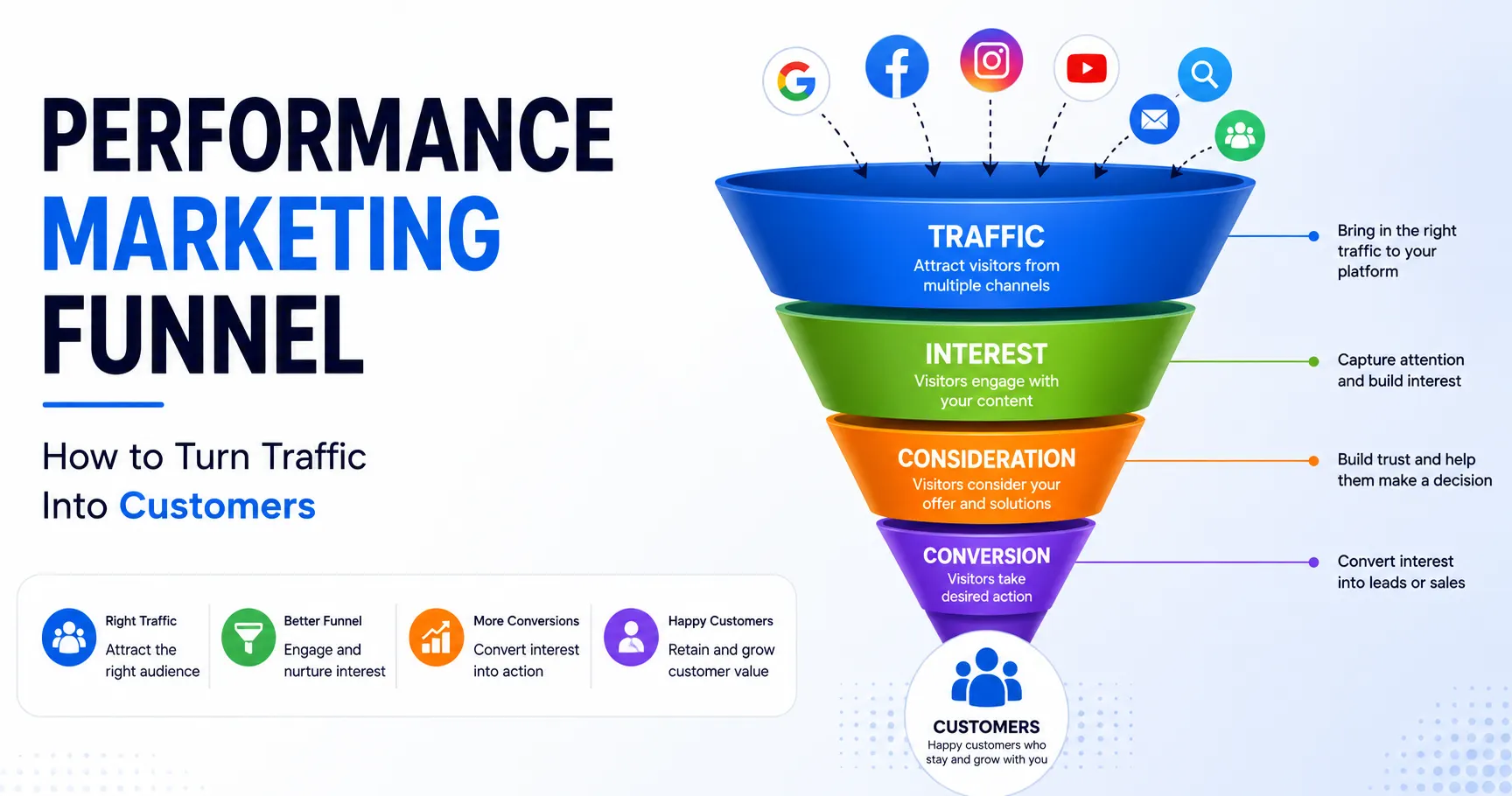
A Performance Marketing Funnel is the journey that turns a visitor into a customer. It helps businesses guide people from discovering a brand to taking action, while measuring what happens at each stage.
In simple terms:
Traffic → Interest → Consideration → Conversion → Customer
The funnel helps marketers understand where visitors are converting, where they are dropping off, and what can be improved to generate better results from the same traffic.
This is what makes performance marketing different: the focus is not just on getting more visitors, but on turning the right traffic into measurable business results.
Performance Funnel vs Customer Journey
A performance marketing funnel is a measurement framework used by marketers to understand how traffic moves toward a conversion. It helps businesses measure stages such as awareness, consideration, conversion, and retention.
A customer journey, however, describes the actual experience a customer goes through before making a decision.
Customers do not always follow a straight path.
For example, a customer might:
Google Search → Visit Website → Check Instagram → Search on Google Again → Read Reviews → Submit an Enquiry → Become a Customer
This means a customer may interact with a brand through multiple channels before converting.
Why This Difference Matters
A funnel helps marketers identify where people are dropping off, while the customer journey helps them understand why people are interacting with the brand in different ways.
By looking at both, businesses can create better campaigns, improve the customer experience, and make more informed optimization decisions.
Ready to grow with AI-powered marketing?
Book a free 30-minute strategy call with the Arena Infosolution team.
How a Performance Marketing Funnel Works
A performance marketing funnel works by moving potential customers from their first interaction with your business toward a desired action.
Different customers can enter the funnel through different channels.
Someone may find you through:
Google Search
Social media
SEO
YouTube
Referral traffic
Email
Retargeting
But the journey doesn't end when they click.
The real performance question is:
What happens after the traffic arrives?
The Performance Marketing Funnel Workflow
Stage 1: Attract
The first stage is bringing relevant people to your business.
This can happen through SEO, paid advertising, social media, content marketing, or other channels.
The goal is not just high traffic.
The goal is relevant traffic.
Stage 2: Engage
Once visitors arrive, your website needs to give them a reason to stay.
Clear information, useful content, reviews, benefits, visuals, and a relevant landing page can help visitors understand your offer.
The goal is to move people from:
“I found this website.”
to:
“This could be useful for me.”
Stage 3: Convert
The next step is getting the visitor to take a valuable action.
Depending on the business, this could be:
Filling out a form
Making a purchase
Booking a consultation
Calling the business
Requesting a demo
Enrolling in a course
A clear CTA and simple conversion process can reduce friction.
Stage 4: Retain
The funnel doesn't necessarily end after the first conversion.
A customer can:
Purchase again
Upgrade
Use another service
Refer someone
Engage with your content
Become a long-term customer
Retention can increase the overall value generated from each customer.
What Makes a Funnel Effective?
A strong performance marketing funnel connects five important elements:
Right Audience
↓
Right Message
↓
Relevant Experience
↓
Easy Conversion
↓
Continuous Optimization
If one of these elements is weak, the funnel can lose potential customers.
For example, excellent advertising cannot completely solve a poor landing page.
Likewise, a great landing page cannot fix completely irrelevant traffic.
The different parts need to work together.
Why Funnel Structure Matters
Two businesses can receive the same amount of traffic but generate completely different results.
Imagine:
Business A
10,000 visitors → 100 customers
Business B
10,000 visitors → 300 customers
Both businesses have the same traffic.
But Business B has a more effective conversion process.
This is why increasing traffic isn't always the first solution.
From Click to Customer: How the Funnel Works
Not every visitor is ready to buy the moment they land on your website. A performance marketing funnel helps move people from first discovering your brand to taking action by giving them the right message, experience, and reason to convert at each stage.
The Funnel
Funnel Stage | Main Goal | What Happens | Best Channels | Key Metric |
|---|---|---|---|---|
Awareness | Attract the right audience | People discover your brand or offer | SEO, Google Ads, Social Media, YouTube | Impressions, Reach, CTR |
Consideration | Build interest & trust | Visitors explore and compare your offer | Content, Landing Pages, Retargeting | Engagement, CPC |
Conversion | Turn interest into action | Users submit a lead, book, or purchase | Landing Pages, Offers, Remarketing | Conversion Rate, CPA, ROAS |
Retention | Build long-term value | Customers return, buy again, or refer others | Email, Remarketing, Loyalty | Repeat Rate, LTV |
How to Build a Funnel That Converts
Building a performance marketing funnel doesn't require dozens of complicated tools. What matters is creating a clear path between audience, traffic, experience, conversion, and measurement.
Here is a practical process.
1. Define Your Audience
Start by understanding who you want to attract.
Think about:
Their needs
Their problems
Their goals
Their search behavior
Their objections
Their buying intent
The clearer your audience is, the easier it becomes to create relevant campaigns and landing pages.
2. Choose the Right Traffic Source
Different audiences respond to different channels.
For example:
Google Search can work well when people are actively looking for a solution.
Social media can be useful for discovery and interest.
SEO can attract people through organic search over time.
Email can help nurture people who already know your brand.
The important question isn't:
“Which channel gives me the most traffic?”
It's:
“Which channel gives me the most valuable traffic?”
3. Give People a Clear Reason to Act
Visitors need a reason to take the next step.
That reason could be:
A useful offer
A free consultation
A demo
A limited-time opportunity
A valuable resource
A clear benefit
Your CTA should also be specific.
Instead of a vague “Submit”, a more descriptive CTA such as “Book a Free Consultation” can make the next step clearer.
4. Track Conversions
Without tracking, it becomes difficult to understand what is actually working.
Track important actions such as:
Form submissions
Purchases
Calls
Bookings
Sign-ups
Downloads
This allows you to connect marketing activity with business outcomes.
5. Optimize Based on Data
Your first funnel doesn't need to be perfect.
Performance marketing works through continuous improvement.
Look at where users are dropping off and test improvements.
You might improve:
Ad copy
Targeting
Landing page
CTA
Offer
Form
Follow-up process
Small improvements at multiple stages can make a significant difference to the overall funnel.
How to Optimize Your Funnel for Better Results
Once your funnel is running, optimization should become an ongoing process.
Tools You Can Use to Track Your Funnel
How to Optimize Your Funnel for Better Results
If visitors are clicking your campaign but leaving without taking action, review the landing page.
Check whether the page:
Matches the advertisement
Clearly explains the offer
Loads quickly
Works well on mobile
Has a visible CTA
Test Different CTAs
Small changes to your CTA can influence how users interact with the page.
Test different:
CTA wording
Button placement
Offers
Supporting copy
Don't assume one version is automatically better. Test and measure.
Refine Audience Targeting
Poor targeting can send the wrong people into your funnel.
Review:
Search intent
Audience segments
Locations
Demographics where relevant
Keywords
Campaign exclusions
The goal is to attract people who are more likely to need your product or service.
Run A/B Tests
Instead of making changes based on assumptions, test different versions.
You can test:
1. Headline A vs Headline B
2. CTA A vs CTA B
3. Landing Page A vs Landing Page B
4. Offer A vs Offer B
The purpose of A/B testing is to learn which version produces a better result for the chosen objective.
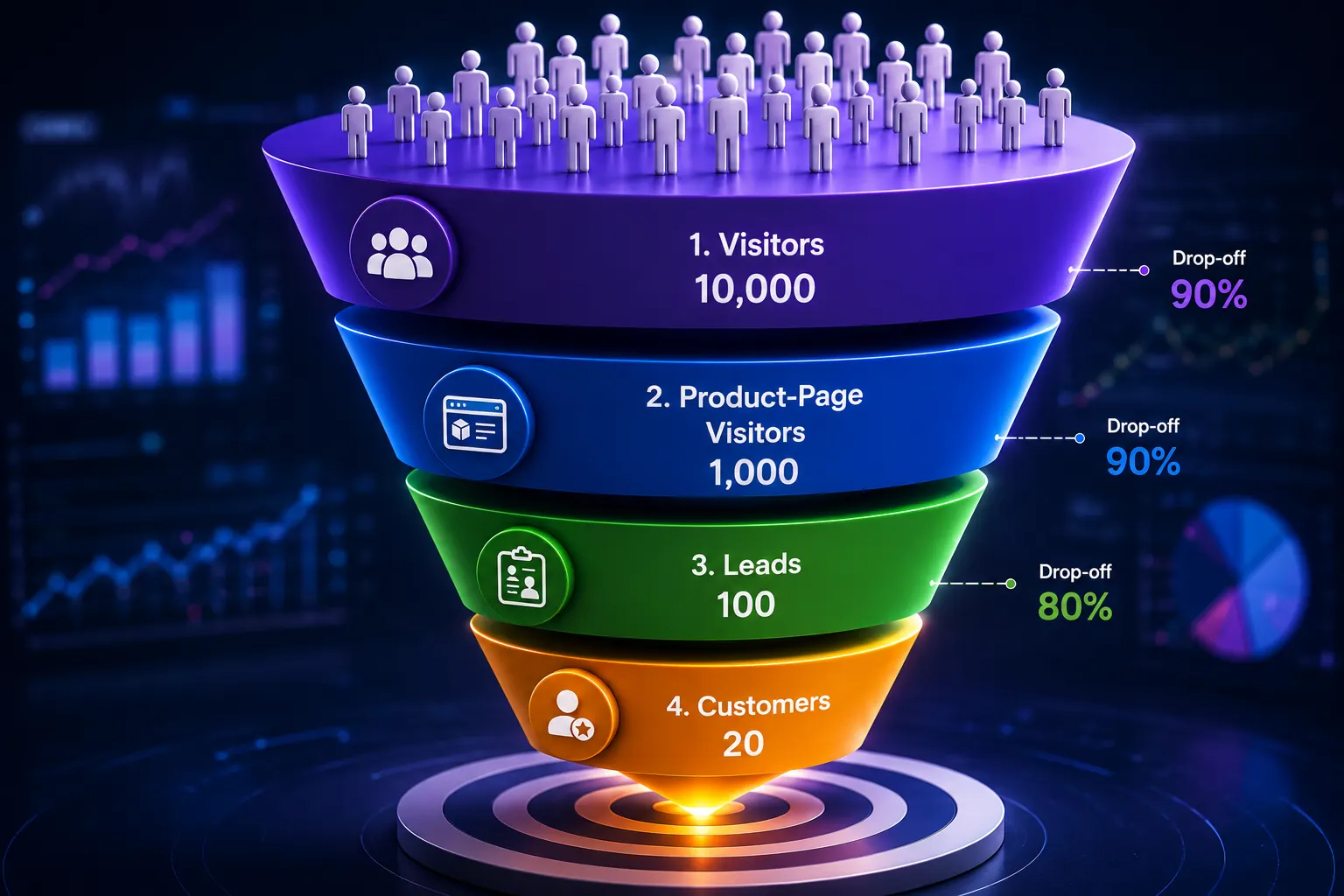
Find Funnel Drop-Off Points
One of the most useful optimization questions is:
“Where are people leaving?”
For example:
10,000 visitors → 1,000 product-page visitors → 100 leads → 20 customers
If a large number of people reach the product page but very few become leads, that stage deserves attention.
Finding the weakest stage helps you focus your optimization efforts instead of changing everything at once.
Common Performance Marketing Funnel Mistakes
A funnel can have good traffic and still produce poor results when the basic pieces don't work together.
Common Performance Marketing Funnel Mistakes
1. Targeting the Wrong Audience
More traffic doesn't help if the visitors don't need your product or service.
2. Sending Traffic to a Weak Landing Page
A strong advertisement cannot compensate for a confusing or irrelevant landing page.
3. Using a Weak CTA
If visitors don't understand what to do next, they may simply leave.
4. Not Tracking Conversions
Without conversion tracking, it's difficult to know which campaigns and channels are actually producing results.
5. Ignoring Follow-Up
Generating a lead is not always the same as generating a customer. Slow or inconsistent follow-up can cause valuable leads to disappear.
The simple lesson is:
Right audience → Relevant message → Strong experience → Clear action → Proper follow-up
7-Day Performance Marketing Funnel Audit
A funnel audit helps you understand where potential customers are entering, where they are losing interest, and what may be preventing them from converting. Instead of changing everything at once, review one part of the funnel each day and use the findings to decide what to improve.
Day 1: Audit Your Traffic Sources
Start by checking where your visitors and leads are coming from.
Review:
Organic search traffic
Google Ads
Social media
Referral traffic
Direct traffic
Email or other campaigns
Ask:
Which source brings the most visitors?
Which source brings the most qualified leads?
Which source generates actual customers?
Do not judge a traffic source only by the number of visitors. A channel that brings fewer visitors but better-quality leads may be more valuable.
Action: Create a simple list of your top traffic sources and compare visitors, leads, customers, and cost.
Day 2: Audit Your Landing Page
Now check what happens after people arrive on your website.
Look at:
Page relevance
Headline clarity
Page loading experience
Mobile usability
Trust signals
Offer visibility
CTA placement
Content clarity
Ask:
Does the landing page immediately explain what the visitor came for?
If someone clicks an advertisement for a specific service, the landing page should continue the same message instead of making the visitor search for the information.
Action: Open your landing page as a first-time visitor and see whether you can understand the offer and next step within a few seconds.
Day 3: Audit Your CTA and Forms
Your visitor may be interested but still fail to convert if taking action is difficult.
Check:
Is the CTA easy to find?
Is the CTA specific?
Is the form too long?
Are unnecessary fields included?
Is the next step clear?
Does the form work properly on mobile?
For example, instead of a generic “Submit”, a more descriptive CTA such as “Book a Free Consultation” can make the intended action clearer.
Action: Test the complete conversion process yourself—from clicking the CTA to submitting the form.
Day 4: Audit Lead Quality
Generating more leads does not always mean generating better results.
Separate your leads into categories such as:
Qualified → Needs follow-up → Low intent → Irrelevant
Then compare which marketing channels are producing the highest-quality leads.
Ask:
Which source produces qualified enquiries?
Which campaigns produce irrelevant leads?
Are leads matching the target audience?
Are people actually interested in the product or service?
Action: Identify your best-performing lead source and investigate what makes those leads different.
Day 5: Audit Sales and Follow-Up
A marketing funnel does not end when a lead is generated.
Check what happens after someone submits an enquiry.
Review:
Response time
Number of follow-ups
Contact attempts
Lead status
Sales conversion
Reasons for lost leads
A simple funnel might look like:
100 Leads → 60 Contacted → 30 Qualified → 10 Customers
If many leads are being generated but very few become customers, the problem may not be the advertising campaign. It could be the qualification or follow-up process.
Action: Find where leads are being lost after submission and identify the reason.
Day 6: Identify Your Biggest Drop-Off Point
Now combine the information from the previous five days.
Map your funnel:
Traffic → Engaged Visitors → Leads → Qualified Leads → Customers
Then ask:
Where is the biggest drop happening?
For example:
10,000 Visitors
↓
2,000 Engaged Visitors
↓
300 Leads
↓
50 Qualified Leads
↓
10 Customers
If the biggest problem is between leads and qualified leads, increasing website traffic may not solve the real issue.
Action: Choose one major bottleneck instead of trying to fix every stage at the same time.
Day 7: Run One Improvement Test
The final day is about turning your audit into action.
Choose the weakest stage and make one meaningful change.
You could test:
A new headline
A different CTA
A shorter form
A stronger offer
Different audience targeting
A new landing-page layout
A different follow-up approach
Do not change everything simultaneously. If you change multiple elements at once, it becomes difficult to understand which change affected the result.
Action: Record the original performance, make one change, and measure the result over an appropriate period.
The 7-Day Audit Rule
The purpose of a funnel audit is not to make the funnel look perfect.
It is to answer three important questions:
Where are people entering?
Where are they dropping off?
What single improvement should we test next?
Once you answer these questions, repeat the process regularly. Performance marketing is not a one-time setup—it is a continuous cycle of Measure → Diagnose → Test → Learn → Improve.
Performance Marketing Funnel Checklist
Before launching or optimizing your funnel, make sure you have the basics covered:
☐ Target audience defined
☐ Clear marketing goal selected
☐ Right traffic source chosen
☐ Campaign message matches the audience
☐ Relevant landing page created
☐ Clear CTA added
☐ Conversion tracking active
☐ Lead/customer journey mapped
☐ Retargeting considered where appropriate
☐ Important KPIs monitored
☐ Funnel drop-off points reviewed
☐ A/B testing planned
☐ Regular optimization process est
Frequently Asked Questions
What is a Performance Marketing Funnel?
A Performance Marketing Funnel is a structured customer journey that moves people from discovering a business to taking a valuable action. It also measures performance at different stages to identify opportunities for improvement.
What are the four stages of a performance marketing funnel?
The four common stages are Awareness, Consideration, Conversion, and Retention. Each stage has a different objective and may use different marketing channels and metrics.
Why is a funnel important in performance marketing?
A funnel helps businesses understand what happens after traffic arrives. It can reveal where potential customers are dropping off and where improvements can increase conversions.
What is the difference between traffic and conversion?
Traffic refers to people visiting your website or interacting with your marketing. Conversion happens when a visitor completes a desired action, such as purchasing, submitting a form, booking a call, or registering.
Which metrics should I track?
Common performance marketing metrics include CTR, CPC, Conversion Rate, CPL, CPA, CAC, and ROAS. The right metrics depend on your campaign objective and business model.
How can I improve my performance marketing funnel?
Start by identifying the weakest stage. Then test improvements to your targeting, advertising, landing page, offer, CTA, follow-up, and conversion process.
Does a performance marketing funnel only work for paid advertising?
No. The funnel can include traffic from SEO, Google Ads, social media, email, referrals, content marketing, and other channels. The key idea is measuring how traffic moves toward business outcomes
Key takeaways
A performance marketing funnel turns relevant traffic into measurable business results.
The main funnel stages are Awareness, Consideration, Conversion, and Retention.
A strong funnel connects traffic sources, landing pages, offers, CTAs, and follow-up.
Metrics such as CTR, CPC, Conversion Rate, CPL, CPA, CAC, and ROAS help identify what is working.
Funnel optimization focuses on finding drop-off points and improving each stage of the customer journey.
Final verdict
A performance marketing funnel gives businesses a clearer way to think about the relationship between traffic and revenue.
The goal isn't simply to attract more people. It's to understand the complete journey:
Traffic → Interest → Consideration → Conversion → Customer
When every stage is connected, marketers can see where opportunities exist, measure the right metrics, and improve the customer journey over time.
The strongest funnels aren't necessarily the most complicated ones. They are the ones that attract the right audience, communicate the right message, create a smooth experience, make conversion easy, and use data to keep improving.
If your website is already receiving traffic but conversions aren't where you want them to be, the next step may not be to spend more on traffic.It may be time to improve the funnel.
About the author
Arena InfoSolution is a digital marketing and performance marketing team focused on helping businesses build stronger online visibility and generate measurable results. The team creates practical, data-driven content around SEO, performance marketing, digital advertising, conversion optimization, and online growth.
Get a free growth consultation
Tell us what you're working on and a senior strategist will map your next move.