
Performance Marketing : How to Set a Paid Advertising Budget for your Business
Learn how to set a paid advertising budget for your business with practical performance marketing strategies. This comprehensive guide covers budget planning, allocation methods, essential metrics like CPA, CAC, and ROAS, common budgeting mistakes, and best practices to maximize your advertising ROI.
The Complete Guide to Setting a Paid Advertising Budget for Your Business.
Discover how to determine the right advertising budget based on your business goals, audience, and expected returns. This guide covers proven budgeting strategies, key cost factors, and practical tips to help you maximize ROI from every marketing dollar.
Introduction
Every business wants more customers, more sales, and better returns from its marketing efforts. One of the fastest ways to achieve these goals is through paid advertising. However, simply running ads is not enough. The real challenge is deciding how much money you should spend.
Effective advertising budget planning helps businesses create a digital advertising budget that supports growth while maximizing ROI.
In this guide, you will learn everything you need to know about setting a paid advertising budget for your business. We will explain the key factors that influence your budget, show you how to calculate the right amount, share practical examples, highlight common mistakes to avoid, and provide proven tips to maximize your advertising investment.
AI summary
Setting a paid advertising budget starts with your business goals, expected revenue, and target audience not a fixed amount. Calculate your budget using key metrics like customer acquisition cost (CAC), conversion rate, and return on ad spend (ROAS), then allocate spending across the right channels, track performance regularly, and optimize campaigns to maximize ROI while avoiding unnecessary costs.
What's inside
What is a Paid Advertising Budget ?
Why Setting the Right Advertising Budget Matters ?
Key Factors That Influence Your Paid Advertising Budget
How to Calculate Your Paid Advertising Budget ?
How to Allocate Your Advertising Budget Across Different Channels ?
Common Paid Advertising Budget Mistakes to Avoid
Best Practices to Maximize Your Advertising Budget
Tools to Plan, Manage, and Track Your Advertising Budget
Frequently Asked Questions (FAQs)
Conclusion
What is a Paid Advertising Budget ?
A paid advertising budget is the amount of money a business plans to spend on paid marketing campaigns over a specific period, such as a day, month, quarter, or year. This budget covers the cost of running advertisements on platforms like Google Ads, Facebook, Instagram, LinkedIn, YouTube, and other digital channels.
Unlike traditional advertising, where it's difficult to measure the exact impact of your spending, performance marketing allows you to track every rupee invested. You can see how many people clicked your ad, filled out a form, made a purchase, or downloaded your app.
Paid Advertising Budget vs. Marketing Budget
Many people confuse a marketing budget with a paid advertising budget, but they are not the same.
Marketing budget planning includes both organic and paid initiatives, while a paid advertising budget focuses only on advertising campaigns.
Feature | Marketing Budget | Paid Advertising Budget |
|---|---|---|
Scope | Covers all marketing activities | Covers only paid advertising campaigns |
Channels included | Includes SEO, content marketing, email marketing, branding, events, PR, and social media | Includes Google Ads, Meta Ads, LinkedIn Ads, YouTube Ads, display ads, and other paid channels |
Primary Focus | Focuses on both paid and organic growth | Focuses only on paid customer acquisition |
Purpose | Builds long-term brand awareness, customer relationships, and overall business growth | Drives immediate results such as clicks, leads, conversions, and sales |
Success Metrics | Measures website traffic, brand awareness, engagement, organic rankings, email performance, and customer retention | Measures CPC, CTR, CPA, ROAS, conversion rate, and ad-generated revenue |
Quick Tip
A paid advertising budget is a subset of your overall marketing budget. In other words, every advertising budget is part of the marketing budget, but a marketing budget includes many activities beyond paid ads.
Why Setting the Right Advertising Budget Matters ?
Setting the right advertising budget is one of the most important decisions in performance marketing. A well-planned budget helps you reach the right audience, generate quality leads, and maximize your return on investment (ROI).
Many businesses believe that spending more on ads automatically leads to better outcomes. However, success in performance marketing is not determined by how much you spend , it's determined by how strategically you spend your budget.
Now let's understand what happens when your budget is too low or too high.
What happens if your budget is too low ?
A small budget may seem like a safe option, but it often limits your campaign's ability to perform.
Limited Reach :
Your ads are shown to fewer people, reducing your chances of generating clicks, leads, or sales.
Example : If your target audience consists of 1,00,000 people but your daily budget only allows your ads to reach 2,000 people, you're missing a large portion of potential customers.
Slower Campaign Learning :
Advertising platforms like Google Ads and Meta Ads use machine learning to optimize campaigns. If your budget is too small, the platform collects data slowly, making it harder to identify the best-performing audiences and ads.
Fewer Conversions :
Less budget usually means fewer clicks and fewer opportunities to convert visitors into customers.
Increasing the budget strategically can provide enough data to improve campaign performance over time.
What happens if your budget is too high ?
Spending more money isn't always better.
If your campaigns aren't optimized, a large budget can quickly become an unnecessary expense.
Wasted Ad Spend :
Without proper targeting or high-quality creatives, increasing your budget simply means paying for more ineffective clicks.
Faster Budget Burn :
Large budgets without regular monitoring can be exhausted quickly, leaving little room for optimization or testing new strategies. This is why successful advertisers review campaign performance regularly and adjust budgets based on real data instead of letting campaigns run unchanged.
Poor Return on Ad Spend (ROAS) :
If your revenue doesn't increase at the same rate as your advertising spend, your ROAS will decline.
Example:
Ad Spend: ₹1,00,000
Revenue Generated: ₹2,00,000
ROAS = 2x
If doubling the budget only increases revenue slightly, your profitability decreases.
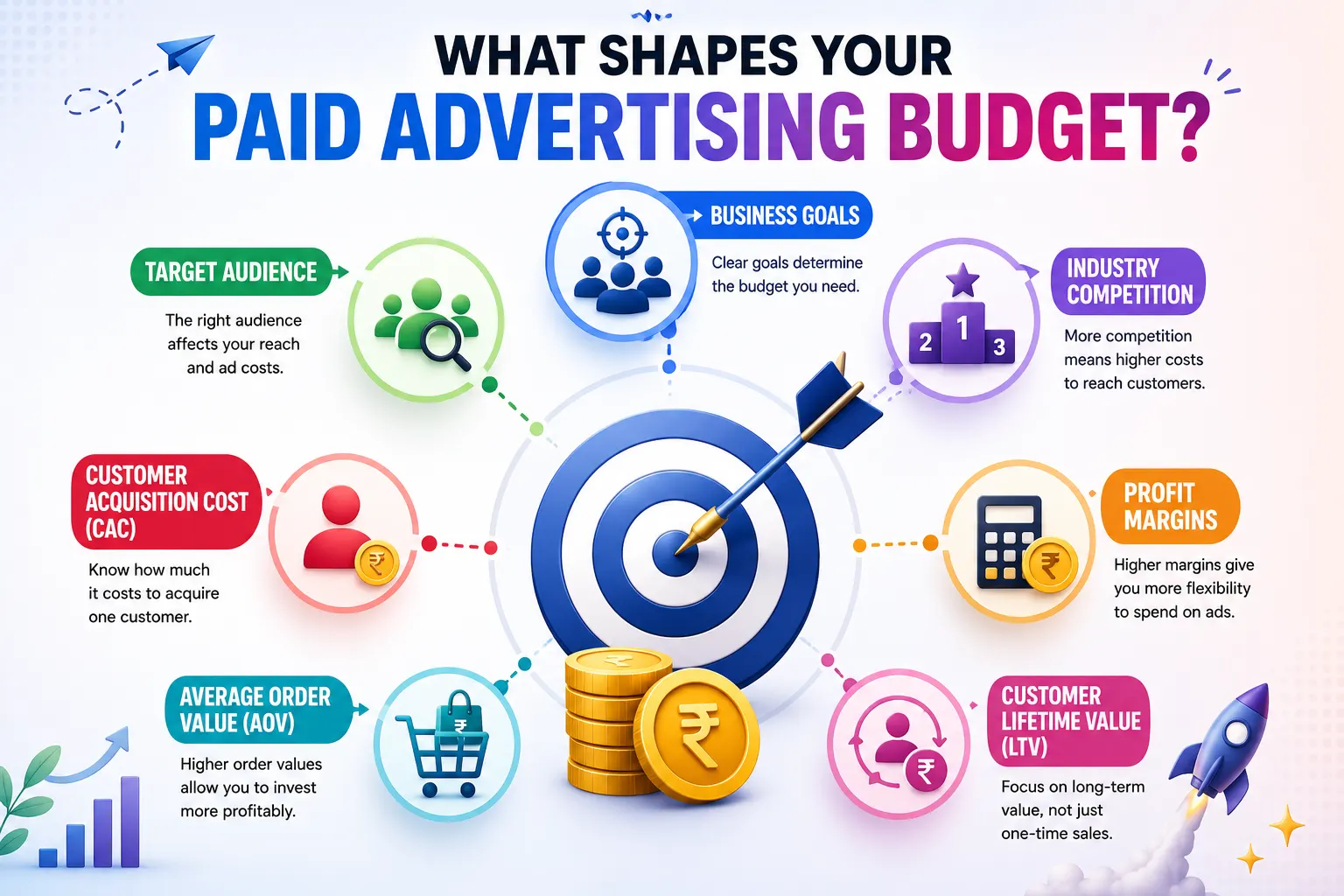
Key Factors That Influence Your Paid Advertising Budget
There is no one-size-fits-all advertising budget. Two businesses in the same industry can have completely different budgets because their goals, audience, competition, and expected returns are different.
Instead of asking " How much should I spend on ads ?", ask yourself :
" How much do I need to spend to achieve my business goals profitably ? "
This is the approach successful performance marketers follow. They calculate their budget based on business objectives and key performance metrics like Customer Acquisition Cost (CAC), Customer Lifetime Value (LTV), and Return on Ad Spend (ROAS), rather than choosing a random amount.
The key factors that determine your paid advertising budget are as follows :
Business Goals :
Your advertising budget should always start with your business goals. Different objectives require different levels of investment.
Business Goal | Budget Requirement |
|---|---|
Brand Awareness | Higher budget to reach more people |
Website Traffic | Budget based on expected clicks |
Lead Generation | Budget based on target number of leads |
Online Sales | Budget based on revenue and ROAS goals |
Example : If you want 500 leads per month and your average Cost Per Lead (CPL) is ₹400, you'll need an estimated budget of ₹2,00,000.
Target Audience :
The audience you want to reach directly affects your advertising costs.
Factors like location, age, interests, income level, and buying intent can increase or decrease your budget.
Industry Competition :
Highly competitive industries usually have higher advertising costs because more businesses compete for the same audience. The more competition there is, the more budget you may need to achieve your goals.
Customer Acquisition Cost (CAC) :
Customer Acquisition Cost (CAC) tells you how much you spend to acquire one customer.
Formula : CAC = Total Advertising Spend ÷ Customers Acquired
Example :
Ad Spend : ₹1,20,000
Customers : 240
CAC = ₹500
Tracking CAC helps you understand whether your campaigns are profitable.
Customer Lifetime Value (LTV) :
Customer Lifetime Value (LTV) is the total revenue a customer generates throughout their relationship with your business.
Formula: LTV = Average Order Value × Purchase Frequency × Customer Lifespan
Businesses with a higher LTV can usually spend more on acquiring customers because they earn more from them over time.
Quick Tip
A higher LTV gives you more flexibility to increase your advertising budget while staying profitable.
Average Order Value (AOV) :
Average Order Value (AOV) is the average amount customers spend in a single purchase.
A higher AOV means you can often afford a higher customer acquisition cost.
For example, a business selling ₹5,000 products can usually spend more on advertising than one selling ₹500 products.
Profit Margins :
Your advertising budget should also be based on your profit margins.
A business earning a 50% profit margin can usually invest more in advertising than a business with a 10% margin.
Before increasing your budget, make sure your advertising costs still leave enough profit.
How to Calculate Your Paid Advertising Budget ?
Knowing the factors that influence your advertising budget is important, but the next step is learning how to calculate the right budget. PPC Budget planning allows you to estimate costs based on your target audience, competition, and expected campaign performance.
Following are the steps to calculate a realistic paid advertising budget :
Define your Marketing Goal :
Before spending any money, decide what you want your campaign to achieve.
Your goal could be :
Generate qualified leads
Increase online sales
Drive website traffic
Get app downloads
Build brand awareness
Having a clear objective helps you estimate how much budget you'll need and which advertising platform will work best.
Set a Measurable Target :
Once you've defined your goal, assign a number to it.
A measurable target gives you a clear benchmark to calculate your advertising budget.
Estimate your Conversion Rate :
Your conversion rate is the percentage of people who complete a desired action after clicking your ad.
Formula : Conversion Rate = (Conversions ÷ Total Visitors) × 100
Example :
Website Visitors = 2,000
Purchases = 40
Conversion Rate = (40 ÷ 2,000) × 100 = 2%
This means that for every 100 visitors, about 2 people become customers.
Knowing your conversion rate helps you estimate how many visitors you'll need to achieve your sales or lead target.
Calculate the Required Traffic :
Now work backward from your goal.
Example :
Goal = 100 Sales
Website Conversion Rate = 2%
Required Visitors = 100 ÷ 2% = 5,000 Visitors
This means you'll need approximately 5,000 website visitors to generate 100 sales.
Estimate your Advertising Cost :
Estimate how much you'll pay for each click.
Suppose your average:
Cost Per Click (CPC) = ₹20
If you need 5,000 visitors, your estimated advertising budget will be :
5,000 × ₹20 = ₹1,00,000
This gives you a practical estimate of the investment required to reach your goal.
Divide your Budget :
After calculating your monthly budget, break it into smaller spending limits to make campaign management easier.
Setting daily and weekly limits helps you control spending while giving enough flexibility to optimize your campaigns.
Quick Tip
Your first budget doesn't have to be perfect. Start with a realistic estimate, monitor your campaign performance for a few weeks, and adjust your budget based on metrics like CPC, conversion rate, and ROAS. Small, data-driven changes often lead to better long-term results.
How to Allocate Your Advertising Budget Across Different Channels ?
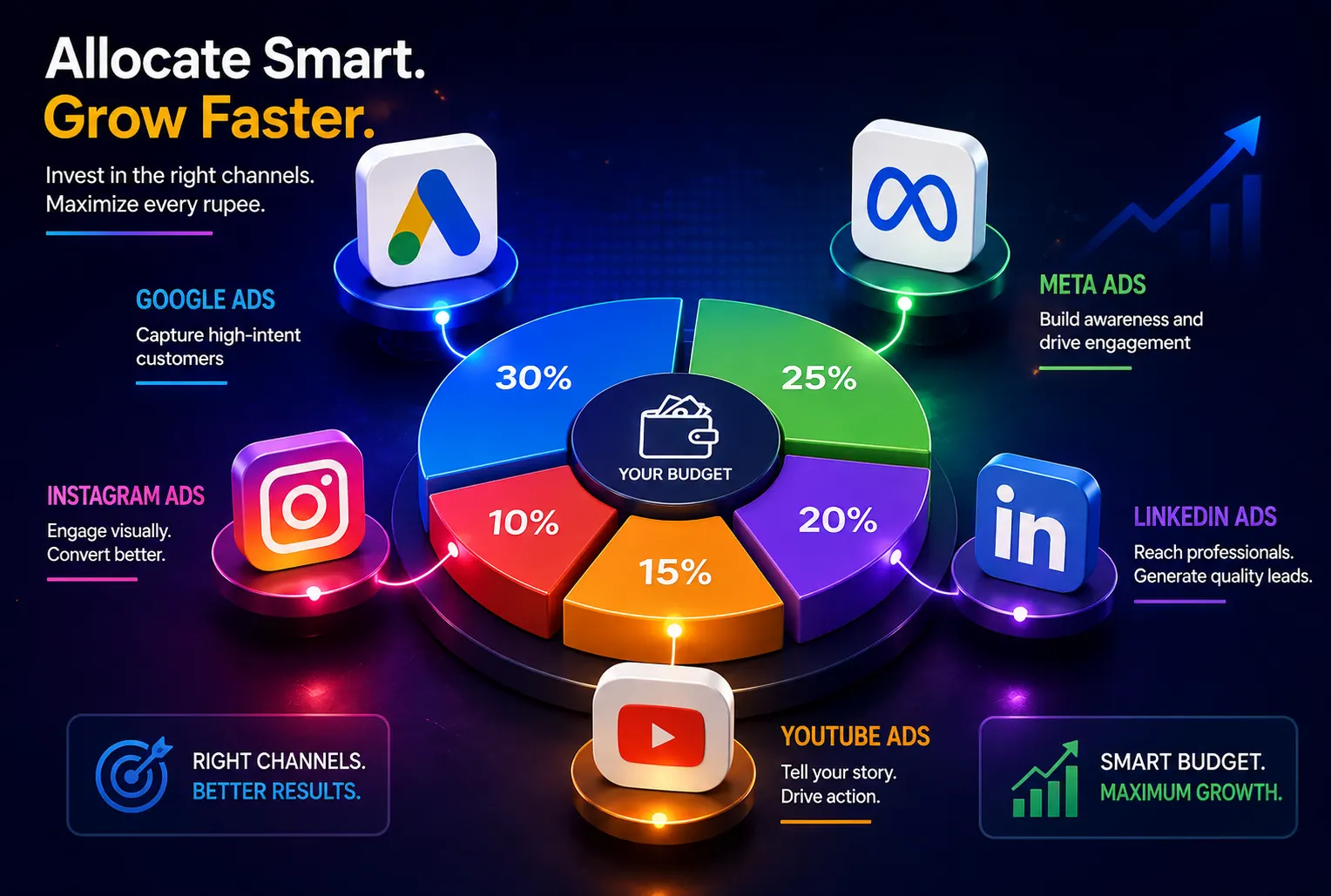
Once you've decided on your advertising budget, the next step is allocating it across the right marketing channels. Investing your entire budget in a single platform isn't always the best strategy.
A successful paid advertising strategy starts with a clear budget allocation strategy, ensuring that each advertising channel receives investment based on its expected performance.
Google Ads :
Google Ads is one of the most effective platforms for capturing users who are actively searching for products or services. Google Ads often delivers high-quality leads and conversions.
Meta Ads (Facebook & Instagram) :
Meta Ads are ideal for creating brand awareness, reaching new audiences, and engaging potential customers through visually appealing content.
Quick Tip
Don't split your budget equally across every platform. Allocate more budget to the channels that consistently deliver the best ROI for your business.
LinkedIn Ads :
LinkedIn generally has a higher cost per click than other platforms, it provides access to decision-makers, business owners, and industry professionals, making it particularly useful for B2B marketing.
YouTube Ads :
Video advertising is a powerful way to increase brand awareness and educate potential customers.
YouTube Ads work well for :
Product demonstrations
Brand storytelling
Customer testimonials
Educational content
They are especially effective during the awareness stage of the marketing funnel.
Common Paid Advertising Budget Mistakes to Avoid
Many businesses focus only on increasing their budget, but long-term success comes from spending wisely, monitoring results, and making continuous improvements.
Following are some of the most common mistakes to avoid :
Setting a Budget Without Clear Goals :
One of the biggest mistakes businesses make is launching campaigns without defining a clear objective.
For example, if you don't know whether your goal is to generate leads, increase sales, or build brand awareness, it becomes difficult to decide how much to spend or measure success.
Spending Too Much Too Soon :
Increasing your budget significantly at the beginning doesn't guarantee better results.
Advertising platforms need time to collect data and optimize campaigns. A sudden increase in spending can lead to unnecessary costs before you've identified what works best.
Quick Tip
Increase your advertising budget in small increments after your campaigns consistently deliver good results. Gradual scaling helps maintain stable performance and reduces unnecessary spending.
Ignoring Campaign Performance :
Many businesses set a budget and let campaigns run without reviewing the results.
Regularly monitoring key metrics such as ROAS, CPA, CTR, and Conversion Rate helps you identify underperforming campaigns and reallocate your budget more effectively.
Allocating the Entire Budget to One Platform :
Relying on a single advertising platform can limit your growth opportunities. Different platforms serve different purposes.
For example, Google Ads captures users with high purchase intent, while Meta Ads are effective for building awareness and engaging new audiences.
Not Reserving a Budget for Testing :
Consumer behavior, advertising trends, and platform algorithms change regularly. If you spend your entire budget on existing campaigns, you may miss opportunities to discover better-performing audiences, creatives, or ad formats.
Focusing Only on Clicks Instead of Conversions :
High click volumes may look impressive, but they don't always lead to sales or qualified leads.
Instead of measuring success by clicks alone, focus on business outcomes such as conversions, revenue, customer acquisition cost, and return on ad spend.
Best Practices to Maximize Your Advertising Budget
Setting a budget is only the first step. To get the best results from your campaigns, you need to ensure every advertising rupee is spent wisely. Regular campaign budget optimization helps improve campaign efficiency without increasing your overall advertising spend.
Following are some best practices to help you make the most of your advertising budget :
Focus on the Right Audience :
Reaching the right audience is more important than reaching a large audience. Showing your ads to people who are genuinely interested in your product or service increases the chances of clicks, leads, and conversions.
Test Different Ad Creatives :
Even small changes to your ad copy, headlines, images, or call-to-action (CTA) can significantly impact campaign performance.
Instead of relying on a single ad, create multiple variations and compare their results. This process, known as A/B testing, helps you identify which creatives generate the highest engagement and conversions.
Quick Tip
Test one element at a time such as the headline, image, or CTA. This makes it easier to identify what's driving better performance.
Optimize Your Landing Pages :
A successful ad doesn't end with a click. If your landing page is slow, confusing, or lacks a clear call-to-action, visitors may leave without taking the desired action.
Make sure your landing page :
Loads quickly
Matches your ad message
Is mobile-friendly
Has a simple and clear CTA
Improving your landing page can increase conversions without spending more on advertising.
Review Campaign Performance Regularly :
Reviewing your campaigns regularly helps you identify what's working and what needs improvement.
Keep an eye on important metrics like :
Return on Ad Spend (ROAS)
Cost Per Acquisition (CPA)
Click-Through Rate (CTR)
Conversion Rate
If a campaign consistently underperforms, pause it and reallocate your budget to campaigns delivering better results.
Tools to Plan, Manage, and Track Your Advertising Budget
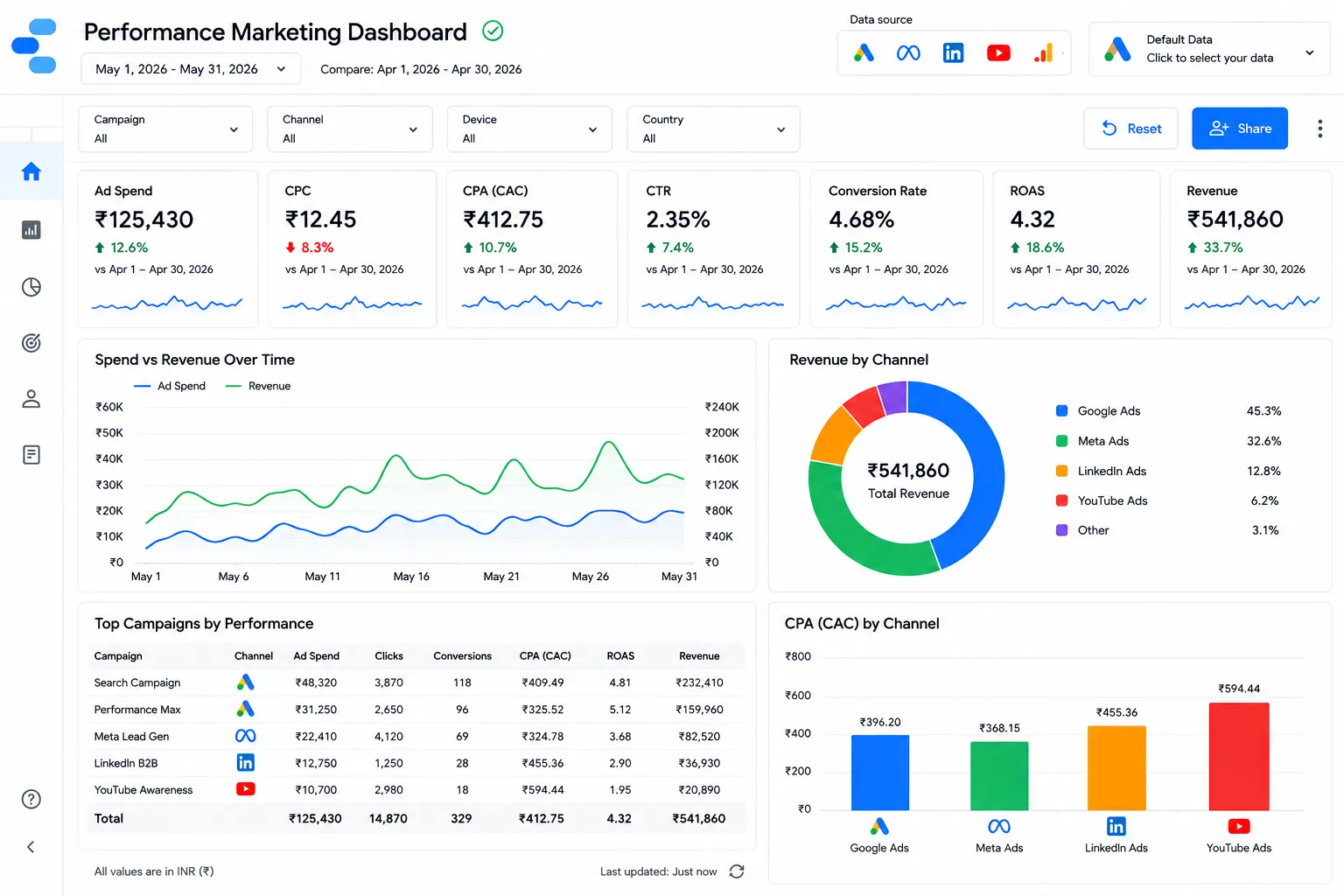
Managing your advertising budget becomes much easier when you use the right tools. These tools help you estimate costs, monitor campaign performance, track conversions, and make data-driven decisions.
Tool | Purpose |
|---|---|
Estimates keyword search volume, CPC, and helps plan Google Ads budgets. | |
Tracks website traffic, user behavior, and conversions to measure campaign performance. | |
Meta Ads Manager | Creates, manages, and optimizes Facebook and Instagram advertising campaigns. |
Looker Studio | Builds interactive dashboards to visualize advertising performance and marketing data in one place. |
Google Sheets / Microsoft Excel | Helps create advertising budget plans, forecast spending, and calculate marketing metrics. |
HubSpot | Tracks leads, customer journeys, and marketing performance to measure campaign effectiveness. |
Quick Tip
Review your advertising reports regularly instead of waiting until the end of the month.
Frequently Asked Questions (FAQs)
Q1. How much should a business spend on paid advertising ?
Your advertising budget should be based on your business goals, target audience, and expected ROI rather than a fixed amount.
Q2. How do I calculate the right paid advertising budget ?
Start with your business goal, estimate your conversion rate and cost per click (CPC), then calculate the budget needed to achieve your target.
Q3. Which platform is best for performance marketing ?
The best platform depends on your goals , Google Ads works well for search intent, while Meta Ads are ideal for brand awareness and customer engagement.
Q4. How often should I review my advertising budget ?
Review your campaign performance weekly and make budget adjustments monthly based on metrics like ROAS, CPA, and conversions.
Q5. What are the most common paid advertising budgeting mistakes ?
Common mistakes include setting unclear goals, overspending too quickly, ignoring campaign data, and focusing on clicks instead of conversions.
Key takeaways
Define clear business goals before deciding your advertising budget to ensure every campaign has a measurable purpose.
Base your budget on data, using metrics like Customer Acquisition Cost (CAC), Customer Lifetime Value (LTV), Average Order Value (AOV), and Return on Ad Spend (ROAS).
Choose the right budgeting method based on your business size, goals, and growth stage instead of relying on guesswork.
Allocate your budget strategically across advertising channels based on their performance and your target audience.
Track key performance metrics such as ROAS, ROI, CPA, CPC, CTR, and Conversion Rate to measure campaign success.
Avoid common budgeting mistakes, including overspending too quickly, ignoring campaign data, and focusing on vanity metrics.
Optimize your campaigns regularly by testing creatives, refining audience targeting, and improving landing pages to maximize ROI.
Treat your advertising budget as an investment, not an expense, and make data-driven decisions to achieve sustainable business growth.
Conclusion
Setting a paid advertising budget is more than deciding how much money to spend—it's about investing strategically to achieve your business goals. By considering factors like your target audience, business objectives, CAC, LTV, and ROAS, you can create a budget that delivers measurable results while minimizing wasted ad spend.
Instead of increasing your digital advertising budget, focus on improving campaign performance through continuous optimization and data-driven decisions.
Remember, performance marketing is an ongoing process of testing, tracking, and optimizing. Start with a realistic budget, monitor your campaign performance regularly, and make data-driven adjustments as you learn what works best. With the right strategy, your advertising budget can become a powerful investment that drives sustainable business growth and long-term success.
Ready to grow with AI-powered marketing?
Book a free 30-minute strategy call with the Arena Infosolution team.
About the author
Arena Performance Marketing Team — A team of performance marketing specialists at Arena Infosolution with expertise in paid advertising, campaign optimization, conversion tracking, marketing analytics, and ROI-driven growth strategies. The team creates research-backed, actionable content that helps businesses set smarter advertising budgets, optimize campaign performance, maximize return on investment, and achieve sustainable digital growth through data-driven performance marketing.
Get a free growth consultation
Tell us what you're working on and a senior strategist will map your next move.