AI Marketing Tools 2026: Best Picks, Comparison & Complete Guide
Explore the top AI marketing tools for 2026, including tools for content creation, email marketing, social media management, marketing automation, and more. This guide compares their key features, use cases, pricing, and benefits to help businesses and marketers choose the right AI tools for their marketing needs.
Introduction
AI has become an important part of modern marketing, helping businesses create content, understand customers, analyze data, and automate repetitive tasks. From content creation and SEO research to social media management and email automation, AI marketing tools can help teams work faster and make more informed decisions.
However, choosing the right tool can be difficult because there are hundreds of options with different features, pricing, and use cases. The best tool depends on what you want to achieve, the size of your business, and the tasks you need to automate or improve.
In this guide, we'll explore the best AI marketing tools in 2026, their key use cases, and how to choose the right tools for your marketing workflow.
This guide covers the best AI marketing tools 2026, including AI marketing software comparison for content creation, email marketing, social media automation, and pricing details.
TABLE OF CONTENTS
Introduction
What Are AI Marketing Tools?
How AI Tools Are Changing Marketing
Top 10 AI Tools for Marketing
AI Tools for Content Creation
AI Tools for SEO and Research
AI Tools for Social Media Marketing
AI Tools for Design and Creative Work
AI Tools for Email and Marketing Automation
How to Choose the Right AI Marketing Tool
AI Marketing Tools for Small Businesses
Key Takeaways
Frequently Asked Questions
Conclusion
About the Author
What Are AI Marketing Tools?
In this guide, we'll explore the best AI marketing tools 2026 has to offer, comparing features, pricing, and real use cases for content creation, email, and social media.
AI marketing tools are software platforms that use artificial intelligence—machine learning, natural language processing, and generative AI—to automate and enhance marketing tasks like content creation, campaign management, analytics, and personalization at scale.
AI marketing tools refer to software platforms that leverage artificial intelligence—particularly machine learning, natural language processing (NLP), and generative AI—to automate, optimize, and enhance marketing tasks that traditionally required significant human effort. These tools span content creation, campaign management, data analytics, customer segmentation, email automation, and social media scheduling.
Unlike traditional marketing software that simply digitizes manual processes, AI marketing tools actively learn from data patterns to make predictions and generate creative assets. For example, while a standard email platform lets you schedule campaigns, an AI-powered version determines optimal send times per recipient and generates personalized copy at scale.
Aspect | Traditional Tools | AI Marketing Tools |
|---|---|---|
Content creation | Manual writing/design | AI-generated drafts + human refinement |
Personalization | Basic segmentation | Individual-level targeting |
Analytics | Past data reports | Predictive insights |
Scaling | Limited by team size | Near-unlimited output |
Adoption has hit an inflection point. According to Jasper's 2026 State of AI in Marketing report, 91% of marketers now actively use AI, up from 63% in 2025. IBM's Global AI Adoption Index places worldwide AI marketing adoption at 76%, up from just 29% in 2021.
Key Takeaways
AI marketing tools can handle creative tasks like writing, design, and video.
They use performance data to improve marketing results.
AI is more than just automation—it can support strategic marketing decisions.
The focus should be on using AI strategically, not simply adopting more tools.
How AI Tools Are Changing Marketing
AI tools are transforming marketing by cutting content production time by 50-70%, enabling hyper-personalization at scale, predicting campaign performance before launch, and automating routine tasks so marketers can focus on strategy.
Marketing has fundamentally shifted in just two years. In 2024, most teams used AI sporadically for basic tasks like rewriting emails or generating social captions. By 2026, AI sits at the core of how marketing operates.
Speed and Scale
The most immediate impact is production velocity. HubSpot's AI Trends 2026 report shows marketers save 6.1 hours per week on average using AI tools. For a 5-person marketing team, that's 150+ hours monthly redirected toward strategy rather than repetitive execution.
Content volume has exploded too. The percentage of AI-written pages in Google's top search results grew from 2.27% in 2019 to 17.31% in 2025, according to Semrush research. AI isn't replacing human writers—it's letting one marketer produce what previously required a small team.
Personalization at Individual Level
Traditional marketing segmented audiences into broad categories. AI tools analyze individual behavior patterns to tailor messaging per person. Salesforce's State of Marketing data reveals 87% of enterprise teams now use AI for real-time personalization, up from 34% in 2023.
Email open rates have jumped accordingly. Adobe Digital Insights found AI-referred visitors show 33% lower bounce rates and stay 45% longer on-site compared to traditional search traffic.
Predictive Capabilities
AI doesn't just execute it predicts. Tools now forecast which content themes will resonate, identify high-value customer segments before they convert, and recommend budget allocation across channels. This shift from reactive reporting to proactive guidance is arguably the biggest change.
Traditional Marketing | AI-Powered Marketing |
|---|---|
Campaign analysis after launch | Performance prediction before launch |
Manual A/B testing | Automatic optimization in real time |
Broad audience segments | Individual-level targeting |
Historical reports | Actionable recommendations |
Expert tip
Use AI to handle data analysis and repetitive content work, but keep strategic decisions with your marketing team. This allows marketers to spend more time on strategy, creativity, and revenue-focused decisions.
Top 10 AI Tools for Marketing
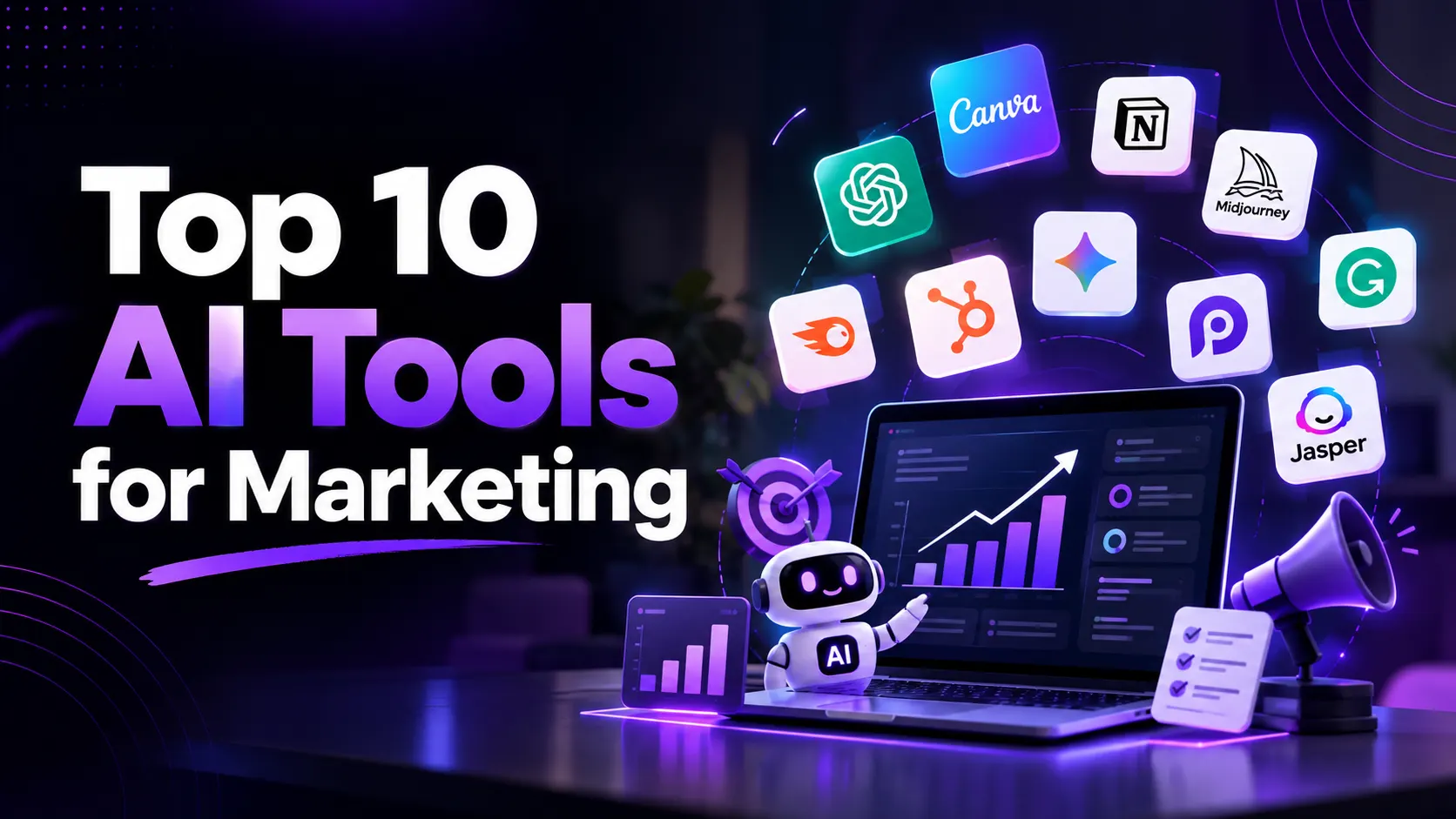
The top AI marketing tools in 2026 include Jasper AI (copywriting), HubSpot (all-in-one platform), Canva (visual design), Copy.ai (social content), Grammarly (editing), Surfer SEO (content optimization), Mailchimp (email automation), Buffer (social media), Zapier (workflow automation), and Synthesia (AI video). Selection depends on your specific bottleneck—ideas, drafting, production, or distribution.
Not all AI marketing tools serve the same purpose. Below are the most impactful options based on adoption rates, feature depth, and user satisfaction in 2026:
When evaluating AI marketing tools pricing and AI marketing platforms review data, these ten stand out for functionality and ROI.
1. Jasper AI — Marketing Copy & Content Generation
Over 350,000 users rely on Jasper for blog posts, email campaigns, and ad copy. Its strength is brand voice consistency across large content volumes. Best for teams producing high-frequency written content.
Best For: Long-form content, brand voice consistency
2. HubSpot — All-in-One Marketing Assistant
Built-in AI covers email creation, social posting, and strategy. Ideal for companies wanting one platform instead of multiple disconnected tools.
Best For: Complete CRM + marketing stack integration
3. Copy.ai — Social Media & Go-To-Market Content
Advanced drafting wizard with strong knowledge-sharing features. Great for startups needing rapid content across multiple channels.
Best For: Social posts, quick turnaround campaigns
4. Grammarly — Content Editing & Tone Adjustment
Beyond spell-check, it refines tone and clarity. Essential for maintaining professional standards at scale.
Best For: Polishing drafts, team-wide quality control
5. Surfer SEO — Search Engine Optimization
Real-time content scoring and keyword optimization. Helps pages rank higher in traditional search while remaining GEO-friendly.
Best For: SEO-driven content, ranking-focused teams
6. Canva — AI Visual Design
Magic Design creates graphics from text prompts. Non-designers can produce on-brand visuals instantly.
Best For: Social graphics, presentations, simple videos
7. Mailchimp — Email Marketing Automation
AI optimizes send times, subject lines, and segmentation. Handles personalization without manual effort.
Best For: Email campaigns, automated nurture sequences
8. Buffer — Social Media Management
Tailors posts for each platform automatically. Includes analytics and scheduling in one dashboard.
Best For: Multi-channel social posting, smaller teams
9. Zapier — Workflow Automation
Connects 5,000+ apps. Triggers actions across tools without coding—like auto-posting new blogs to social channels.
Best For: Integration between existing tools, reducing manual work
10. Synthesia — AI Video Generation
Creates videos with AI avatars and voiceovers. No camera or studio needed. Used by 34,000+ companies including Nike and Amazon.
Best For: Training videos, explainer content, multilingual versions
Tool Type | Top Choice | Starting Price |
|---|---|---|
Copywriting | Jasper AI | $49/month |
All-in-One | HubSpot | Free tier available |
Social Media | Buffer | $6/month |
Mailchimp | $13/month | |
Visuals | Canva | Free / $12.99/month |
Video | Synthesia | $22/month |
Expert tip
Start with 2-3 tools that solve your biggest bottlenecks. Most marketers find that 91% of AI adoption happens within the first quarter—but spreading purchases too thin reduces ROI.
AI Tools for Content Creation
AI writing tools have become core infrastructure for content teams in 2026 — 67% of marketing teams now use them actively.
Tool | Best For | Starting Price | Free Plan |
|---|---|---|---|
Writesonic | SEO blogs, fact-checked articles | $16/month | ✅ 10K words |
Short-form copy, GTM workflows | $29/month | ✅ 2K words | |
Jasper | Brand voice, team collaboration | $39–49/month | ❌ 7-day trial |
Writesonic — Built-in SEO + fact-checking, best ROI for bloggers.
Copy.ai — 90+ templates, Workflows automation, perfect for sales.
Jasper — Best brand voice memory, ideal for teams (but expensive).
Expert tip
Solo creators → Writesonic ($16/month). Small business → Start with Copy.ai Free. Marketing teams → Jasper.
AI Tools for SEO and Research
AI-powered SEO tools make it easier to find relevant keywords, understand search intent, analyze competitors, and identify content opportunities. Instead of spending hours going through search results and spreadsheets, marketers can use these tools to turn SEO research into a faster, more structured process.
Some useful options include:
Semrush: Useful for keyword research, competitor analysis, site audits, and tracking search performance.
Ahrefs: Strong for keyword research, backlink analysis, competitor research, and finding content opportunities.
Surfer SEO: Helps optimize content by comparing it with pages already performing well in search results.
Frase: Useful for researching search results, building content briefs, and identifying important questions and topics to cover.
These tools are particularly valuable when planning content because they help marketers understand what people are searching for, what competing pages cover, and where useful content gaps may exist.
Expert tip
Don't blindly follow AI-generated keyword or content suggestions. Use them as research inputs, then validate the search intent and usefulness of the topic before creating content.
AI Tools for Social Media Marketing
AI social media management tools have transformed how teams handle posting, with Buffer, ContentStudio, and Predis.ai leading adoption in 2026.
Social media management is one of AI's biggest wins. According to Ascend2's 2025 research, 35% of marketers now use AI specifically for social media management and ad targeting third only to content creation (37%) and email optimization (36%).
Time Savings & Efficiency
Manual social posting eats hours weekly. AI tools change that equation:
Buffer tailors posts per platform automatically—what works on LinkedIn may fail on TikTok
FeedHive scans your post history and resurfaces high performers for recycling
ContentStudio tracks trending topics and influencer activity in your niche
The impact? Teams report 5-7 hours saved per week on content scheduling alone.
Content Generation at Scale
Creating unique visuals and copy for 5+ platforms used to require a designer and copywriter. Now AI handles it:
Tool | Best Feature | Starting Price |
|---|---|---|
Creates text + images + video in one workflow | $19/month | |
Buffer | Multi-channel scheduling with AI suggestions | $6/month |
ContentStudio | Topic monitoring + sentiment analysis | $19/month |
FeedHive | Auto-recycles top-performing posts | $15/month |
SocialPilot | Bulk schedules 500+ posts at once | $30/month |
Trend Detection & Engagement
AI doesn't just post—it listens. Tools like Brand24 monitor brand mentions across web and social, alerting you to PR crises or viral moments in real-time. Sprout Social uses AI to recommend response times and message tone based on engagement history.
Video Content Boom
Video AI saw 340% usage growth between 2025-2026 (Wistia State of Video). HeyGen creates avatar-led videos without cameras, while Runway generates short clips from text prompts—perfect for Reels, Shorts, and Stories.
AI Tools for Design and Creative Work
Leading AI design tools in 2026 include Canva (all-in-one visual creation), Adobe Firefly (generative fill + text effects), Midjourney (high-quality image generation), DALL-E 3 (precise text rendering), Leonardo.ai (asset production), and Remove.bg (instant background removal). These tools generate images from prompts, expand existing visuals, remove backgrounds automatically, and create brand-consistent designs without professional software skills.
Design work has undergone the biggest transformation of any marketing function. Before AI, creating a social banner required Photoshop expertise, multiple revision cycles, and hours of manual adjustment. Now the same output takes minutes with AI assistance.
Adobe's Creative Cloud data shows 73% of designers now use generative AI tools weekly, up from 19% in 2023. The impact isn't about replacing designers—it's about eliminating tedious tasks like background removal, color matching, and layout iteration so creatives can focus on strategy and concept.
Before | After |
|---|---|
Background Removal: 15–30 minutes per image | Background Removal: Around 3 seconds per image |
Social Banner Creation: 2–3 hours | Social Banner Creation: 10–15 minutes |
Logo Variations: 4–6 hours | Logo Variations: Around 20 minutes |
Product Mockups: 3–4 hours | Product Mockups: Around 5 minutes |
Tools like Remove.bg process images in under 5 seconds versus 20+ minutes manually. Canva's Magic Design generates complete social templates from a single prompt with on-brand colors and fonts pre-applied.
Quality Considerations
While speed is impressive, quality varies by use case. Midjourney v6 produces photorealistic imagery that rivals professional photography, but struggles with consistent branding elements. Adobe Firefly excels at integration with existing Adobe workflows, though output resolution caps at 15MP in standard plans.
One concern emerged from Semrush's 2025 analysis: purely AI-generated images rank in top positions just 9% of the time, while human-curated AI content ranks high in 80% of cases. This confirms AI works best as augmentation—not replacement—for creative teams.
42% marketers report advanced AI use
3.5× more likely to outperform CAC targets
96% meet or exceed MQL targets
AI Tools for Email and Marketing Automation
AI-powered email and automation tools help marketers create personalized campaigns, segment audiences, automate follow-ups, and optimize email timing. Leading AI marketing automation tools and AI tools for email marketing include Mailchimp, Hoppy Copy, and seventh Sense for send-time optimization.
Some useful options include:
Mailchimp: AI-assisted email creation, audience segmentation, and campaign automation.
HubSpot: Combines AI-powered marketing automation with CRM, email, and customer data.
Brevo: Useful for automated email campaigns, personalization, and customer journeys.
ActiveCampaign: Focuses on email automation, segmentation, and personalized customer journeys.
Best for: Businesses that want to automate repetitive marketing tasks while keeping customer communication personalized.
Expert tip
Automate repetitive workflows, but keep important customer-facing messages human-reviewed. Automation should improve consistency, not make every interaction feel automated.
How to Choose the Right AI Marketing Tool
The right AI marketing tool depends on your specific marketing goal, workflow, budget, and team size. Start by identifying the task you want to improve—such as content creation, SEO research, social media, design, email marketing, or automation.
Before choosing a tool, consider:
Features: Does it solve the problem you actually have?
Integrations: Can it work with the platforms your team already uses?
Ease of use: Will your team be able to adopt it without a steep learning curve?
Pricing: Does the cost make sense for your current usage and business size?
Scalability: Can the tool support you as your marketing needs grow?
Avoid choosing multiple tools simply because they offer AI features. Start with 2–3 tools that solve your biggest bottlenecks, measure their impact, and expand your toolkit only when there is a clear need.
AI Marketing Tools for Small Businesses
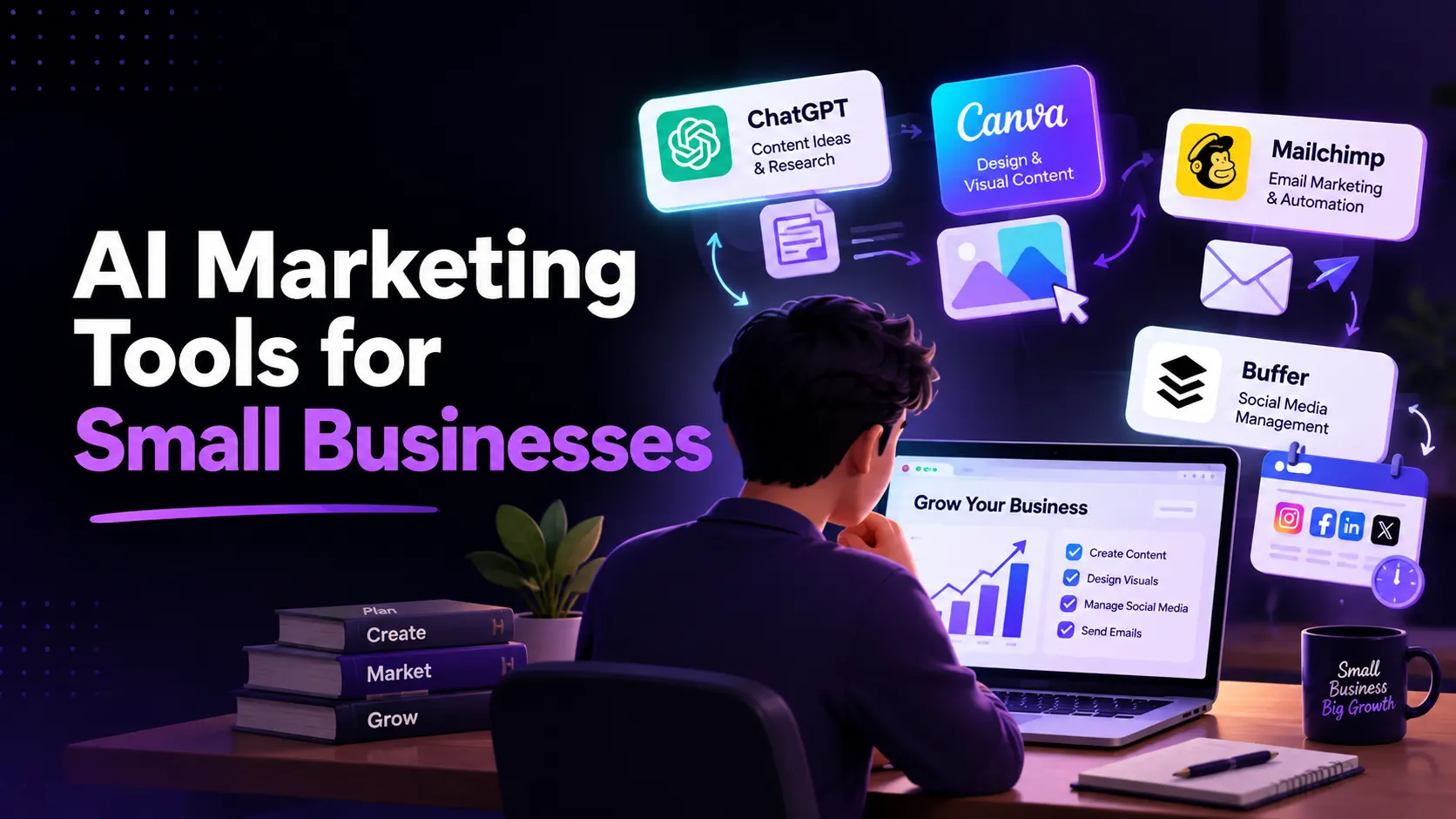
Small businesses usually need tools that are affordable, easy to use, and capable of handling multiple marketing tasks. Instead of investing in a large stack, start with tools that solve your most important bottlenecks.
For example, Canva can support design and visual content, ChatGPT can help with content ideas and research, while Mailchimp or Buffer can simplify email and social media management.
The best approach is to start with 2–3 tools, use them consistently, and add more only when a specific marketing need arises. This keeps costs manageable and prevents teams from paying for overlapping features.
Key takeaways
AI marketing tools can speed up content creation, SEO research, social media, design, email, and automation.
Choose tools based on your specific marketing needs, not just popularity.
Start with 2–3 tools that solve your biggest bottlenecks.
Use AI to improve efficiency, but keep human strategy, creativity, and review in the workflow.
Avoid paying for multiple tools with overlapping features.
Frequently Asked Questions
What are AI marketing tools used for?
AI marketing tools can help with content creation, SEO research, social media management, email marketing, design, customer analysis, and repetitive marketing tasks.
Are AI marketing tools useful for small businesses?
Yes. Small businesses can use affordable AI tools to handle routine marketing work faster without needing a large marketing team.
How many AI marketing tools should a business use?
There is no fixed number. Start with 2–3 tools that solve your biggest problems and add more only when a genuine need arises.
Can AI marketing tools replace marketing teams?
Not completely. AI can automate repetitive tasks and assist with research and content, but strategy, creativity, decision-making, and understanding customers still require human input.
Are free AI marketing tools enough for beginners?
They can be enough to get started. Free plans are useful for testing workflows, while paid tools become more valuable when you need advanced features, higher usage limits, or team collaboration.
How do I choose the right AI marketing tool?
Start with the specific problem you want to solve, then compare the tool's features, integrations, ease of use, pricing, and scalability before making a decision.
Conclusion
AI marketing tools can help businesses create content faster, simplify research, automate repetitive tasks, and improve marketing workflows. But using more tools does not automatically mean better results.
The right approach is to identify your biggest marketing bottlenecks, choose a few tools that solve them, and combine AI with human strategy and creativity. As AI continues to evolve, businesses that use these tools thoughtfully can improve efficiency without losing the human side of marketing.
About the author
Arena Infosolution is a digital marketing agency helping businesses build stronger online visibility through SEO, GEO, AEO, performance marketing, and digital growth strategies. The team focuses on practical, results-driven marketing solutions that help businesses attract the right audience and grow online.
Want this done for your business?
Get a free growth consultation
Tell us what you're working on and a senior strategist will map your next move.