Performance Marketing or Digital Marketing: Which Approach Delivers Better ROI?
Digital marketing builds long-term visibility, while performance marketing focuses on measurable results. Using both together can help businesses achieve sustainable and trackable growth.
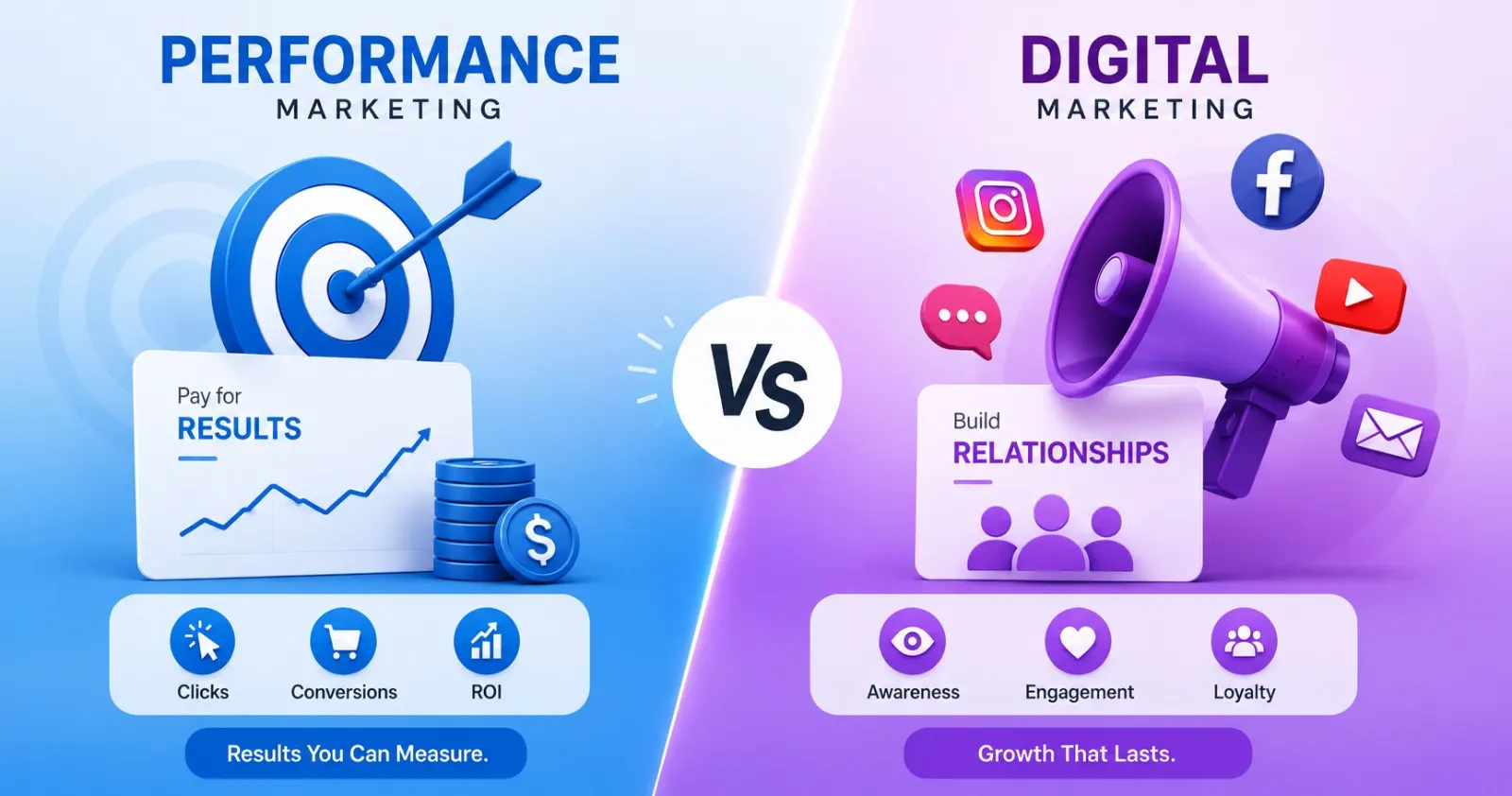
Understand the real difference between Performance Marketing and Digital Marketing.
Learn how their goals, channels, strategies, and metrics differ—and where they overlap. By the end, you’ll know which approach is right for your business goals and how both can work together to drive growth.
Introduction
Digital marketing has become an essential part of how businesses attract, engage, and convert customers online. But when businesses explore different marketing strategies, two terms often create confusion: digital marketing and performance marketing. Understanding Performance Marketing vs Digital Marketing can help businesses choose the right strategy based on their goals, audience, budget, and expected outcomes.
Digital marketing is a broad approach that includes channels such as SEO, social media, content marketing, email marketing, and online advertising. Performance marketing, on the other hand, focuses more strongly on measurable results such as leads, sales, conversions, and return on advertising spend.
In this guide, we’ll break down both approaches, compare their key differences, explain how they work together, and help you understand which approach may be right for your business.
AI summary
Digital marketing focuses on building online visibility, awareness, engagement, and long-term growth, while performance marketing focuses more directly on measurable results and return on investment (ROI). Businesses often use both together to attract the right audience, build trust, generate leads, and increase sales.
What's inside
What Is Digital Marketing?
What Is Performance marketing?
Performance Marketing vs Digital Marketing: Comparison Table
How Performance Marketing Fits Into Digital Marketing
Digital Marketing Channels vs Performance Marketing Channels
Performance Marketing Metrics You Should Know
Real-World Example: Digital Marketing vs Performance Marketing
Which Is Better for Your Business?
How to Build a Strategy Using Both Approaches
Common Mistakes Businesses Should Avoid
What Is Digital Marketing?
Digital marketing is the process of promoting a business, product, or service through online channels to reach and engage with a target audience. It helps businesses build awareness, attract potential customers, communicate with their audience, and generate leads or sales through digital platforms.
Unlike traditional marketing, which relies on channels such as newspapers, television, radio, and billboards, digital marketing uses platforms where people spend their time online. These include search engines, social media, websites, email, online advertising, and content platforms.
For example, when someone searches for “best digital marketing course in Jaipur” on Google and finds a useful blog, sees an Instagram post from an institute, or clicks on a Google ad, these can all be part of a digital marketing strategy.
What Is Performance Marketing?
Performance marketing is a results-driven form of digital marketing where businesses focus on measurable actions such as clicks, leads, app installs, or sales. Instead of only focusing on how many people see an advertisement, performance marketing looks at what users actually do after interacting with a campaign.
The main idea is simple: spend money on marketing, measure the results, and optimize the campaign to improve performance.
For example, an online education company may run a Meta Ads campaign to generate course enquiries. If the campaign brings 100 leads from a specific budget, the business can measure the cost per lead (CPL) and determine whether the campaign is generating valuable results.
Performance marketing is commonly used when a business has a clear and measurable goal, such as:
Generating leads
Increasing online sales
Getting website conversions
Driving app installs
Increasing registrations
Acquiring new customers
Performance Marketing vs Digital Marketing: Comparison Table
The easiest way to understand the difference is to compare both approaches based on their purpose, scope, measurement, and typical use cases.
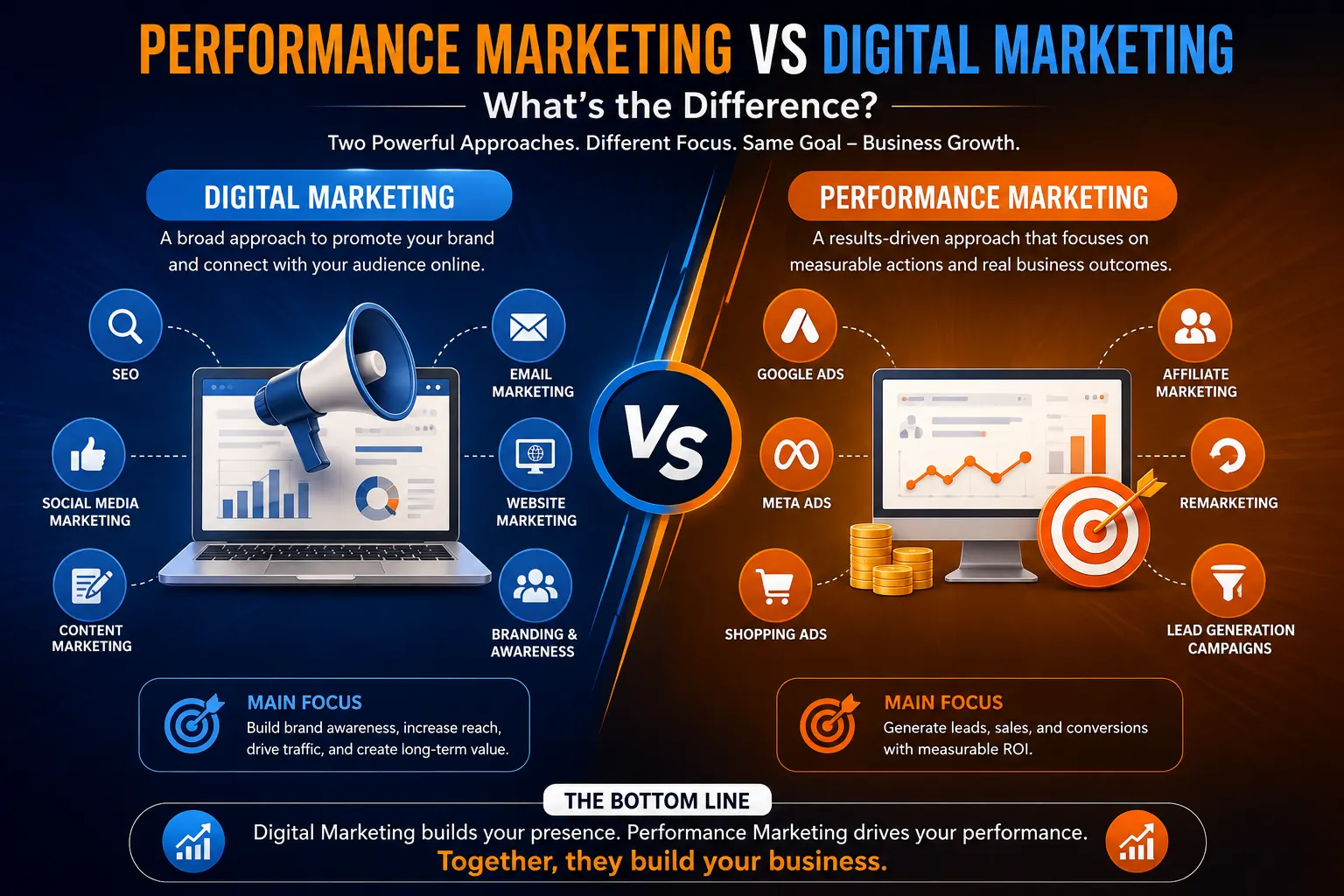
Factor | Digital Marketing | Performance Marketing |
|---|---|---|
Definition | Marketing a business through digital channels to reach and engage an online audience. | A results-focused approach that emphasizes measurable actions and conversions. |
Scope | Broad and includes SEO, content, social media, email, PPC, affiliate marketing, and more. | More focused on campaigns designed around measurable outcomes such as leads, sales, or conversions. |
Main Goal | Build awareness, visibility, engagement, trust, leads, and long-term growth. | Generate measurable actions such as leads, sales, registrations, or acquisitions. |
Payment Model | Can involve both paid and organic activities. | Commonly associated with paid campaigns and outcome-focused spending, depending on the channel. |
Time Focus | Often includes both short-term and long-term strategies. | Usually more focused on measurable results within a defined campaign period. |
Measurement | May measure traffic, rankings, engagement, reach, leads, and sales. | Strong focus on conversions, acquisition costs, revenue, and return on investment. |
Key Metrics | Organic traffic, rankings, engagement, reach, leads, conversions, and website traffic. | CPC, CPL, CPA, CTR, conversion rate, CAC, and ROAS. |
Budget Control | Budget may be spread across multiple activities and channels. | Campaign budgets can be adjusted based on performance and conversion data. |
Optimization | Content, SEO, website, social media, and campaigns can be improved over time. | Ads, audiences, keywords, landing pages, and budgets are frequently optimized based on results. |
Example | Publishing SEO blogs to increase organic visibility and build authority. | Running Meta Ads to generate course enquiries at a target cost per lead. |
How Performance Marketing Fits Into a Digital Marketing Strategy
Performance marketing works as a focused part of a broader digital marketing strategy. While digital marketing covers different activities such as SEO, content marketing, social media, email marketing, and paid advertising, performance marketing focuses more strongly on measurable actions and business outcomes.
For example, a business may use SEO and content marketing to build long-term organic visibility while using Google Ads or social media advertising to generate immediate traffic and leads. The performance marketing campaigns can then be measured through metrics such as clicks, leads, conversions, and cost per acquisition.
This combination allows businesses to work toward both short-term and long-term goals.
Example
Imagine a digital marketing institute wants to increase student admissions.
SEO: Creates helpful blogs to attract students searching for digital marketing courses.
Social Media Marketing: Builds awareness and engages potential students.
Content Marketing: Shares career guides, tips, and educational content.
Performance Marketing: Runs paid campaigns specifically to generate enquiries and admissions.
Analytics: Measures which campaigns are generating the best results.
This shows that digital marketing builds the overall online presence, while performance marketing can focus on driving and measuring specific actions.
Why Combining Both Can Be Effective
Using both approaches can help businesses avoid depending on only one marketing channel. Long-term activities such as SEO can build sustainable visibility, while performance campaigns can help generate measurable results within a shorter period.
The best strategy depends on the business's goals, audience, budget, industry, and expected results. In many cases, performance marketing and digital marketing work better together rather than as competing strategies.
Practical Case Study: Using Performance Marketing and Digital Marketing Together
Imagine an online digital marketing institute that wants to increase student admissions. It needs two things: quick leads for the upcoming batch and long-term visibility for the brand. This is where performance marketing and digital marketing can work together.
Step 1: Using Performance Marketing for Quick Results
The institute can run paid campaigns on platforms such as Google Ads and Meta Ads to reach people who are actively interested in digital marketing courses.
For example, the campaign could target:
College students looking for career-focused courses
Fresh graduates searching for job-oriented skills
Working professionals interested in career growth
People searching for digital marketing courses
The ads can direct users to a course landing page with a clear “Enquire Now” or “Book a Free Counselling Session” button.
The institute can then track important performance metrics such as:
Number of leads
Cost per lead (CPL)
Click-through rate (CTR)
Conversion rate
Cost per acquisition (CPA)
Return on ad spend (ROAS), where applicable
The main goal is to generate measurable actions such as leads, enquiries, or admissions.
Step 2: Using Digital Marketing for Long-Term Growth
At the same time, the institute can use broader digital marketing activities to build its online presence.
It could publish helpful blogs such as:
“What Is Digital Marketing and Why Is It Important?”
“Best Digital Marketing Skills to Learn in 2026”
“Digital Marketing Career Opportunities for Freshers”
The institute can also use SEO, social media marketing, email marketing, video content, and other channels to reach and educate its audience.
These activities may not generate an immediate admission from every visitor, but they can help the business build visibility, trust, audience engagement, and long-term organic traffic.
Step 3: Combining Both Approaches
The strongest strategy is often to use both approaches together.
For example, a student may first discover the institute through a Google search or educational blog. Later, the same student may see a Meta advertisement for the upcoming batch. After visiting the website and comparing the course details, the student may finally submit an enquiry.
Here, digital marketing helps the institute build awareness and trust, while performance marketing helps it drive and measure specific actions.
The Result
This example shows that the two approaches do not necessarily compete with each other.
Performance marketing focuses strongly on measurable actions and conversions, while digital marketing covers a broader range of activities that can support awareness, engagement, customer relationships, and long-term growth.
For many businesses, combining both can create a more balanced marketing strategy: performance marketing can support immediate campaigns, while broader digital marketing activities build a foundation for sustainable growth.
Which Should You Choose: Performance Marketing or Digital Marketing?
The right choice depends on your business goals, budget, and how quickly you want to see results. Here are some simple situations to help you decide.
Choose Performance Marketing If:
You need quick leads or sales
If your main goal is to generate leads, enquiries, app installs, or sales in a short period, performance marketing can be a suitable option.
You want to track every campaign result
Performance marketing allows you to monitor metrics such as clicks, conversions, cost per lead, CPA, and ROAS.
You are launching a new offer or promotion
If you have a limited-time discount, new product, or upcoming course admission, paid performance campaigns can help you reach your target audience quickly.
You have a specific conversion goal
If your campaign has a clear goal such as “Generate 100 qualified leads” or “Increase online sales,” performance marketing can be useful.
Choose Digital Marketing If:
You want to build your brand
If your goal is to increase brand awareness and establish your business online, digital marketing provides a broader approach.
You want long-term organic growth
SEO, content marketing, social media, and other digital activities can help you build visibility and relationships over time.
You want to educate your audience
Blogs, videos, social media posts, and other content can help potential customers understand your products or services before making a decision.
You want to build customer trust
Consistent content, useful information, social engagement, and a strong online presence can help develop trust with your audience.
Choose Both If:
You want immediate results and long-term growth
For many businesses, the best approach is not choosing one over the other. Performance marketing can support immediate lead generation and sales, while digital marketing can build brand visibility, trust, and long-term growth.
Simple Example:
A digital marketing institute can use Google Ads and Meta Ads to generate enquiries for its upcoming batch while using SEO, blogs, social media, and video content to attract and educate potential students over the long term.
Quick Decision Guide
Your Goal | Better Approach |
|---|---|
Generate leads quickly | Performance Marketing |
Increase online sales | Performance Marketing |
Promote a limited-time offer | Performance Marketing |
Build brand awareness | Digital Marketing |
Improve organic visibility | Digital Marketing |
Educate your audience | Digital Marketing |
Build long-term online presence | Digital Marketing |
Get quick results + long-term growth | Use Both |
The key takeaway: Performance marketing is strongly focused on measurable actions and conversions, while digital marketing takes a broader approach to building online visibility and customer relationships. In many cases, combining both creates a more complete marketing strategy.
How Performance Marketing Fits Into Digital Marketing
Performance marketing is not separate from digital marketing—it is one part of the larger digital marketing strategy. Digital marketing covers many activities used to build awareness, attract audiences, engage customers, and grow a brand online. Performance marketing focuses more specifically on measurable actions and results, such as clicks, leads, sales, app installs, or conversions.
For example, a business may use SEO and social media to build long-term visibility, while using Google Ads or Meta Ads to generate leads quickly. The performance marketing activities can then be measured using metrics such as CPC, CPL, CPA, conversion rate, and ROAS.
Digital Marketing Channels vs Performance Marketing Channels
Digital marketing uses a wide range of channels to reach and engage an audience. Performance marketing can use many of the same channels, but the key difference is how they are used and measured.
For example, SEO can be part of digital marketing when the goal is to build long-term organic visibility. In performance marketing, paid search ads may be used with a specific goal such as generating leads or sales and measuring the cost of each conversion.
Digital Marketing Channels | Performance Marketing Channels |
|---|---|
SEO | Google Ads / PPC |
Content Marketing | Meta Ads |
Social Media Marketing | Affiliate Marketing |
Email Marketing | Performance-based influencer campaigns |
Video Marketing | Retargeting Ads |
Website & Blog | Shopping Ads |
Online PR | Lead-generation campaigns |
For example, a company may use Instagram organically to build brand awareness, while using Instagram ads to generate leads and track the cost per lead (CPL). This means the same platform can support both digital marketing and performance marketing.
Performance Marketing Metrics You Should Know
Performance marketing depends heavily on data. Instead of only asking whether a campaign is getting attention, marketers look at specific metrics that show what people are doing and how much the business is spending to get those results.
Here are the key performance marketing metrics every marketer should understand:
CTR (Click-Through Rate): Shows the percentage of people who clicked an ad after seeing it.
CPC (Cost Per Click): Shows how much the advertiser pays, on average, for each click.
CPL (Cost Per Lead): Measures the average cost of generating one lead.
CPA (Cost Per Acquisition): Shows the average cost of acquiring a customer or completing a desired action.
Conversion Rate: Measures the percentage of visitors or users who complete a desired action, such as submitting a form or making a purchase.
ROAS (Return on Ad Spend): Shows how much revenue is generated for every amount spent on advertising.
ROI (Return on Investment): Measures the overall profitability of a marketing investment.
Impressions: The number of times an advertisement or piece of content is displayed.
Reach: The number of unique people who see an advertisement or campaign.
Frequency: Shows how many times, on average, the same person has seen an advertisement.
Real-World Example: Digital Marketing vs Performance Marketing
Imagine a digital marketing agency promoting an online course.
Digital Marketing: The agency uses SEO, social media, blogs, email, and videos to build brand awareness and long-term visibility.
Performance Marketing: The agency runs Google Ads and Meta Ads to generate leads or sales and measures results such as CPL, CPA, and ROAS.
In simple terms: Digital marketing focuses on the overall online presence, while performance marketing focuses on measurable results.
Which Is Better for Your Business?
Neither is always better. The right choice depends on your business goals, budget, and growth stage.
Digital Marketing: Better for long-term brand awareness, SEO, content, and customer relationships.
Performance Marketing: Better when you want measurable results such as leads, sales, or conversions quickly.
Best approach: Use both together—digital marketing for long-term growth and performance marketing for measurable short-term results.
How to Build a Strategy Using Both Approaches?
Digital marketing and performance marketing work best when used together. Digital marketing builds long-term visibility and trust, while performance marketing focuses on measurable actions such as leads, sales, and conversions.
1. Set Clear Goals
Decide what you want to achieve, such as brand awareness, website traffic, leads, sales, or registrations. Clear goals help you choose the right channels and measure success.
2. Build Your Online Presence
Use SEO, content marketing, social media, and email marketing to attract and engage your target audience. These activities help establish your brand and build long-term visibility.
3. Run Targeted Paid Campaigns
Use platforms such as Google Ads and Meta Ads to reach people who are more likely to take action. Send them to a relevant landing page with a clear call-to-action.
4. Track the Results
Monitor important metrics such as CTR, CPC, CPL, conversion rate, CPA, and ROAS. Don't focus only on clicks or leads—look at the quality of results and their business impact.
5. Optimize Regularly
Use your data to identify what is working and what needs improvement. Test different audiences, advertisements, keywords, and landing pages, then adjust your strategy accordingly.
Common Mistakes Businesses Should Avoid
When using digital and performance marketing together, businesses should avoid these common mistakes:
Not setting clear goals before starting campaigns.
Targeting the wrong audience, which can waste budget.
Focusing only on clicks instead of actual leads or sales.
Ignoring SEO and organic marketing while relying only on paid ads.
Not tracking important metrics such as CPL, CPA, conversion rate, and ROAS.
Failing to test and optimize campaigns regularly.
FAQs: Performance Marketing vs Digital Marketing
1. What is the main difference between digital marketing and performance marketing?
Digital marketing focuses on overall online growth, while performance marketing focuses on measurable results like leads, sales, and conversions.
2. Is performance marketing part of digital marketing?
Yes. Performance marketing is a results-focused part of digital marketing.
3. Which is better for quick results?
Performance marketing is usually better for generating quick, measurable results through paid campaigns.
4. Can businesses use both approaches together?
Yes. Using both can help businesses build their brand while generating measurable leads and sales.
5. Which approach is more suitable for a small business?
It depends on the goal and budget. A combination of organic digital marketing and carefully managed performance campaigns can be effective.
Key takeaways
Digital marketing focuses on overall online growth and brand visibility.
Performance marketing focuses on measurable actions like leads, sales, and conversions.
Key metrics include CTR, CPC, CPL, CPA, conversion rate, and ROAS.
Digital marketing supports long-term growth, while performance marketing can deliver faster measurable results.
The best strategy is to combine both approaches based on your business goals and budget.
Track, test, and optimize your campaigns regularly to improve results.
Conclusion
Performance marketing and digital marketing are closely connected, but they serve different purposes. Digital marketing is the broader strategy that helps businesses build visibility, engage audiences, and strengthen their online presence. Performance marketing focuses more specifically on measurable actions, such as leads, sales, clicks, and conversions.
Choosing between them depends on your business goals, budget, target audience, and expected results. For many businesses, the most effective approach is not to choose one over the other but to combine both strategies.
Use digital marketing to build a strong and lasting online presence, and use performance marketing to drive and measure specific business results. When planned together, they can create a more complete and effective digital marketing strategy.
Ready to grow with AI-powered marketing?
Book a free 30-minute strategy call with the Arena Infosolution team.
About the author
Arena Performance Marketing Team - A digital marketing team focused on helping businesses improve their online presence and achieve measurable growth. Our team works across SEO, performance marketing, social media, and other digital marketing strategies, sharing practical insights based on real-world marketing needs.
Get a free growth consultation
Tell us what you're working on and a senior strategist will map your next move.