Answer Engine Optimization (AEO): How to Get Your Business Featured in AI Answers
Learn what Answer Engine Optimization (AEO) is, how it differs from traditional SEO, and why optimizing content for AI-powered search engines is becoming essential in 2026. This guide explains the key principles, benefits, and practical strategies to improve visibility across Google AI Overviews, ChatGPT, Gemini, and other answer engines.
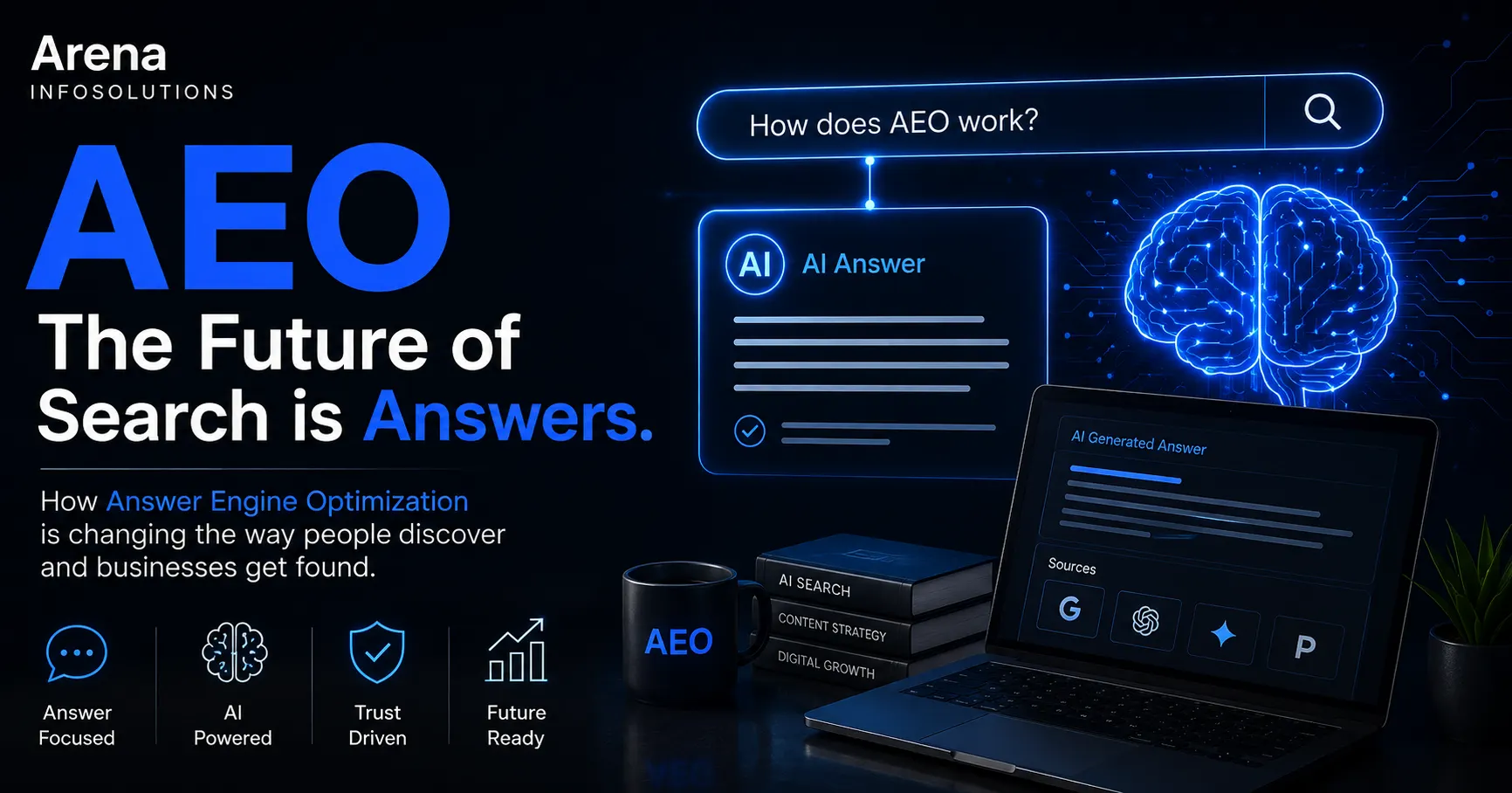
Search is no longer just about ranking on Google. It is about becoming the answer that AI systems choose to show users.
Understand how AEO works across Google AI Overviews, ChatGPT, Gemini, Claude, and Perplexity.
Learn the difference between AEO, SEO, and GEO.
Discover a practical framework to optimize content for AI-powered answer engines.
Prepare your website for the future of AI-driven search.
What's inside
What AEO actually means
Why search is changing
How answer engines work
AEO vs SEO vs GEO
AEO framework
Technical optimization
Real examples
Checklist
Future of AEO
AI summary
Answer Engine Optimization (AEO) is the process of optimizing content so AI-powered search engines and answer engines can understand, extract, and present it directly in search results. AEO focuses on clear answers, structured headings, FAQs, entities, and semantic relevance, helping businesses improve visibility across Google AI Overviews, ChatGPT, Gemini, Perplexity, and other AI search platforms.
AEO in 60 Seconds
Answer Engine Optimization (AEO) is the process of creating and structuring content so that AI-powered search systems can understand it, extract key information, and present it directly as an answer to users. Instead of optimizing only for rankings and clicks, AEO focuses on answer visibility, AI citations, and machine-readable content.
Here is what you need to know:
AEO helps your content appear in AI-generated answers, not just traditional search results.
Google AI Overviews, ChatGPT, Gemini, Claude, and Perplexity are increasing the demand for answer-ready content.
SEO and AEO work together—SEO helps search engines find your content, while AEO helps AI systems understand and present it.
Structured formatting, clear definitions, entities, schema markup, and topical authority are core elements of AEO.
Businesses that adopt AEO early can gain higher visibility, stronger brand authority, and more qualified organic traffic as AI-driven search continues to grow.
Search Has Entered a New Era
Search is moving beyond traditional lists of links. Google AI Overviews and platforms such as ChatGPT, Gemini, Claude, and Perplexity can now provide direct answers by interpreting and combining information from multiple sources.
This changes what search visibility means for businesses. Ranking is still important, but content must also be clear, trustworthy, and structured enough to be understood and referenced by AI-powered search systems.
Answer Engine Optimization helps businesses prepare for this shift by making valuable information easier to discover, understand, and use.
What Is Answer Engine Optimization (AEO)?
Answer Engine Optimization (AEO) is the practice of creating and structuring content so search engines and AI-powered answer systems can understand the information, identify the most relevant parts, and use them when generating answers to user questions.
Traditional SEO focuses heavily on helping pages appear in search results. AEO goes a step further by making information easier to interpret, extract, summarize, and reference within answer-driven search experiences.
The Simplest Way to Understand AEO
Imagine someone searches, “What is Answer Engine Optimization?”
A traditional search experience may show several articles explaining AEO. An answer engine may instead provide a direct explanation and reference information from sources it considers relevant and trustworthy.
For a website to become a useful source, its content should provide a clear answer, explain the topic accurately, demonstrate expertise, and make important information easy to identify.
How AEO Works
Answer Engine Optimization starts with understanding how answer engines work and how AI-powered search systems process information.. Instead of simply matching keywords with web pages, modern answer engines interpret content, identify relevant information, and use multiple sources to generate responses.
When a user asks a question such as “How does AEO work?”, When a user asks a question such as “How does AEO work?”, AI answer engines such as Google AI Overviews, ChatGPT, Gemini, Claude, and Perplexity may analyze information from different sources before generating a response.
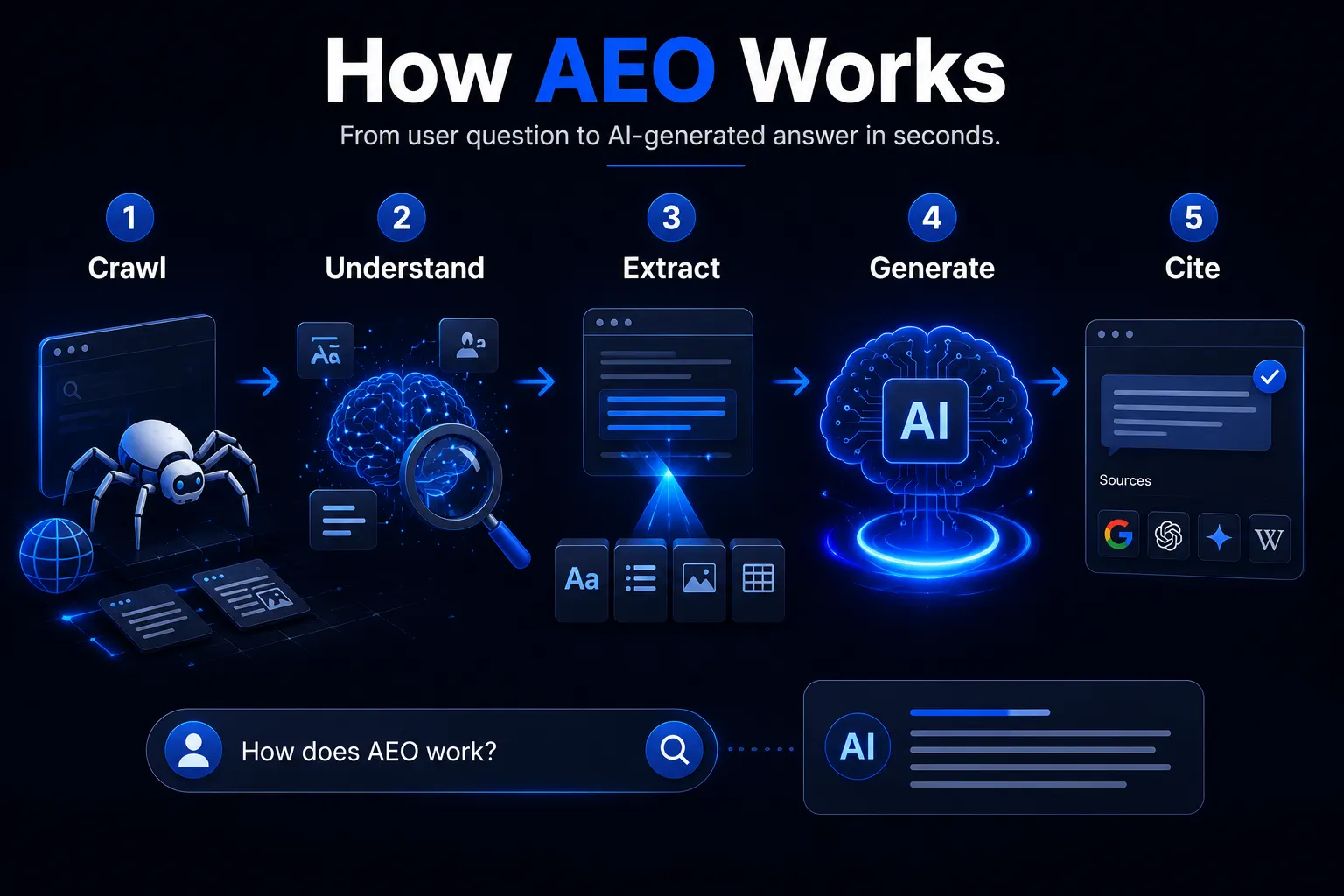
The AEO Workflow
Stage 1: Crawl
Search engines and AI systems need access to web content before it can be discovered and processed. Crawlable pages, working links, and accessible content provide the foundation.
Stage 2: Understand
Systems interpret the meaning, entities, topics, and relationships within the content to understand what the page is actually about.
Stage 3: Extract
Relevant information such as definitions, facts, explanations, lists, and comparisons can be identified and extracted from the content.
Stage 4: Generate
The system combines relevant information from available sources to generate a response that addresses the user's question.
Stage 5: Cite
When sources are referenced in an AI-generated answer, clear, authoritative, and trustworthy content has a better opportunity to be recognized as a useful source.
What Makes Content Easy to Extract?
Clear definitions, descriptive headings, short paragraphs, lists, tables, examples, and well-organized information make content easier for both people and machines to understand.
For example, starting a section with a direct definition such as “Answer Engine Optimization is…” gives the reader and AI systems an immediate understanding of the topic.
Why Structure Matters More Than Ever
Two pages can contain similar information, but the page with clearer structure, stronger context, and more trustworthy information is easier to interpret and retrieve.
AEO is therefore not simply about writing more content. It is about making valuable information clear, accessible, and easy to understand.
AEO vs SEO vs GEO: What Is the Difference?
SEO, AEO, and Generative Engine Optimization (GEO) are closely related, but they focus on different aspects of modern search visibility.
The Core Difference
Aspect | SEO | AEO | GEO |
|---|---|---|---|
Primary Goal | Rank higher in search results | Become the direct answer | Increase visibility in AI-generated search experiences |
Focus | Keywords and rankings | Questions, answers, and content structure | AI retrieval, citations, and contextual relevance |
Platforms | Google, Bing, traditional search engines | Google AI Overviews, ChatGPT, Gemini, Claude, Perplexity | AI search systems and generative search platforms |
Success Metric | Traffic and rankings | Answer visibility and AI citations | AI visibility, brand mentions, and generative discovery |
Content Style | Optimized web pages | Direct, structured, answer-ready content | Entity-rich, authoritative, AI-friendly content |
SEO: The Foundation
Search Engine Optimization focuses on improving a website's visibility in traditional search results through content quality, technical optimization, relevance, authority, and user experience.
AEO: Optimizing for Answers
Answer Engine Optimization focuses on making information clear and structured so answer engines can understand, extract, and use it when responding to user questions.
GEO: Optimizing for AI Discovery
Generative Engine Optimization focuses on improving a brand's visibility and representation within AI-generated search experiences, where systems may summarize information from multiple sources.
How They Work Together
These strategies should not be treated as competing approaches. Strong technical SEO helps search systems access content, AEO makes information easier to understand and extract, and GEO focuses on broader visibility within generative search.
The strongest strategy combines all three rather than replacing one with another.
SEO creates the foundation. AEO makes the information answer-ready. GEO expands visibility across generative search experiences.
Why AEO Matters in 2026
Search is becoming increasingly conversational. Users are no longer relying only on traditional search results; they are asking AI systems to summarize information, compare options, explain concepts, and recommend solutions.
This shift makes Answer Engine Optimization increasingly important for businesses that want to remain visible when users search through AI-powered experiences. Companies that adapt early will have a stronger chance of becoming trusted sources across AI-powered search experiences.
AI Is Changing How People Discover Information
Google AI Overviews and conversational AI platforms can provide direct answers instead of requiring users to visit multiple websites. This changes the role of content from simply attracting clicks to also becoming a reliable source of information.
Visibility Is Becoming More Than Rankings
Traditional rankings still matter, but visibility can now include being referenced, summarized, or cited within AI-generated answers. Businesses therefore need content that is useful, trustworthy, and easy for answer engines to understand.
The Arena A.N.S.W.E.R. Framework for AEO
Expert Tip
Treat every section of your content as a standalone answer. A page that can be understood without additional context is significantly more likely to appear in Google AI Overviews, ChatGPT, Gemini, Claude, Perplexity, and other AI-powered search platforms.
A — Audience Questions
Identify the real questions your audience is asking and build a question based content strategy around those needs.
N — Natural Language
Write answers in the same natural language people use when searching or asking AI.
S — Semantic Entities
Cover the important entities, concepts, relationships, and context around the topic.
W — Well-Structured Content
Use clear headings, short paragraphs, lists, tables, and structured content for AI that makes important information easy to understand and retrieve.
E — Evidence and Expertise
Support claims with credible sources, expert knowledge, original insights, examples, and trustworthy information.
R — Retrieval-Friendly Formatting
Make important information easy to find, understand, extract, and reference.
Putting the Framework into Practice
A simple way to remember the framework is:
A — Audience Questions
N — Natural Language
S — Semantic Entities
W — Well-Structured Content
E — Evidence and Expertise
R — Retrieval-Friendly Formatting
If a page follows all six principles, it becomes significantly more likely to perform well across both traditional search engines and AI-powered answer engines. The Arena A.N.S.W.E.R. Framework is not a replacement for SEO; it is a practical method for adapting SEO content to the AI-first search environment of 2026 and beyond.
Technical AEO: Making Content Easy to Understand
Technical AEO is about creating a website that search engines and AI-powered systems can crawl, interpret, and retrieve information from efficiently. Good content alone is not enough if important information is difficult to access or understand.
Keep Your Website Crawlable
Search engines need to access your pages before they can understand or index them. Make sure important pages are not accidentally blocked, internal links work correctly, XML sitemaps are available, and pages return the correct status codes.
Use Structured Data
Structured data gives search engines and AI systems additional context about what a page represents. Relevant Schema.org types such as Article, Organization, Product, and FAQPage can help describe content more clearly when implemented correctly.
Schema markup does not guarantee inclusion in AI-generated answers, but it can strengthen the machine-readable foundation of a website.
Build Clear Internal Links
Connect related pages using descriptive anchor text. Strong internal linking helps search engines discover related content and understand how individual pages fit within a broader topic.
For example, an AEO article can naturally link to related content about SEO, AI search, structured data, and GEO.
Improve Page Experience
Fast loading times, mobile usability, clean page structure, and accessible content reduce friction for both users and search systems. Technical optimization should support the content rather than distract from it.
Technical AEO Checklist
Before publishing any page, check the following:
Your checklist
Use a clear H1, H2, and H3 structure.
Write in natural, conversational language.
Add definitions for important concepts.
Use short paragraphs and descriptive headings.
Include lists and comparison tables where they improve understanding.
Add FAQs for common user questions.
Mention relevant entities such as Google AI Overviews, ChatGPT, Gemini, Claude, Perplexity, OpenAI, and Google Search Central naturally.
Answer the main question within the first few sentences.
Technical AEO is not about adding complexity. It is about removing friction between your content and the systems that need to understand it. The easier your content is to crawl, understand, and retrieve, the greater the likelihood that AI-powered answer engines will recognize it as a reliable and authoritative source.
How to Optimize Content for AEO
Answer Engine Optimization is not only about technical optimization; it is also about how businesses optimize content for AI search through clear structure, useful answers, and relevant context.
Start with the Answer, Not the Introduction
Avoid long introductions. Place the direct answer within the first few sentences of a section before expanding with additional details.
Write in Natural Language
AI systems are trained on conversational language. Instead of forcing keywords repeatedly, write the way real people ask questions.
For example:
What is AEO?
How does AEO work?
Is AEO replacing SEO?
Why does AEO matter for businesses?
This approach aligns with how users interact with Google AI Overviews, ChatGPT, Gemini, and other AI assistants.
Use Lists and Tables Strategically
Structured information is easier to extract than dense paragraphs.
Use bullet lists for:
Benefits
Features
Steps
Checklists
Best practices
Bullet lists and comparison tables make information easier to scan and extract. They are useful for explaining steps, features, and differences while supporting featured snippets optimization where appropriate.
Add Real Examples
Support important points with practical examples. A product page that includes specifications, pricing, FAQs, and shipping information is far easier for AI systems to summarize than a page containing only promotional copy.
Strengthen Entity Coverage
Mention relevant entities naturally throughout the content as part of entity based optimization, including Google AI Overviews, ChatGPT, Gemini, Claude, Perplexity, OpenAI, Google Search Central, and Schema.org.
Create Standalone Sections
Every major section of your article should be understandable even if it is read independently.
For example, the section “What Is AEO?” should make sense without requiring the reader to read the entire article first. This increases the likelihood that AI systems can extract that section as a standalone answer.
AEO Content Optimization Checklist
Before publishing, make sure the page answers the main question immediately, uses a clear heading structure, includes examples, and provides information that is easy for both humans and AI systems to understand and retrieve.
Well-optimized AEO content is not necessarily longer. It is clearer, better organized, and easier for answer engines to interpret accurately.
AEO for Different Businesses
AEO can benefit almost any business that depends on online discovery. The strategy stays the same at its core, but the questions, content formats, and customer journeys change by business type.
Ecommerce Businesses
Focus on product specifications, comparisons, FAQs, pricing information, use cases, and buying questions. For example, a skincare brand can create clear answers around ingredients, skin types, usage, and product comparisons.
SaaS Companies
SaaS brands can optimize product pages, feature documentation, integration guides, comparison pages, and troubleshooting content. Clear explanations make it easier for AI-powered search systems to understand what the product does and when it is useful.
Local Businesses
Local businesses should answer location-specific questions about services, pricing, availability, operating hours, and customer needs. Service pages and FAQs should provide direct, accurate information rather than relying only on promotional copy.
Agencies and Consultants
Agencies can build authority by answering the questions their ideal clients ask before making a decision. Detailed service guides, comparison content, case studies, and practical educational resources can demonstrate expertise while improving visibility across search and AI platforms
Common AEO Mistakes That Prevent AI Visibility
AEO is not about creating more content. It is about creating content that is clear, useful, trustworthy, and easy for answer engines to understand.
Writing Long Introductions Before Answering the Question
Do not make readers wait for the answer. Address the main question early and provide supporting context afterward.
Always answer the primary question within the first few sentences of a section, then expand with additional details.
Keyword Stuffing
Repeating AEO-related keywords unnaturally can reduce readability and does not make content more useful. Use relevant terms naturally within a clear topic.
Ignoring Structure
Large blocks of text, unclear headings, and poorly organized information make content harder to understand and extract. Use descriptive headings, short paragraphs, lists, and tables where appropriate.
Publishing Generic AI Content
AI-generated content without original expertise, evidence, examples, or useful insights adds little value. Review and improve AI-assisted content with real knowledge and human judgment.
Ignoring Trust Signals
Clear authorship, credible sources, accurate information, original research, and strong topical coverage help establish trust.
Weak Topical Authority
Publishing a single article on AEO is rarely enough.
Answer engines are more likely to trust websites that consistently publish related content such as SEO, GEO, technical optimization, AI search, structured data, and content strategy.
This is why content clusters are so important for long-term AEO performance.
Treating AEO as a Shortcut
AEO does not guarantee AI citations or visibility. It works best as part of a broader strategy that combines strong content, technical SEO, authority, structured data, and a trustworthy website.
The goal is not to manipulate answer engines. It is to make valuable information easier to understand, verify, and use.
The Future of AEO
Answer Engine Optimization is not a temporary trend. As AI becomes a larger part of how people discover and evaluate information, websites will increasingly need to become trusted sources that AI systems can understand and reference.
Users are already moving toward conversational search, making conversational search optimization increasingly relevant for businesses that want to remain visible in AI-powered search.
Several trends will shape the future of AEO:
AI-generated answers will become more common in search.
Conversational and voice-based search will continue to grow.
Entity understanding will become increasingly important.
Structured data and machine-readable content will support better interpretation.
Brand authority and topical depth will remain important trust signals.
The future of search is not only about being found. It is about being understood, trusted, and referenced. Businesses that build clear, authoritative, and answer-focused content today will be better prepared for that future.
Frequently Asked Questions
Is Answer Engine Optimization replacing SEO?
No. Answer Engine Optimization is not replacing SEO; it is extending it. SEO helps search engines discover, index, and rank your content, while AEO helps AI systems understand and present your content as a direct answer. The strongest digital strategy combines both SEO and AEO.
What is the difference between AEO and GEO?
AEO focuses on helping content become the direct answer in AI-powered search systems. GEO (Generative Engine Optimization) focuses on improving visibility across AI-driven search experiences by strengthening entities, topical authority, citations, and brand recognition. AEO is answer-focused, while GEO is visibility-focused across generative search platforms.
Does AEO help with Google AI Overviews?
Yes. AEO improves the likelihood that your content can be understood, extracted, and cited by systems such as Google AI Overviews. Clear definitions, structured headings, FAQs, comparison tables, and schema markup make content easier for Google’s AI systems to process.
Do small businesses need AEO?
Absolutely. Local businesses, agencies, consultants, ecommerce stores, and SaaS companies can all benefit from Answer Engine Optimization. AEO helps businesses appear in conversational searches and AI-generated responses, even when users do not click traditional search results.
Is schema markup required for AEO?
Schema markup is not mandatory, but it is highly recommended. Structured data helps search engines understand the purpose and structure of your content more accurately, which supports machine readability and strengthens the technical foundation of AEO.
Can AI-written content rank in answer engines?
Yes, but only if it is accurate, well-structured, original, and demonstrates expertise. Generic AI-generated content that simply repeats existing information is unlikely to perform well. AI-assisted content should always be reviewed, edited, and enhanced with real examples, insights, and trustworthy references.
Final Thoughts
Search is moving from a world of ranked links toward a world of direct, AI-generated answers. This does not make traditional SEO less important; it changes how businesses need to think about visibility.
Answer Engine Optimization gives businesses a practical way to prepare their content for this shift. The focus is not on chasing a particular AI platform or trying to manipulate algorithms. It is about creating information that is accurate, useful, well structured, technically accessible, and supported by genuine expertise.
The strongest AEO strategy starts with strong SEO foundations and builds on them with answer-focused content, clear entities, structured information, credible sources, and original insights.
Businesses that start building these foundations today will be better prepared as AI-powered search continues to evolve.
Key takeaways
AEO helps content appear in AI-generated answers.
Structured headings and FAQs improve answer extraction.
Entity-based optimization strengthens AI understanding.
SEO, AEO, and GEO work best together.
Businesses should optimize for Google AI Overviews and AI search engines.
Final Verdict
Answer Engine Optimization is one of the most important search strategies for 2026 because it helps your content become visible inside AI-generated answers, not just traditional search results. Businesses that combine strong SEO foundations with structured, answer-first content and topical authority will be best positioned for the future of AI-powered search.
Ready to grow with AI-powered marketing?
Book a free 30-minute strategy call with the Arena Infosolution team.
About the author
Arena SEO Team — Search optimization specialists at Arena Infosolution focused on SEO, GEO, AEO, technical SEO, and AI search strategy, publishing research-backed content that helps businesses improve visibility across Google Search, Google AI Overviews, ChatGPT, Gemini, Claude, and other AI-powered search platforms.
Get a free growth consultation
Tell us what you're working on and a senior strategist will map your next move.