Best SEO Agencies for Small Businesses in 2027: What to Compare
Choosing the right SEO agency can help small businesses improve search visibility and attract relevant customers. Learn what to compare, from SEO services and pricing to reporting, experience, and contract terms, before making a decision.
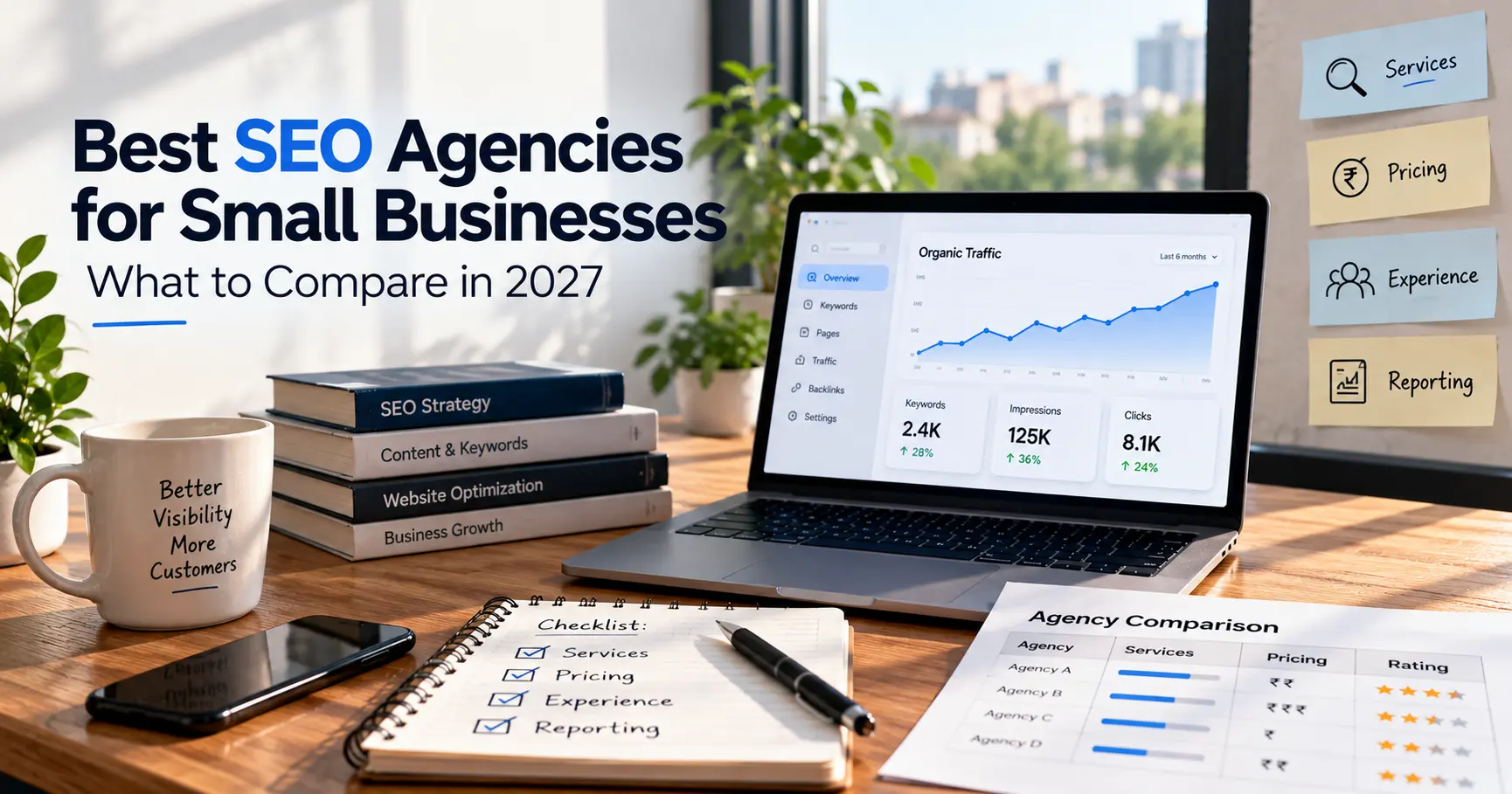
Make a Smarter SEO Investment for Your Small Business
The right SEO partner should understand your business goals, explain its strategy clearly, and show how its work can contribute to measurable growth.
Introduction
Choosing among the best SEO agencies for small businesses can be difficult when providers offer different services, pricing models, and promises. The right choice depends on your website, target audience, competition, and business goals.
A local service business may need local SEO services, while an ecommerce website may require technical improvements and product-page optimisation. Comparing proposals on price alone can overlook these important differences.
This guide explains how to choose an SEO agency by evaluating its experience, strategy, deliverables, reporting, pricing, and contract terms. It also provides a practical framework for comparing agencies before making a decision.
Key takeaways
Check relevant experience: Choose an agency that understands your business model and target audience.
Review the proposed strategy: Look for clear priorities, practical recommendations, and defined deliverables.
Compare pricing carefully: Evaluate the work included rather than choosing based on cost alone.
Measure meaningful outcomes: Consider relevant traffic, leads, and conversions alongside search visibility.
Check transparency: Review reporting, contract terms, and ownership of essential business accounts before signing.
TABLE OF CONTENTS
Why Choosing the Right SEO Agency Matters
10 Things to Compare Before Hiring an SEO Agency
How to Compare SEO Agencies
How Much Should a Small Business Spend on SEO?
How to Measure an SEO Agency’s Performance
SEO Agency Red Flags to Watch For
Specialist SEO Agency or Full-Service Agency?
Questions to Ask Before Signing an SEO Contract
Frequently Asked Questions
Conclusion
What Is an SEO Agency?
An SEO agency helps businesses improve their visibility in organic search results through activities such as keyword research, technical SEO, content optimisation, and performance analysis. Its services depend on the website and the business's needs.
For small businesses, an SEO agency can provide specialist support for improving search visibility and attracting relevant visitors. Before hiring one, evaluate its proposed strategy, deliverables, and approach to measuring results.
Why Choosing the Right SEO Agency Matters
SEO can help small businesses reach potential customers through organic search, but the right approach depends on the business model and its current website performance.
An agency should identify the website's needs, prioritise relevant opportunities, and explain how its work supports business objectives. For one business, this may mean improving local visibility; for another, it may involve technical SEO, SEO content improvements, or ecommerce category pages.
Before hiring an SEO agency for small businesses, clarify the proposed work, implementation responsibilities, and performance metrics. This helps you compare providers based on their actual value rather than rankings or promises alone.
10 Things to Compare Before Hiring an SEO Agency
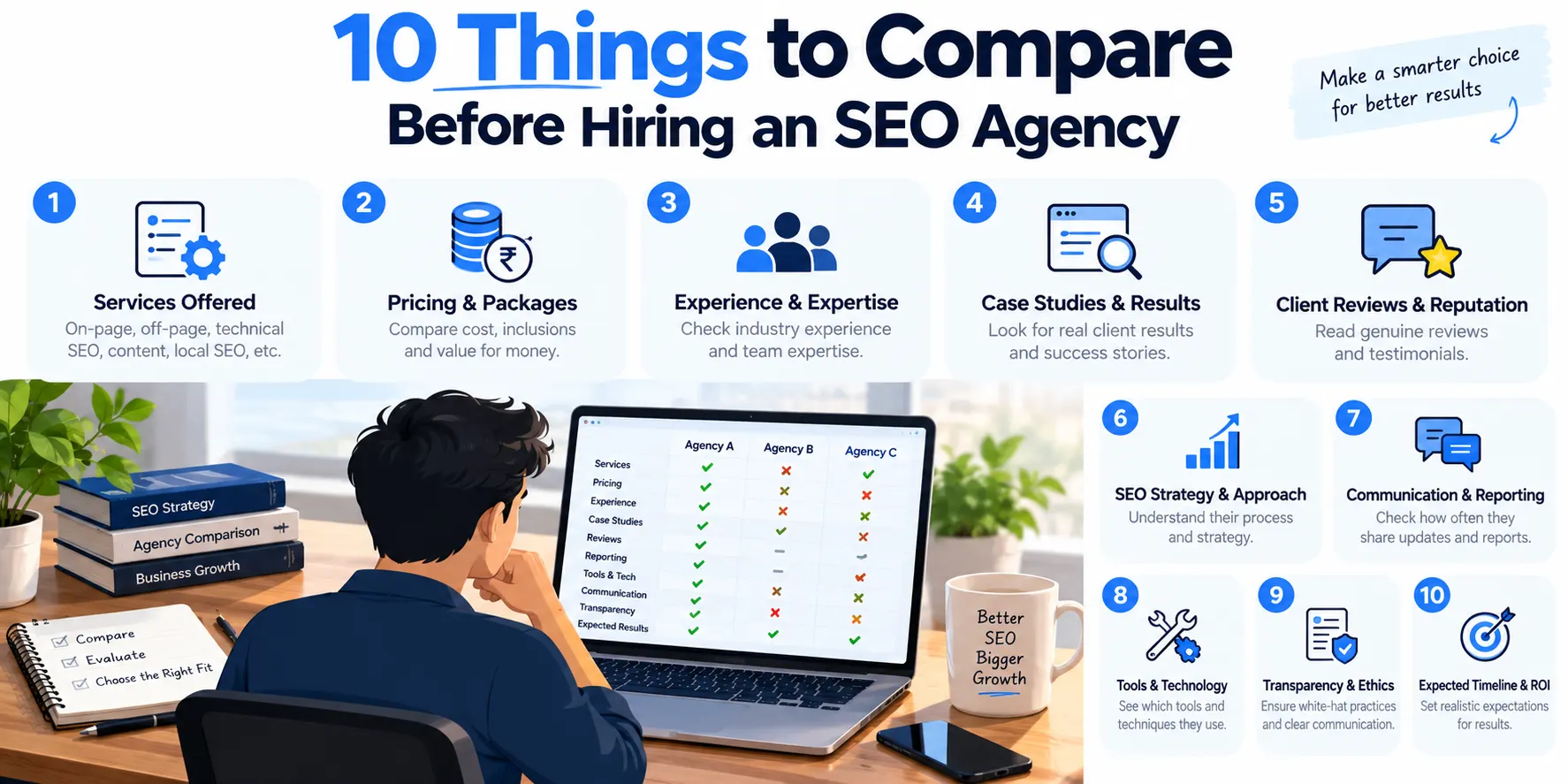
1. Relevant Experience and Industry Knowledge
Look for an agency that understands your business model, target audience, and market. Relevant experience can help it identify suitable opportunities, although previous results do not guarantee future outcomes.
Compare: Similar projects, relevant case studies, and understanding of your target market.
Red flag: Claims of expertise without evidence or a clear explanation of how its experience applies to your business.
2. SEO Audit and Initial Strategy
An SEO audit should identify website issues and opportunities before the agency recommends a strategy. Depending on the website, it may cover indexing, technical issues, content, internal links, and existing search performance.
Compare: Audit scope, prioritised recommendations, and implementation responsibilities.
Red flag: A generic package recommended without assessing your website.
3. Keyword Research and Search Intent
Keyword research should consider relevance, competition, and what users want to achieve with a search. High search volume alone does not guarantee useful traffic.
Compare: Search intent, keyword-to-page mapping, and alignment with business goals.
Red flag: Targeting high-volume keywords without explaining their relevance to your customers.
4. On-Page SEO and Content Quality
On-page SEO includes page titles, headings, internal links, content structure, and other elements that help users and search engines understand a page. New content should serve a clear purpose and answer genuine user needs.
Compare: Existing-page improvements, content quality, and alignment with search intent.
Red flag: Publishing large volumes of repetitive or low-value content just to target keywords.
5. Technical SEO Capabilities
Technical SEO services may address crawlability, indexing, site structure, duplicate URLs, canonical tags, and page performance. The required work depends on the website's size and condition.
Compare: Technical assessment, issue prioritisation, and support with implementation.
Red flag: A long list of errors without explaining their significance or how to fix them.
6. Local SEO Services
Local SEO can help businesses reach customers searching within a relevant area. Work may include Google Business Profile optimisation, accurate business information, location pages, and review management.
Compare: Local search experience, location strategy, and relevant reporting.
Red flag: Guarantees of a specific Google Maps position.
7. Link Building and Off-Page SEO
A sound link-building approach focuses on earning relevant links through useful content, industry relationships, or legitimate digital PR. Backlink quantity alone is not a reliable measure of quality.
Compare: Link relevance, acquisition methods, and transparent reporting.
Red flag: Bulk backlinks, link schemes, or promises of guaranteed rankings through purchased links.
8. Reporting and Communication
SEO reporting should explain completed work, performance changes, and next steps. Metrics should reflect business objectives rather than rankings alone.
Compare: Reporting frequency, access to relevant analytics, and clarity of communication.
Red flag: Reports full of unexplained numbers with no connection to business outcomes.
9. Case Studies and Proven Results
Useful SEO case studies explain the starting situation, work performed, timeframe, and measured outcomes. Results should be presented with enough context to assess their relevance.
Compare: Comparable projects, transparent methodology, and evidence of traffic or business outcomes.
Red flag: Impressive statistics without a timeframe or explanation of the agency's contribution.
10. Contracts, Deliverables and Ownership
SEO contracts should define services, fees, responsibilities, reporting, renewal conditions, and cancellation terms. Businesses should also retain appropriate access to their websites and essential analytics accounts.
Compare: Written deliverables, additional charges, account access, and ownership arrangements.
Red flag: Unclear contract terms or restrictions on access to essential business assets.
How to Compare SEO Agencies
Ready to grow with AI-powered marketing?
Book a free 30-minute strategy call with the Arena Infosolution team.
Comparing SEO agencies becomes easier when you evaluate them using the same criteria. Use this table to review proposals, identify important differences, and determine which agency best matches your business requirements.
Comparison Factor | What to Look For | Warning Sign |
|---|---|---|
Industry Experience | Relevant projects and business understanding | Unsupported expertise claims |
SEO Audit | Clear findings and prioritised recommendations | Generic audits without action plans |
Keyword Strategy | Relevant keywords aligned with search intent | Focus only on search volume |
On-Page SEO | Useful content and page optimisation | Keyword stuffing or low-quality content |
Technical SEO | Practical fixes and implementation support | Unexplained technical recommendations |
Local SEO | Relevant local strategy and GBP expertise | Guaranteed Google Maps rankings |
Link Building | Relevant links earned through legitimate methods | Bulk or manipulative backlinks |
Reporting | Clear metrics, completed work, and next steps | Rankings without business context |
Case Studies | Verifiable results and relevant examples | Unsupported performance claims |
Contracts | Transparent pricing, deliverables, and ownership | Unclear terms or restricted account access |
Expert tip
When comparing two or three agencies, request written proposals and evaluate them against these factors. Pay particular attention to the work included, implementation responsibilities, and how each agency plans to measure results.
How Much Should a Small Business Spend on SEO?
SEO costs vary depending on a business's goals, website size, competition, target locations, and the amount of work required. A small local business may need a different level of support from an ecommerce website with hundreds of product pages.
Agencies may charge a monthly retainer, an hourly rate, or a fixed project fee. The right pricing model depends on the scope of work, the expected duration of the engagement, and whether the agency is responsible for strategy, implementation, or both.
What Influences SEO Pricing?
Several factors can affect the cost of an SEO engagement:
Website size and condition: Websites with extensive technical issues or large numbers of pages may require more work.
Competition: Highly competitive industries may need broader content, technical, and authority-building efforts.
Service scope: Technical SEO, content creation, local SEO, and link acquisition involve different levels of effort.
Implementation requirements: Costs may differ depending on whether the agency makes changes directly or provides recommendations for your team to implement.
Reporting and support: Dedicated account management, frequent consultations, and additional analysis may affect the overall fee.
How to Evaluate Whether the Price Is Reasonable
Instead of comparing monthly fees alone, review what each proposal includes. One agency may offer strategy and recommendations, while another may also handle content production, technical fixes, and implementation.
Before committing, ask for a written breakdown of deliverables, additional charges, contract duration, and responsibilities. Make sure the proposed work addresses your business priorities and fits your available budget.
Avoid choosing an agency solely because it offers the lowest price. Equally, a higher fee does not automatically indicate better service. Evaluate the agency's expertise, the quality of its plan, the evidence supporting its approach, and how it intends to measure progress.
Expert tip
Start with clearly defined priorities and agree on how progress will be reviewed. This helps you assess the value of the engagement before expanding the scope of work.
How to Measure an SEO Agency’s Performance
When evaluating the best SEO agencies for small businesses, review their performance against the objectives agreed upon at the start of the engagement. Rankings provide useful context, but they do not show the full business impact of SEO.
Key metrics to track include:
Organic clicks and impressions: Google Search Console shows how pages perform in search results.
Organic traffic: Analytics helps measure visits from unpaid search results.
Leads and conversions: Track relevant enquiries, form submissions, calls, or purchases.
Business outcomes: Where reliable tracking is available, assess qualified leads and revenue.
Work completed: Review implemented fixes, improved pages, and other agreed deliverables.
Effective SEO reporting and performance tracking may involve Google Search Console, Google Analytics, and, where appropriate, CRM or call-tracking data to connect SEO activity with business enquiries.
Compare results over meaningful periods and account for seasonality and other changes. SEO outcomes vary, and not every change produces an immediate improvement.
A reliable SEO agency for small businesses should explain its results clearly, document completed work, and recommend practical next steps based on the data.
SEO Agency Red Flags to Watch For
Not every SEO proposal offers the same level of transparency or quality. Before hiring an agency, look for warning signs that may indicate unrealistic promises, unclear processes, or risky practices.
1. Guaranteed Rankings
No agency can guarantee a specific position in Google's organic search results. Be cautious of promises that your website will reach the number one position within a fixed timeframe.
2. Unclear Deliverables
If an agency cannot explain what work is included in its fee, it becomes difficult to evaluate progress. Ask for a written scope of work with clearly defined responsibilities.
3. Risky Link-Building Practices
Bulk backlinks, link schemes, and other manipulative tactics can violate Google's spam policies. Ask how the agency acquires links and evaluates their relevance.
4. Low-Quality, Mass-Produced Content
Publishing large volumes of content without ensuring usefulness, originality, and relevance is not a reliable SEO strategy. Ask how content quality and user needs are evaluated.
5. No Clear Reporting
An agency should explain its activities, performance metrics, and next steps. Be cautious if it avoids questions about results or provides reports without meaningful context.
6. Restricted Account Access
Your business should retain appropriate ownership and administrative access to essential assets, including its website, analytics accounts, and Google Business Profile.
7. No Realistic Discussion of Timelines
SEO results depend on several factors, including competition, website condition, and the work required. Be cautious of agencies that promise immediate, guaranteed outcomes without assessing your situation.
How to protect your business: Ask specific questions, review the contract carefully, request relevant evidence, and make sure the proposed strategy follows Google's published guidance. A transparent agency should be able to explain its recommendations, limitations, and responsibilities clearly.
Specialist SEO Agency or Full-Service Agency?
When comparing the best SEO agencies for small businesses, consider whether a specialist SEO agency or a full-service digital marketing agency better fits your needs. A specialist focuses primarily on organic search, while a full-service agency may also provide paid advertising, social media, content creation, and website development.
Specialist SEO Agency
A specialist may suit businesses that need technical SEO services or local SEO services. A full-service provider may be useful when several marketing channels require coordinated support.
This option may suit businesses that want to strengthen their organic search performance or address specific website issues. Before hiring an agency, review its SEO strategy, relevant experience, and ability to implement recommendations rather than simply provide an audit report.
Full-Service Digital Marketing Agency
A full-service digital marketing agency offers SEO alongside other services, such as paid advertising, social media marketing, content creation, and website development.
This option may be useful for small businesses that need support across multiple marketing channels. However, check whether SEO is handled by experienced specialists and whether the proposed small business SEO services match your actual requirements.
How to Choose the Right Agency
Consider these factors before making a decision:
Business goals: If organic search is your main priority, a specialist SEO agency may offer the focused expertise you need.
Required services: If you also need paid ads, social media, or website development, a full-service agency may provide more coordinated support.
Implementation support: Check whether the agency will implement SEO recommendations or expect your team to handle the work.
Budget and deliverables: Compare SEO agency pricing alongside the services, responsibilities, and reporting included in each proposal.
Performance measurement: Ask how the agency will track progress through relevant metrics such as organic traffic, qualified leads, and conversions.
Neither option is automatically better. When evaluating SEO agencies for small businesses, compare their expertise, proposed strategy, transparency, and ability to support your objectives rather than choosing based only on the number of services they offer.
Questions to Ask Before Signing an SEO Contract
Before hiring one of the best SEO agencies for small businesses, ask these questions to understand the services, costs, and expected outcomes.
What does your SEO audit include? Ask whether the agency reviews technical issues, on-page elements, content gaps, and indexing problems.
How do you measure SEO performance? Understand which metrics the agency tracks, including organic traffic, leads, conversions, and completed work.
Can you share relevant SEO case studies? Request examples of previous projects and the results achieved, while keeping in mind that outcomes vary by business.
What are your SEO contract and deliverables? Confirm the scope of work, reporting frequency, fees, contract duration, and ownership of website content and assets.
How do you approach local SEO services? If your business serves a specific area, ask how the agency plans to improve local visibility.
How do you determine SEO agency pricing? Ask what is included in the fee and whether additional charges may apply.
These questions make SEO agency comparison easier and help you understand how to choose an SEO agency that fits your business goals. A reliable SEO agency for small businesses should answer clearly, explain its recommendations, and avoid guaranteeing specific rankings.
Expert tip
Request written answers to important questions and compare them against each agency's proposal. This makes it easier to evaluate pricing, responsibilities, and deliverables before selecting an SEO partner.
Frequently Asked Questions
1. How Do I Choose the Best SEO Agency for a Small Business?
To choose among the best SEO agencies for small businesses, compare relevant experience, SEO strategy, deliverables, reporting, and pricing. Ask how the agency plans to improve your website's visibility and measure results. Choose an SEO agency for small businesses that explains its approach clearly and sets realistic expectations.
2. How Much Do Small Business SEO Services Cost?
The cost of small business SEO services depends on your website's size, competition, business goals, and the work required. When comparing SEO agency pricing, review the services included, technical improvements, content work, reporting, and contract terms rather than choosing based on price alone.
3. What Services Should Small Business SEO Services Include?
Depending on your needs, services may include keyword research, technical SEO, on-page optimisation, content improvements, local SEO, link building, and performance reporting. The right combination depends on your website and business objectives.
4. How Long Does SEO Take to Show Results?
SEO timelines vary based on competition, website condition, the changes implemented, and other factors. Ask the agency to explain its priorities and how it will measure progress. Be cautious of guaranteed rankings within a fixed period.
5. Should a Small Business Hire a Specialist SEO Agency or a Full-Service Agency?
A specialist SEO agency may suit businesses focused on organic search, while a full-service agency may be useful when support across multiple marketing channels is needed. Compare expertise, responsibilities, and the services included in each proposal.
6. How Can I Measure an SEO Agency’s Performance?
Review relevant metrics such as organic clicks, search impressions, qualified leads, conversions, and revenue where tracking is available. Google Search Console and Google Analytics can help evaluate performance when configured correctly.
7. What Are the Warning Signs of an Unreliable SEO Agency?
Be cautious of guaranteed rankings, unclear deliverables, manipulative link-building practices, poor reporting, and restricted access to your business accounts. Ask for written commitments and make sure the proposed approach follows Google's guidance.
Conclusion
Choosing the right SEO agency requires more than comparing prices or looking at promised rankings. Small businesses should evaluate relevant experience, audit quality, keyword strategy, technical expertise, content quality, reporting, and contract terms before making a decision.
When comparing the best SEO agencies for small businesses, focus on the quality of the proposed work, the transparency of the process, and how the agency plans to support your business objectives. Ask clear questions, review relevant evidence, and ensure that responsibilities and deliverables are documented.
The right SEO partner should understand your business needs, explain its recommendations clearly, and measure progress using meaningful performance data. Taking the time to compare your options carefully can help you make a more informed decision and build a stronger foundation for long-term organic growth.
About the Author
Arena Infosolution shares practical insights on search engine optimisation, digital marketing, and online business growth. Its content explores SEO strategy, technical optimisation, content quality, and search visibility to help businesses make informed decisions about their digital presence.
This article explains how small businesses can evaluate SEO agencies by comparing their expertise, proposed strategies, deliverables, reporting practices, and pricing transparency. The aim is to help readers assess their options using clear criteria rather than relying on ranking promises or marketing claims.
Ready to grow with AI-powered marketing?
Book a free 30-minute strategy call with the Arena Infosolution team.
Get a free growth consultation
Tell us what you're working on and a senior strategist will map your next move.