Getting Ad Clicks but No Customers? Here’s Why
Getting clicks but no customers? Learn why your ads may not be converting and how audience targeting, ad messaging, landing pages, offers, tracking, and conversion optimization can help turn clicks into real customers.
Stop Measuring Ad Success by Clicks Alone
Understand why ad clicks are not turning into customers
Identify problems with audience targeting and ad messaging
Find out how landing pages affect conversions
Learn which advertising metrics actually matter
Discover practical ways to turn clicks into real business result
TABLE OF CONTENTS
Why ads can get clicks but no customers
7 common reasons behind low conversions
How to identify where your ad funnel is breaking
Important advertising metrics to monitor
How to fix campaigns that generate clicks but few customers
A practical example of high clicks and low sales
Common advertising mistakes to avoid
An ads conversion checklist
Frequently Asked Questions
Final Thoughts
AI summary
Ads can receive plenty of clicks without generating customers when something goes wrong between the advertisement and the final conversion. Common problems include reaching the wrong audience, a mismatch between the ad and landing page, an unclear offer, a difficult conversion process, or inaccurate tracking.
Businesses can identify these issues by examining the complete advertising funnel and monitoring metrics such as conversion rate, cost per acquisition, lead quality, and revenue. Testing and improving each stage based on campaign data can help turn advertising traffic into more valuable business results.
Why Are Your Ads Getting Clicks but No Customers?
Getting clicks is a positive sign, but clicks alone do not guarantee leads or sales. Visitors may click because the ad looks interesting, but what happens after the click determines whether they become customers. If users drop off because of the audience, landing page, offer, or conversion process, your campaign may generate traffic without real business results.
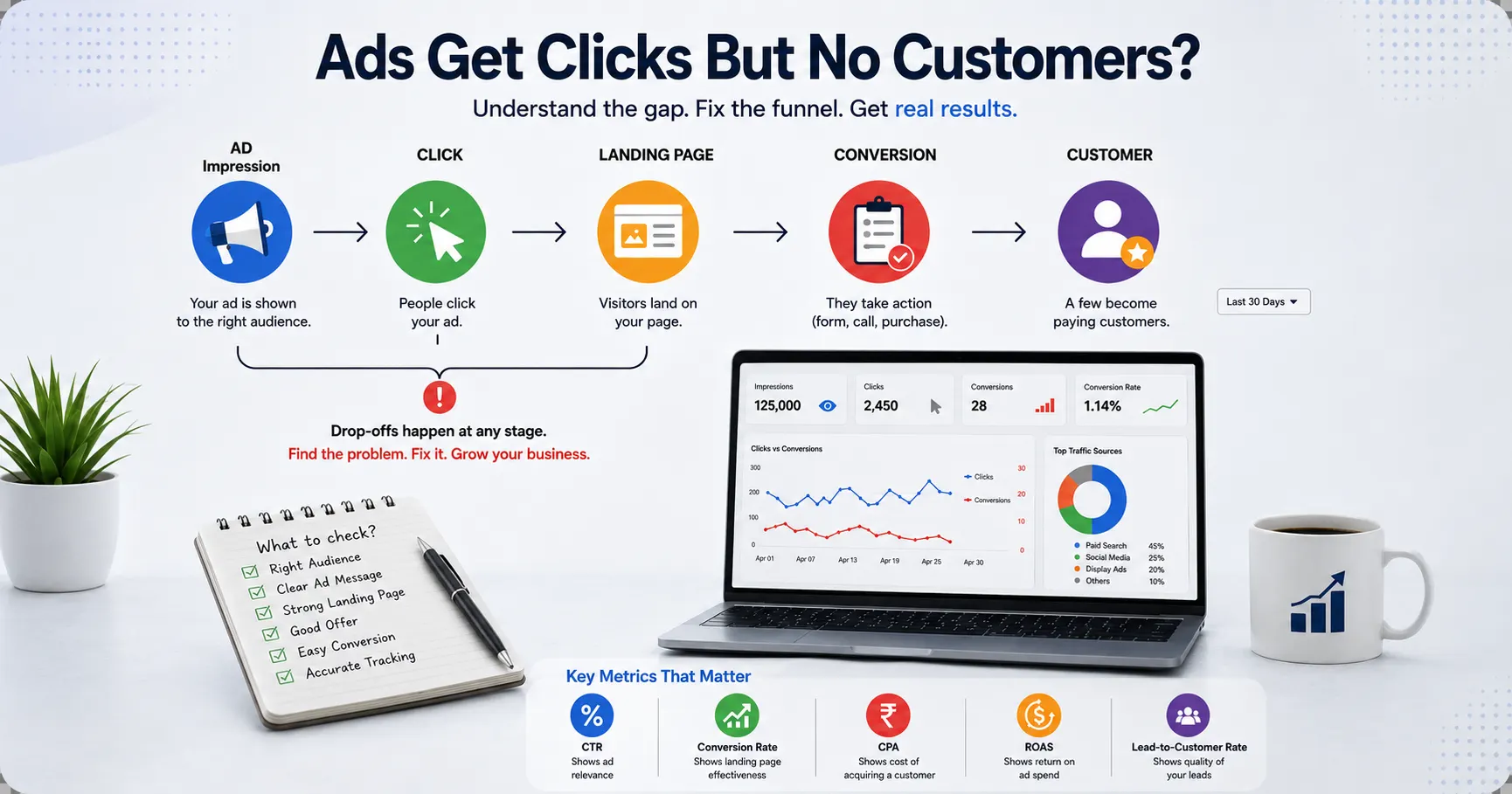
Ad → Click → Landing Page → Interest → Conversion → Customer
What Should You Check First?
When your ads are getting clicks but customers are not increasing, it is important to check where the problem is in your ad funnel. Start by reviewing your audience targeting, ad message, landing page, offer, conversion process, and tracking. These areas can help you understand why people are clicking but not
Audience: Are the people clicking potential customers?
Ad message: Does the advertisement clearly communicate the offer?
Landing page: Does the page provide what the ad promised?
Offer: Is there a clear reason to take action?
Conversion process: Is it easy to enquire, purchase, or book?
Tracking: Are conversions being recorded correctly?
Important: A high number of clicks shows that people are responding to the ad, but it does not show whether those visitors are valuable to the business.
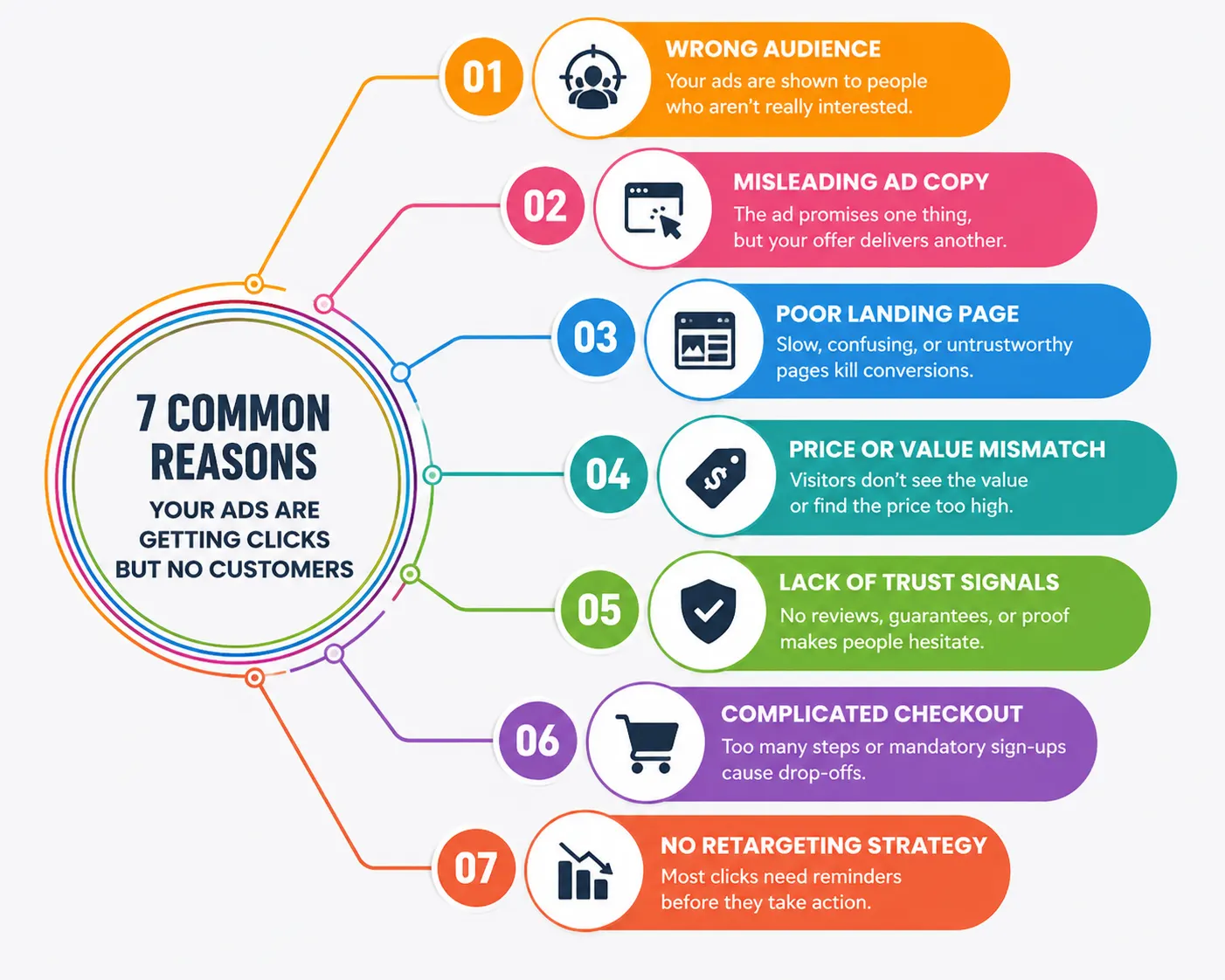
7 Common Reasons Your Ads Are Getting Clicks but No Customers
Getting clicks without customers usually means something is preventing visitors from moving forward in the customer journey.
1. You're Targeting the Wrong Audience
One common reason ads get clicks but no customers is incorrect audience targeting. Your ads may reach interested people who have low buying intent. Check your targeting based on:
Search intent
Location
Demographics
Interests and behaviour
Previous interactions
Buying stage
A smaller audience with stronger buying intent can be more valuable than a large audience that is only curious.
2. Your Ad Promises More Than Your Landing Page Delivers
People click ads with certain expectations. If the landing page does not match the ad's service, price, or benefit, visitors may leave.
Keep the journey connected:
Ad Message → Landing Page → Offer → Action
Your headline, offer, and CTA should match the message that attracted the visitor.
3. Your Landing Page Is Not Built for Conversions
A landing page can get plenty of visitors but still generate few leads or sales. Common problems include:
Unclear headlines
Weak CTAs
Slow loading
Poor mobile experience
Long forms
Missing trust signals
The page should guide visitors toward one clear action, such as buying, booking, or enquiring. They should quickly understand what is offered, why it is useful, and what to do next.
4. Your Offer Is Not Strong Enough
Sometimes the audience and landing page are relevant, but the offer does not give visitors enough reason to act.
A stronger offer can include:
A specific benefit
Competitive pricing
Free consultation
Useful guarantee
Suitable service package
Solution to a specific problem
The goal is to make the value of your offer easy to understand.
5. The Buying Process Is Too Complicated
Even interested visitors can leave if taking action requires too much effort. Long forms, extra pages, or complicated checkout processes can create friction.
Keep the journey simple:
Click → Understand the Offer → Take Action
Only ask for information that is genuinely necessary.
6. Your Conversion Tracking May Be Incorrect
Sometimes ads generate results, but tracking does not record them properly. This can make a campaign appear less successful than it actually is.
Google Ads conversion tracking can help businesses measure valuable actions such as purchases, leads, phone calls, and other customer actions.
Before making major changes, check that:
Conversion events are configured correctly
Forms are being tracked
Purchase events are working
Analytics connections are functioning
Duplicate conversions are avoided
Reliable data helps you make better advertising decisions.
Google Analytics can also help businesses measure important events and understand how users interact with their website.
7. You're Optimizing for Clicks Instead of Conversions
Clicks are useful, but they are not always the final business goal. A campaign focused mainly on traffic may attract people who click but are unlikely to purchase or enquire.
More clicks ≠ More customers
Instead, define the action that matters most, such as a qualified lead, purchase, booking, or enquiry, and optimize your campaign around that goal.
Quick Takeaway
If your ads get clicks but no customers, don't immediately focus on getting more traffic. First check audience quality, message relevance, landing-page experience, offer strength, conversion friction, tracking, and campaign optimization.
How to Find Where Your Ad Funnel Is Breaking
Instead of looking at your advertising campaign as one single activity, divide it into different stages and check how users move through each step. This makes it easier to identify where potential customers are dropping off and why clicks are not turning into conversions.
A typical advertising funnel looks like this:
Ad Impression → Click → Landing Page Visit → Engagement → Conversion → Customer
Each stage can reveal a different problem.
Check Clicks and Conversions
Click-through rate shows whether people are responding to your advertisement and finding it interesting enough to click. Conversion data goes one step further by showing whether those clicks are leading to meaningful actions, such as enquiries, sign-ups, or purchases.
A high CTR with a low conversion rate means the problem may exist after the click.
Check What Happens After the Click
Once visitors reach your website, examine their behaviour and see what they do next. Check whether they explore the page, engage with the offer, or leave without taking any action. This can help you identify problems with the landing page or conversion process.
Ask:
Are visitors staying on the page?
Are they engaging with the content?
Are they viewing the offer?
Are they reaching the call-to-action?
Are they leaving quickly?
If many visitors leave shortly after arriving, review whether the page matches the advertisement and meets visitor expectations.
Check the Quality of Your Leads
Not every conversion has the same business value, so it is important to look beyond the number of leads generated. Check whether the people responding to your ads are genuinely interested in your product or service and have a real chance of becoming customers.
A campaign may generate many enquiries while producing very few genuine sales opportunities.
Check whether leads are:
Relevant to your product or service
Within your target location
Interested in the actual offer
Suitable for your pricing
Ready to take the next step
The goal is not just more conversions—it is more valuable conversions.
Identify the Biggest Drop-Off Point
Look for the stage where the largest number of potential customers are being lost. Whether they leave after clicking the ad, visiting the landing page, or starting the conversion process, identifying this drop-off point helps you focus on the area that needs improvement most.
For example:
High Clicks → High Landing Page Visits → Low Form Submissions
This could indicate a landing-page or offer problem.
Another situation could be:
Good Leads → Very Few Customers
Here, the issue may involve pricing, follow-up, lead qualification, or the sales process.
Quick Takeaway
Don't judge an advertising campaign from one number. Follow the complete journey from impression to customer and identify the stage where potential customers are being lost.
What Metrics Should You Check?
Clicks are only one part of advertising performance. Businesses should monitor several connected metrics to understand whether campaigns are producing useful results.
Metric | What It Tells You | What to Check If Weak |
|---|---|---|
CTR | Whether people respond to the ad | Audience and ad messaging |
Conversion Rate | Whether visitors take action | Landing page and offer |
Cost Per Lead | Cost of generating a lead | Targeting and conversion efficiency |
CPA | Cost of acquiring a customer | Lead quality and sales process |
ROAS | Revenue generated from ad spend | Campaign efficiency |
Lead-to-Customer Rate | How many leads become customers | Lead quality and follow-up |
Click-Through Rate
CTR shows how frequently people click an advertisement after seeing it. A higher CTR generally means the ad is attracting attention, but it does not necessarily mean those clicks will turn into leads or customers.
A high CTR can indicate that the ad is attracting attention, but it does not guarantee conversions.
Conversion Rate
Conversion rate shows how many visitors complete a desired action after clicking your ad, such as a purchase, form submission, or enquiry. A low rate may indicate issues with the landing page or conversion process.
Depending on the business, a conversion could be:
A purchase
Form submission
Booking
Phone call
Quote request
Service registration
A low conversion rate despite strong traffic usually means something after the click needs attention.
Cost Per Lead and Cost Per Acquisition
Cost per lead measures how much you spend to generate each potential customer or enquiry. Cost per acquisition (CPA) measures the total cost of acquiring an actual customer. Tracking both helps you understand whether your advertising spend is generating valuable business results.
A low-cost lead is not necessarily valuable if it rarely becomes a customer.
Return on Ad Spend
ROAS compares the revenue generated from your advertising with the amount spent on those ads. It helps you understand how effectively your advertising budget is generating revenue and whether your campaigns are delivering a worthwhile return.
For example:
₹80,000 Revenue ÷ ₹20,000 Ad Spend = 4:1 ROAS
ROAS helps evaluate advertising efficiency, although it does not represent profit because other business costs still need to be considered.
Lead-to-Customer Rate
This metric shows how effectively your generated leads are turning into paying customers. A higher lead-to-customer rate usually indicates that your leads are relevant and your sales process is working effectively.
For example:
100 Leads → 20 Customers = 20% Lead-to-Customer Rate
If lead volume is healthy but the customer rate is poor, investigate lead quality, follow-up, pricing, and the sales process.
Quick Takeaway
No single metric tells the complete story. CTR explains engagement, conversion rate shows action, while CPA, ROAS, and lead-to-customer rate connect advertising activity with business outcomes.
How to Fix an Ad Campaign That Gets Clicks but No Customers
A successful performance marketing strategy focuses on measurable results rather than clicks alone.
Businesses should also review their broader SEO and digital marketing efforts to understand how paid and organic channels work together.
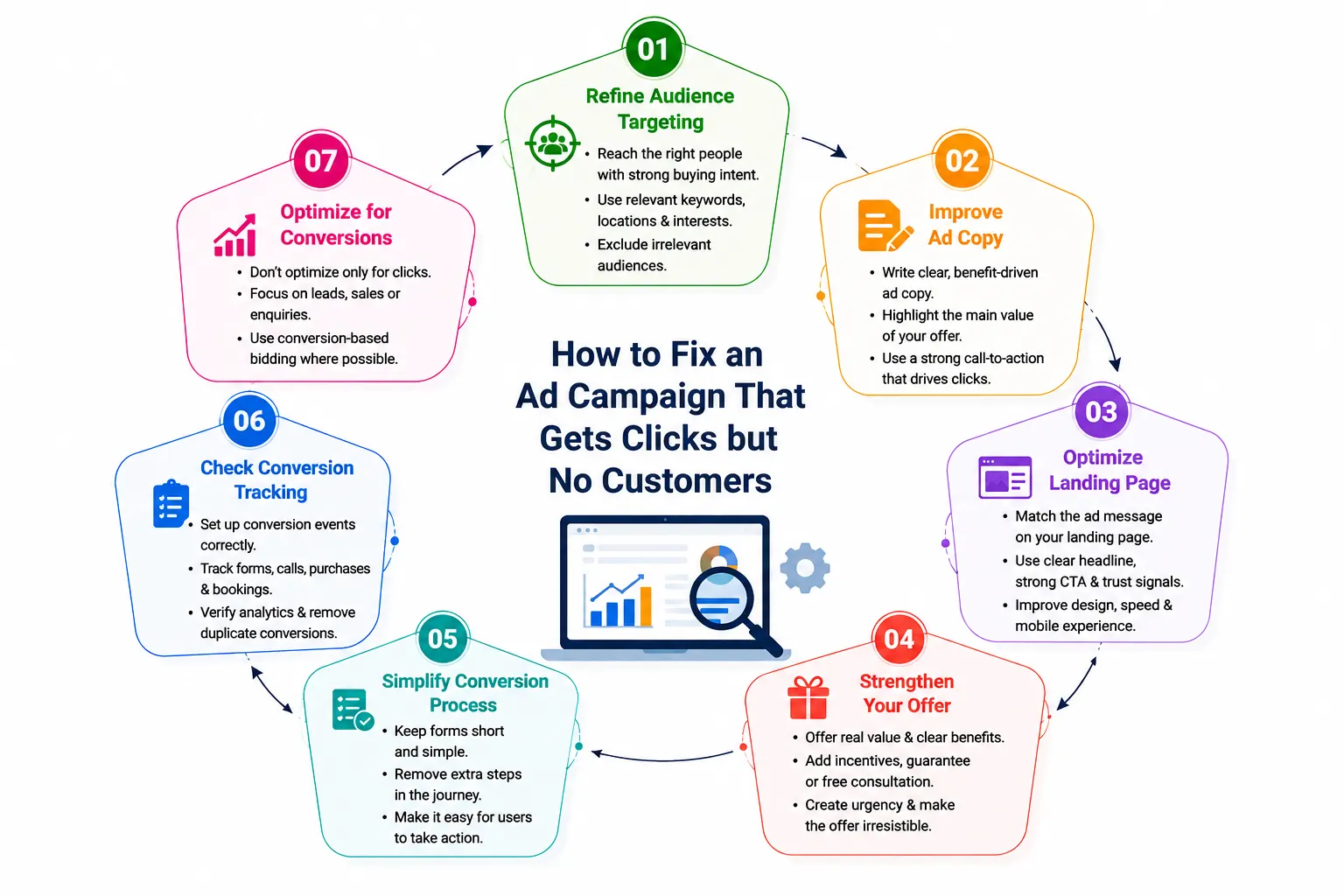
1. Refine Your Audience Targeting
Review whether clicks are coming from your ideal customers.
Remove clearly irrelevant audiences, keywords, locations, or placements where appropriate. Focus on people who have a genuine need for your product or service.
The goal is relevant traffic with stronger customer potential, not maximum traffic.
2. Improve Your Ad Copy
Your advertisement should clearly explain what you are offering and why it matters.
A strong ad should communicate:
The customer's problem
The main benefit
The relevant offer
A clear next step
Avoid promises that the landing page cannot support.
3. Optimize Your Landing Page
Improve the page before increasing your advertising budget.
Focus on:
A clear headline
Relevant benefits
Strong call-to-action
Mobile-friendly design
Fast loading
Useful supporting information
Appropriate trust signals
Visitors should quickly understand what you offer, why it matters, and what they should do next.
4. Make the Conversion Process Easier
Remove unnecessary steps from the customer journey.
If a visitor wants to submit an enquiry, avoid making the form unnecessarily long. If they want to purchase, keep the buying process straightforward.
Every unnecessary step can increase abandonment.
5. Test Different Offers
If visitors are interested but hesitant to act, test different ways of presenting value.
You can experiment with:
Benefits
Service packages
Pricing presentation
Calls-to-action
Consultation options
Relevant guarantees
Make focused changes so you can understand what improves performance.
6. Check Your Conversion Tracking
Make sure important actions are being recorded.
Review forms, purchases, calls, bookings, and other relevant conversion events before concluding that the campaign is failing.
7. Optimize Based on Business Results
Move beyond:
Impressions → Clicks
and examine:
Clicks → Leads → Qualified Leads → Customers → Revenue
This gives you a clearer picture of whether advertising is contributing to business growth.
Quick Takeaway
The solution is rarely “spend more.” Find the weakest stage, improve it, measure the change, and use the data to guide the next decision.
Example: When High Clicks Don't Mean High Sales
Consider an online business running a paid advertising campaign for one of its products. The campaign may generate a high number of clicks, but that does not always mean those visitors will become customers. By looking at each stage of the funnel, the business can identify where potential customers are being lost.
The campaign generates:
5,000 ad clicks
4,200 landing-page visits
120 enquiries
25 qualified leads
8 customers
At first glance, 5,000 clicks look impressive. However, the funnel shows significant drop-offs before visitors become qualified leads and customers.
What Could Be Going Wrong?
If visitors reach the page but do not enquire, review the landing page and offer. If enquiries are high but qualified leads are low, check audience targeting. If qualified leads do not become customers, look at pricing, follow-up, product fit, and the sales process.
The key point is that the click itself is not the problem to solve.
Quick Takeaway
High clicks are only the beginning of the customer journey. A successful campaign must attract relevant people and help move them toward a valuable business action.
Common Mistakes Businesses Make
1. Focusing Only on Clicks
Clicks are easy to measure, but campaigns should ultimately be judged by the business results they produce.
2. Increasing the Budget Too Quickly
If the campaign has a conversion problem, spending more can simply produce more non-converting traffic.
Fix the underlying issue before scaling.
3. Changing Everything at Once
Changing the audience, ad copy, landing page, offer, and budget simultaneously makes it difficult to understand which change affected performance.
Make controlled improvements wherever possible.
4. Treating Every Lead as Equal
A large number of low-quality leads can be less useful than a smaller number of qualified prospects.
Evaluate lead quality rather than focusing only on lead volume.
5. Ignoring the Sales Process
Advertising can generate a relevant enquiry, but the business still needs to handle that opportunity effectively.
If qualified leads are not becoming customers, review follow-up, pricing, communication, and sales qualification.
Quick Takeaway
More traffic, more budget, and more leads do not automatically produce more customers. Advertising performance should be evaluated across the complete customer journey.
A Simple Checklist Before Spending More on Ads
Audience
Are you reaching the right customers?
Is your targeting relevant?
Does the traffic show genuine buying intent?
Advertisement
Is the message clear?
Is the offer relevant?
Is the call-to-action understandable?
Landing Page
Does the page match the ad?
Is it mobile-friendly?
Is there one clear next step?
Conversion
Are forms working?
Is the process simple?
Are conversions being tracked?
Performance
What is the conversion rate?
What is the CPA?
Is advertising generating sustainable revenue?
Follow-Up
Are leads contacted promptly?
Are qualified leads followed consistently?
Where are prospects being lost?
Quick Takeaway
Before spending more, make sure your current campaign is making good use of the traffic it already receives. Fix conversion problems first instead of simply buying additional clicks.
Frequently Asked Questions
Why are my ads getting clicks but no customers?
Clicks indicate interest or curiosity, but they do not guarantee purchase intent. The problem may be related to audience targeting, landing-page experience, offer quality, conversion friction, tracking, or sales follow-up.
Why do people click my ad and then leave?
Visitors may leave when the landing page does not match the advertisement, the offer is unclear, the website is difficult to use, or there is no obvious next step.
Should I increase my ad budget if I am getting lots of clicks?
Not immediately. First determine whether the existing traffic is converting. Increasing the budget before fixing the funnel can increase spending without improving customer numbers.
How can I improve my ad conversion rate?
Review audience relevance, ad messaging, landing-page quality, offer clarity, conversion friction, and tracking. Make focused changes and measure the results.
What metrics should I monitor besides clicks?
Important metrics include conversion rate, cost per lead, CPA, ROAS, lead quality, and lead-to-customer rate.
Key takeaways
Clicks don’t equal customers: A high number of ad clicks does not always mean your campaign is successful.
Check your audience: Make sure your ads are reaching people who are genuinely interested in your product or service.
Match your ad and landing page: The landing page should deliver what your advertisement promises and make the next step clear.
Make conversion easy: Complicated forms, unclear CTAs, or a difficult buying process can cause potential customers to leave.
Track the right metrics: Focus on conversion rate, cost per acquisition, ROAS, and lead-to-customer rate—not just clicks.
Find the funnel drop-off: Identify where people stop moving from click to landing page, conversion, and finally becoming customers.
Conclusion
Ads that receive clicks but fail to generate customers are not necessarily broken. The issue may be audience targeting, landing-page experience, offer quality, conversion friction, tracking, or the sales process.
The best approach is to examine the complete journey:
Ad → Click → Landing Page → Lead → Qualified Lead → Customer → Revenue
By identifying where performance is being lost, businesses can make better optimization decisions and improve the value they get from their advertising investment.
Ultimately, successful advertising is not about generating the highest number of clicks. It is about connecting the right audience, the right message, and the right customer experience to produce measurable business results.
Ready to grow with AI-powered marketing?
Book a free 30-minute strategy call with the Arena Infosolution team.
About the author
Arena Infosolution is a digital marketing company focused on practical strategies for SEO, performance marketing, content marketing, and online business growth. The team shares useful digital marketing insights to help businesses understand their marketing performance and make more informed decisions.
Get a free growth consultation
Tell us what you're working on and a senior strategist will map your next move.