The Ultimate 2027 SEO & GEO Guide: How to Improve Your Website’s Visibility on Google & AI Overviews
Explore this SEO and GEO guide to understand technical SEO, Generative Engine Optimization, and practical ways to improve visibility across Google Search and AI-powered search experiences.
Learn how to strengthen your SEO, optimize content for AI-powered search, and build a practical strategy to improve your website’s visibility in 2027.
This SEO and GEO guide Copy explains how businesses can improve their website's visibility across traditional search results and AI-powered search experiences. By understanding SEO and Generative Engine Optimization (GEO), businesses can develop practical strategies for Google AI Overviews, helpful content, and long-term search visibility.
Introduction
Search engine optimization is evolving as people increasingly discover information through traditional search results and AI-powered experiences. Google AI Overviews and AI Mode can summarize information, explore related questions, and provide links to relevant websites. For businesses and marketers, this creates a practical challenge: how can a website remain discoverable when users can find answers in more than one way?
This is where SEO and Generative Engine Optimization (GEO) come into the conversation. Traditional SEO focuses on helping search engines discover, understand, and rank useful web pages. GEO focuses on improving the chances that a brand or its content is surfaced, mentioned, or cited in AI-generated responses. These approaches are complementary rather than competing strategies.
Google confirms that established SEO best practices remain relevant to AI search features. It recommends making content accessible, ensuring important information is available as text, maintaining useful internal links, and creating helpful, reliable content. However, meeting these requirements does not guarantee that a page will appear in an AI Overview or receive a citation.
In this SEO and GEO guide for 2027, we will explore the technical foundations, content strategies, authority signals, and measurement methods that can help businesses build a more resilient search visibility strategy. The goal is not to chase a guaranteed ranking or a shortcut to AI citations, but to create genuinely useful content that people and search systems can understand and discover.
Ready to grow with AI-powered marketing?
Book a free 30-minute strategy call with the Arena Infosolution team.
Key takeaways
SEO remains the foundation: Make sure your website is crawlable, indexable, technically accessible, and easy for search engines to understand.
GEO complements traditional SEO: Structure useful content clearly so AI-powered search experiences can understand and potentially reference it, without expecting guaranteed citations.
Prioritize people-first content: Answer real user questions with accurate information, relevant examples, expert insights, and trustworthy sources.
Build authority beyond individual pages: Maintain consistent brand information, strengthen relevant internal links, and earn credible mentions from relevant third-party sources.
Measure visibility, not just rankings: Monitor Search Console performance, relevant AI-search reporting where available, website traffic, and meaningful conversions.
TABLE OF CONTENTS
What Are SEO and GEO?
SEO vs GEO: Key Differences
How Google AI Overviews and AI Mode Work
Technical SEO Foundations for AI Search
How to Create Content for SEO and GEO
Building Brand Authority and Trust
Website Experience and Core Web Vitals
How to Measure SEO and AI Search Visibility
Common SEO and GEO Myths to Avoid
A Practical SEO and GEO Strategy for 2027
Frequently Asked Questions
Conclusion
What Are SEO and GEO?
Search Engine Optimization (SEO) and Generative Engine Optimization (GEO) are two complementary approaches to improving a website’s visibility across search experiences.
Search Engine Optimization (SEO) is the process of improving a website’s technical accessibility, content relevance, site structure, and credibility so search engines can discover, understand, and potentially rank its pages in relevant organic search results. Common SEO activities include improving crawlability and indexability, creating helpful content, strengthening internal links, and earning relevant, trustworthy backlinks.
Generative Engine Optimization (GEO) focuses on improving the likelihood that a brand, website, or its information will be discovered, mentioned, or cited in AI-generated responses. This involves publishing clear and accurate information, supporting claims with reliable sources, demonstrating relevant expertise, and maintaining consistent brand information across credible platforms.
The main difference is the visibility outcome each approach seeks to improve: SEO focuses on visibility in search results, while GEO focuses on visibility within AI-generated answers. They share important foundations, including accessible web pages, useful content, clear information, and credibility.
For example, a digital marketing agency can use SEO to optimize its service pages for relevant Google searches. It can complement that work with GEO-oriented practices by publishing detailed service explanations, answering genuine customer questions, sharing verifiable case studies, and maintaining consistent business information across relevant sources.
Neither approach guarantees a particular ranking, AI Overview appearance, or citation. The practical goal is to make your website useful to people and accessible and understandable to the systems that may surface its information.
SEO vs GEO: Key Differences
SEO and GEO support website visibility in different ways. SEO focuses on improving visibility in organic search results, while GEO aims to increase the chances of a brand or its content being mentioned or cited in AI-generated answers.
Factor | SEO | GEO |
|---|---|---|
Main goal | Organic search visibility | AI-generated answer visibility |
Content focus | Search intent and useful information | Clear, accurate, verifiable answers |
Key foundations | Technical SEO, content, internal links | Accessible content, clarity, and credibility |
Measurement | Impressions, clicks, rankings, conversions | Available AI reports, citations, mentions, referrals |
How Should Businesses Approach SEO and GEO?
Start with technical SEO and helpful content. Make important pages accessible, answer real user questions, support claims with reliable sources, and maintain consistent brand information. Then measure organic search performance alongside AI visibility where reliable reporting is available.
Neither SEO nor GEO guarantees rankings or AI citations. Both require ongoing improvement based on evidence and results.
How Google AI Overviews and AI Mode Work
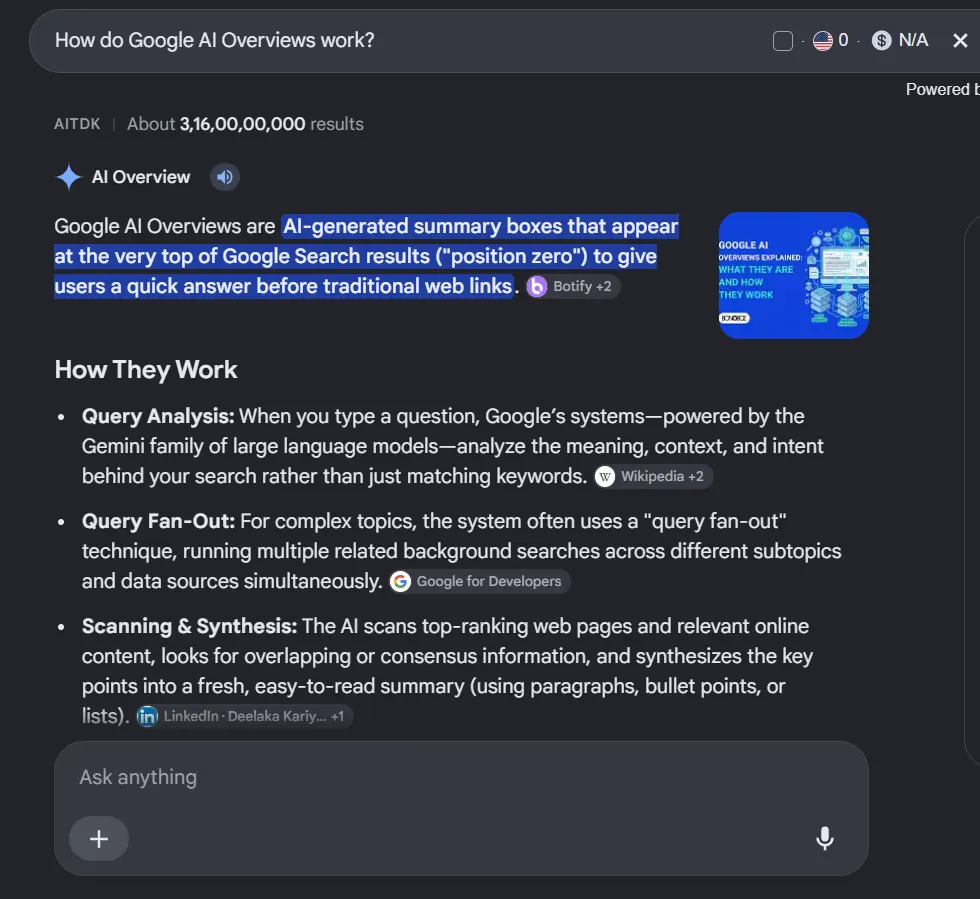
Google AI Overviews provide summaries of information for certain searches, while AI Mode helps users explore more complex questions through detailed responses and follow-up searches. Both experiences can include links to relevant web pages.
Google may use a process called query fan-out, which explores multiple related searches across subtopics and sources to build a more comprehensive response. For example, a search about improving website visibility may involve related questions about technical SEO, helpful content, and website authority.
This creates an opportunity for businesses to publish useful content that addresses the main question as well as its relevant subtopics. Organize information with descriptive headings, explain concepts clearly, and support factual claims with reliable sources instead of creating separate pages for every possible query.
Important: Google's existing SEO best practices remain relevant to AI Overviews and AI Mode. However, following these practices does not guarantee that a website will be mentioned or cited in AI-generated answers. For more details, refer to Google Search Central's official guide to AI features.
Technical SEO Foundations for AI Search
Technical SEO helps search engines discover, crawl, and understand your website. A strong technical foundation supports SEO and helps make your content accessible to search systems.
Key factors to focus on include:
Crawlability and Indexability: Ensure important pages are accessible and eligible for indexing.
XML Sitemap: Maintain an updated sitemap containing important URLs.
Internal Linking: Connect related pages using descriptive anchor text to improve navigation and content discovery.
Mobile Usability and Page Experience: Ensure your website works well on mobile devices and offers a smooth browsing experience. Monitor Core Web Vitals to assess loading, responsiveness, and visual stability.
Structured Data: Use relevant structured data that accurately reflects visible page content.
Expert tip
Use Google Search Console to inspect URLs and identify indexing issues. Technical SEO helps establish eligibility for search visibility, but it does not guarantee rankings or AI citations.
How to Create Content for SEO and GEO
Creating content for SEO and GEO starts with understanding what users are searching for and providing information that genuinely answers their questions. Instead of focusing only on keywords, prioritize search intent, clarity, and usefulness.
Start by identifying the main question your audience wants answered. Explain the topic directly, then add relevant details, examples, or supporting evidence. Use descriptive headings to organize information naturally, making it easier for readers to find what they need.
For example, a blog about technical SEO should explain important concepts and show how businesses can identify common website issues. Practical guidance adds more value than repeating generic definitions found across multiple websites.
Content should also be accurate and trustworthy. Verify statistics, support factual claims with reliable sources, and update outdated information when necessary.
Ultimately, quality matters more than content volume. Publishing several repetitive articles is less useful than creating a smaller number of comprehensive pages that satisfy distinct user needs.
Building Brand Authority and Trust
Brand authority develops when a business consistently provides reliable information, demonstrates relevant expertise, and builds a credible online presence. For SEO and GEO, trust should come from genuine experience and useful contributions rather than simply publishing more content.
Businesses can strengthen credibility by sharing original case studies, explaining their processes, maintaining accurate business information, and earning relevant mentions from reputable websites. Customer reviews and testimonials can also help potential customers evaluate a business, provided they reflect genuine experiences.
Example: A digital marketing agency that publishes detailed case studies, explains its SEO methodology, and presents verifiable client results gives potential customers more useful evidence than an agency that makes broad claims without supporting information.
Authority takes time to build. Avoid fake reviews, fabricated credentials, or artificial brand mentions. Focus on demonstrating what your business knows, what it has achieved, and how it helps its audience.
Website Experience and Core Web Vitals
A good website experience helps visitors access information easily and navigate your content without unnecessary friction. In an effective SEO and GEO strategy, usability, mobile responsiveness, and page performance should support the quality of your content.
Google's Core Web Vitals measure three aspects of user experience: loading performance (LCP), responsiveness (INP), and visual stability (CLS). These metrics can help identify areas where a website experience needs improvement.
Benefits and Limitations of Improving Website Performance
Benefits | Limitations |
|---|---|
Faster pages can make browsing more convenient. | Performance improvements may require technical development. |
Better usability can help visitors find information more easily. | A fast website alone does not guarantee higher rankings. |
Mobile-friendly layouts support visitors across devices. | Results depend on content quality and other SEO factors too. |
For businesses aiming to improve AI search visibility, website performance should complement—not replace—helpful content, technical SEO, and clear information architecture. Core Web Vitals are useful diagnostic metrics, but they are not a standalone SEO strategy.
How to Measure SEO and AI Search Visibility
Measuring SEO and AI search visibility helps businesses understand whether their optimization efforts are reaching the right audience. An effective SEO and GEO guide should explain how to track performance beyond keyword rankings alone.
Traditional SEO performance can be monitored through Google Search Console and analytics tools. Track organic impressions, clicks, click-through rate (CTR), relevant search queries, organic traffic, and conversions to evaluate whether your content is attracting potential customers.
AI search visibility requires a broader approach. Where reliable data is available, monitor brand mentions, citations in AI-generated answers, referral traffic from AI platforms, and conversions from those visits. AI visibility may vary depending on the platform, query, and reporting method.
For example, a business may notice stable organic traffic but an increase in visitors referred by AI search platforms. Tracking both sources can provide a more complete picture of its search performance.
The goal of SEO for AI Overviews and Generative Engine Optimization is not simply to collect more metrics. It is to identify what helps users discover your business and take meaningful action. Measure consistently, compare trends over time, and avoid drawing conclusions from isolated results.
Common SEO and GEO Myths to Avoid
A reliable SEO and GEO guide should separate proven practices from unrealistic promises. As AI search optimization evolves, businesses should avoid strategies based on assumptions rather than evidence.
Myth 1: GEO replaces traditional SEO.
Generative Engine Optimization complements SEO rather than replacing it. Technical accessibility, useful content, and clear website structure remain important foundations.
Myth 2: AI-specific content guarantees citations.
Optimizing content for Google AI Overviews does not guarantee that a page will appear in an AI-generated answer. Inclusion depends on several factors and cannot be assured.
Myth 3: Repeating keywords improves AI visibility.
Excessive keyword repetition can make content unnatural. Use relevant terms such as “AI search visibility” where they genuinely fit the topic.
Myth 4: More content always means better results.
Publishing many similar articles can create unnecessary duplication. Focus on satisfying distinct user needs with accurate, helpful information.
The best AI search optimization strategy combines sound SEO practices, trustworthy content, and consistent performance measurement rather than relying on shortcuts.
A Practical SEO and GEO Strategy for 2027
A successful SEO and GEO guide should turn recommendations into a practical process. Businesses can improve their search strategy by strengthening existing pages, answering relevant questions, and measuring meaningful results instead of chasing every new AI search trend.
Start with a technical SEO audit to identify crawling, indexing, mobile usability, and site structure issues. Next, review existing content to find outdated information, unanswered questions, and opportunities to provide more useful explanations.
Apply these SEO and GEO strategies in a focused sequence:
First, strengthen your foundation. Make important pages accessible, improve internal linking, and ensure your website provides a clear user experience.
Next, improve content quality. Match content to search intent, use accurate information, include relevant examples, and explain complex topics in straightforward language.
Then, build credibility. Demonstrate genuine expertise through original insights, verifiable case studies, and consistent business information.
Finally, measure and refine. Track organic search performance alongside available AI search visibility data. Use the findings to update your content and prioritize improvements.
This approach to AI search optimization helps businesses build on established SEO practices while adapting to changing search experiences. Results vary, so review performance regularly and focus on improvements that benefit your audience.
Frequently Asked Questions
1. What Is the Difference Between SEO and GEO?
SEO improves a website's visibility in organic search results, while Generative Engine Optimization (GEO) focuses on increasing the chances of content being mentioned or cited in AI-generated responses. This SEO and GEO guide explains how both approaches can work together.
2. Does GEO Replace Traditional SEO?
No. GEO complements traditional SEO. Technical SEO, useful content, and a well-structured website remain important foundations for AI search optimization.
3. How Can I Improve Visibility in Google AI Overviews?
To improve visibility in Google AI Overviews, follow established SEO best practices and focus on helpful, accurate content. SEO for AI Overviews should prioritize clear explanations, relevant information, and reliable sources. However, no optimization technique guarantees inclusion or citations.
4. How Can Businesses Measure AI Search Visibility?
Monitor available AI search reports, brand mentions, citations, referral traffic, and conversions where reliable data is available. Compare these indicators with organic search performance to evaluate progress.
5. Is AI Search Optimization Useful for Small Businesses?
Yes. Small businesses can improve discoverability by maintaining accurate business information, updating important website pages, and publishing content that answers customers' questions. Consistent improvements can support long-term search visibility.
6. How Long Does It Take to See Results from SEO and GEO?
An effective SEO and GEO guide should set realistic expectations. Results depend on website quality, competition, content relevance, and existing authority. Improvements may take time, and neither higher rankings nor AI citations have a guaranteed timeline.
7. Does Technical SEO Affect AI Search Visibility?
Yes. Technical SEO helps search engines access and understand website content. Improving crawlability, indexability, and site structure supports AI search visibility, but it does not guarantee inclusion in AI-generated answers.
8. Can Existing Blog Content Be Optimized for AI Search?
Yes. Businesses can update existing articles with accurate information, clearer explanations, relevant examples, and answers to user questions. These improvements can support Generative Engine Optimization (GEO) and traditional SEO without creating unnecessary duplicate content.
9. Which Metrics Should I Track for AI Search Optimization?
Track organic clicks, impressions, relevant search queries, and conversions alongside available AI search visibility indicators, such as brand mentions, citations, and referral traffic. For SEO for AI Overviews, monitor relevant reporting where available and compare trends over time.
Conclusion
This SEO and GEO guide explains how traditional SEO and Generative Engine Optimization can work together to improve AI search visibility. Businesses should focus on technical SEO, helpful content, and reliable information to strengthen their online presence.
As AI search optimization evolves, monitoring results becomes equally important. Effective SEO performance measurement involves tracking organic traffic, search impressions, clicks, conversions, and available AI search data. These insights help businesses identify opportunities and refine their strategies.
Following SEO best practices can support visibility in Google AI Overviews and other search experiences, but no strategy guarantees rankings or AI citations.
Ready to grow with AI-powered marketing?
Book a free 30-minute strategy call with the Arena Infosolution team.
About the author
The Arena Infosolution Team creates educational content on SEO, Generative Engine Optimization (GEO), digital marketing, and AI-powered search. The team focuses on sharing practical insights and actionable guidance to help businesses and marketers understand evolving search practices and improve their online visibility.
Get a free growth consultation
Tell us what you're working on and a senior strategist will map your next move.