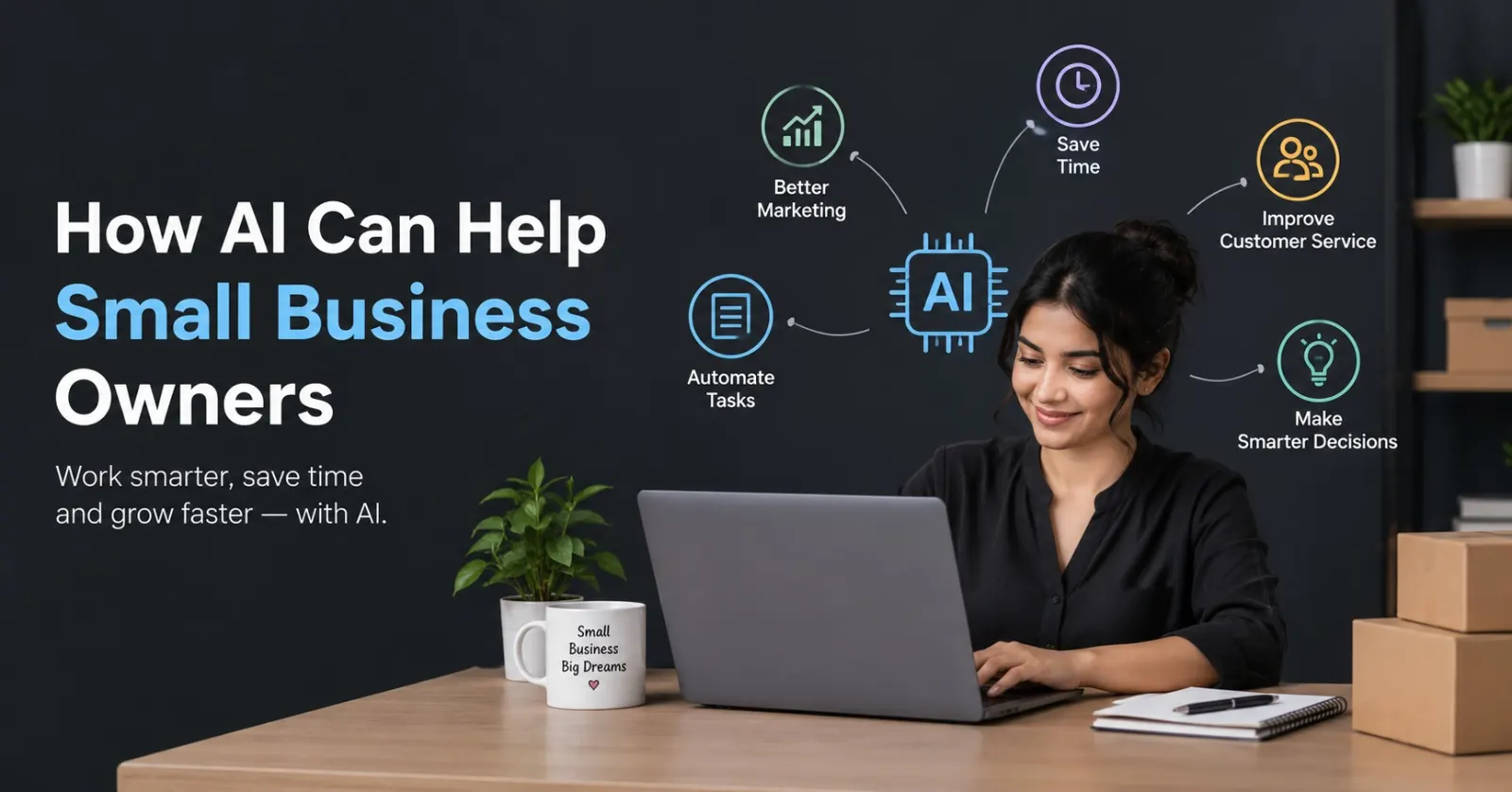
AI Search vs Traditional Search: What's the Difference?
Discover how AI Search differs from Traditional Search, how each works, their key differences, real-world examples, and why businesses should optimize for both search experiences.
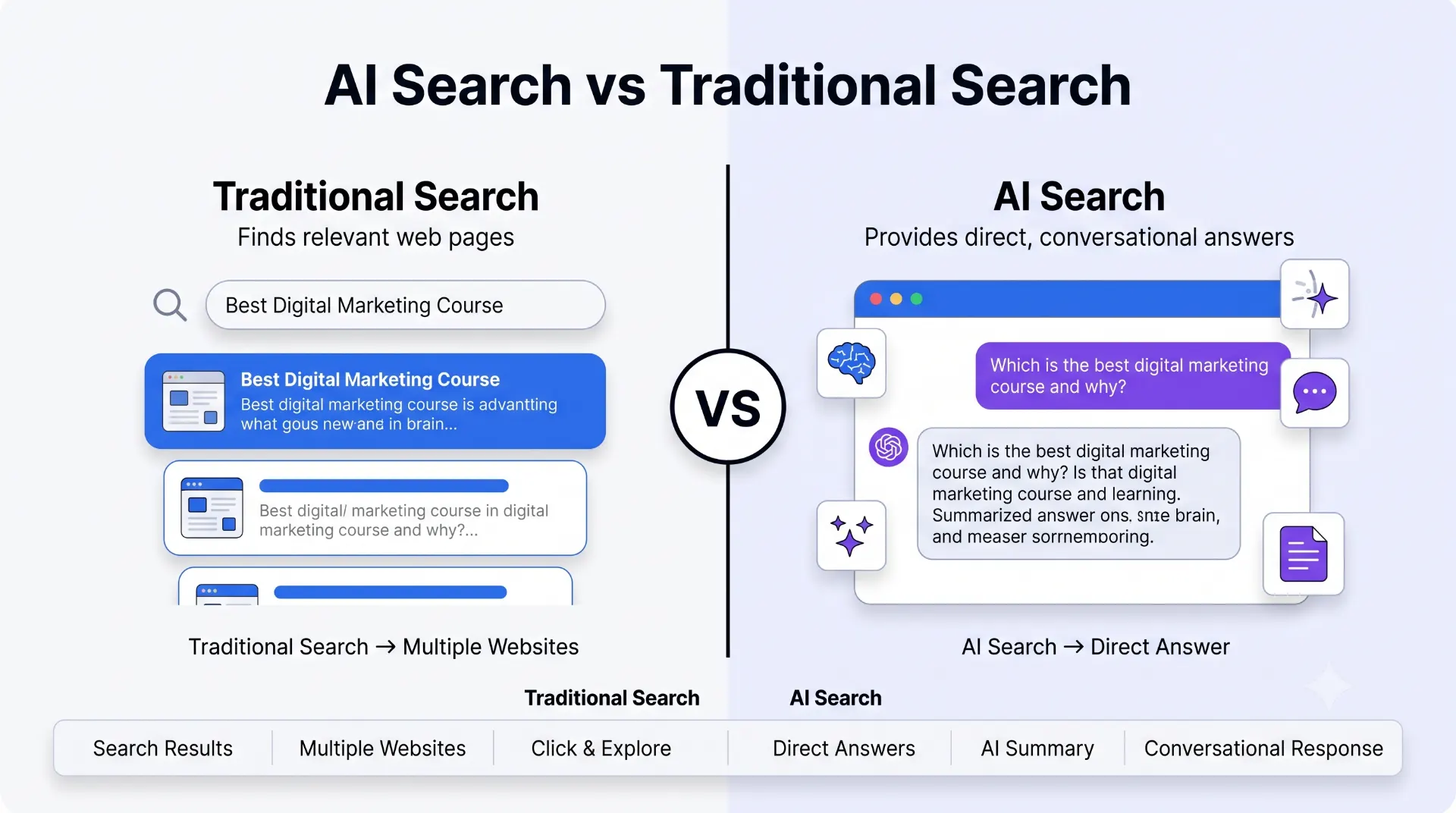
AI Search vs Traditional Search: Key Differences, Benefits & What Businesses Need to Know
AI Search provides conversational answers, while Traditional Search helps users discover and compare authoritative web pages. Understanding both is essential for modern businesses.
What's Inside
Key differences between AI Search and Traditional Search
How AI Search and Traditional Search work
When to use AI Search, Traditional Search, or both
Best practices for optimizing content for search engines and AI-powered platforms
Why AI Search is transforming the future of digital discovery
Quick Summary
Understand how AI Search and Traditional Search work and where they differ.
Compare their strengths, limitations, and ideal use cases.
Learn how AI-powered search is changing the way people discover information.
Explore when businesses should optimize for SEO, GEO, or both.
Discover practical strategies to improve visibility across search engines and AI platforms.
💡 Expert Insight
"The future of search isn't AI versus SEO—it's AI plus SEO. Businesses that publish original, trustworthy, and well-structured content are more likely to earn visibility in both search engines and AI-powered assistants."
Feature | Traditional Search | AI Search |
|---|---|---|
Primary Goal | Shows a list of relevant web pages | Provides direct, conversational answers |
Results Format | Blue links with snippets | AI-generated summaries with citations (when available) |
User Experience | Requires users to open multiple websites | Delivers answers in one conversation |
Best For | Finding official sources, news, and detailed research | Learning concepts, summarizing information, brainstorming ideas |
Content Discovery | Based on keywords, backlinks, and SEO signals | Based on relevance, context, authority, and AI understanding |
Speed | Users compare multiple websites | Faster answers with fewer clicks |
Examples | Google Search, Bing | ChatGPT, Google AI Overviews, Gemini, Microsoft Copilot, Perplexity |
Which Search Method Should You Use?
If your goal is to... | Best Choice | Why? |
|---|---|---|
Find an official government website | Traditional Search | Provides direct access to official sources and documents. |
Understand a new topic quickly | AI Search | Gives a simplified explanation in one response. |
Compare multiple products or services | AI Search + Traditional Search | AI summarizes options, while search engines help verify details and reviews. |
Verify facts or statistics | Traditional Search | Allows you to cross-check information from trusted websites. |
Brainstorm ideas or create content | AI Search | Generates ideas, outlines, and content suggestions quickly. |
Conduct in-depth research | AI Search + Traditional Search | AI speeds up research, while search engines provide authoritative references. |
There is no single winner between AI Search and Traditional Search. The best choice depends on your goal. AI Search is ideal for learning, summarising, and brainstorming, while Traditional Search remains essential for finding official sources, verifying information, and conducting detailed research. In most situations, using both together provides the best results
What is Traditional Search?
Traditional Search is the process of finding information through search engines like Google and Bing. When a user enters a query, the search engine analyzes keywords, search intent, and hundreds of ranking factors to display a list of the most relevant web pages.
Instead of providing a direct answer, Traditional Search presents multiple website links, allowing users to explore different sources, compare information, and choose the content they trust. This approach is especially useful when researching detailed topics, accessing official websites, verifying facts, or comparing multiple viewpoints.
Search engines use technologies such as crawling, indexing, and ranking algorithms to organize billions of web pages and deliver relevant results based on the user's query.
What is AI Search?
AI Search is a modern way of finding information that uses artificial intelligence to understand the meaning and intent behind a user's question. Instead of simply displaying a list of web pages, AI Search generates direct, conversational answers by analyzing information from multiple sources and presenting it in an easy-to-understand format.
Generative AI Search uses advanced language models to understand user intent, generate contextual answers, and summarize information from multiple trusted sources instead of only listing web pages
AI-powered search platforms such as ChatGPT, Google AI Overviews, Gemini, Microsoft Copilot, and Perplexity help users ask questions in natural language, receive personalized responses, and continue the conversation with follow-up questions. This creates a more interactive search experience compared to traditional search engines.
Unlike Traditional Search, which requires users to visit multiple websites, AI Search focuses on delivering clear answers quickly. However, users should still verify important information using trusted and authoritative sources, especially for topics related to health, finance, legal advice, or other high-impact decisions.
How AI Search and Traditional Search Work
How AI Search Works
AI Search uses artificial intelligence, natural language processing, and large language models to understand user intent instead of simply matching keywords. It analyzes multiple trusted sources, summarizes the information, and delivers a conversational response that directly answers the user's question.
How Traditional Search Works
Traditional Search works by crawling, indexing, and ranking web pages based on hundreds of ranking signals such as relevance, authority, backlinks, and content quality. Users receive a list of web pages and choose which sources to visit for detailed information.
Although both AI Search and Traditional Search help users find information, they follow different processes to deliver results. Understanding how each method works makes it easier to choose the right approach for different search needs.
Traditional Search Process | AI Search Process |
|---|---|
User enters a keyword or search query. | User asks a question in natural language. |
The search engine scans its index for relevant web pages. | The AI understands the intent and context of the question. |
Pages are ranked using algorithms based on relevance, quality, and authority. | The AI analyzes information from multiple sources and generates a response. |
Users open different websites to find the information they need. | Users receive a direct answer and can ask follow-up questions. |
The final understanding depends on the user's research. | The AI summarizes the information into an easy-to-read response. |
Neither approach is better in every situation. Traditional Search gives users greater control over the sources they explore, while AI Search offers speed, convenience, and conversational assistance. Using both together often provides the most complete and reliable search experience.
AI Search vs Traditional Search: 7 Key Differences Explained
When comparing Traditional Search vs AI Search, it is important to understand that both approaches solve different user needs. AI Search delivers direct answers, while Traditional Search helps users discover and verify information from authoritative websites.
The Difference between AI Search and Traditional Search goes beyond technology—it changes how users discover, evaluate, and consume information online.
Although both AI Search and Traditional Search help users find information online, they work in fundamentally different ways. From how they process queries to how they present results, each approach has its own strengths and ideal use cases. Understanding these differences will help you choose the right search method based on your needs.
Businesses that want to stay competitive should learn how to optimize for both traditional search engines and AI-powered search experiences. Arena Infosolution provides practical training to help professionals adapt to the future of search.
AI Search vs Traditional Search: 7 Key Differences Explained
Feature | Traditional Search | AI Search |
|---|---|---|
1. Search Results | Displays a ranked list of web pages based on relevance, authority, and other ranking factors. Users usually visit multiple websites to gather complete information. | Provides direct, conversational answers by analyzing and summarizing information from multiple trusted sources instead of only displaying links. |
2. User Interaction | Users typically search using keywords or short phrases and manually refine their queries if they don't find the desired results. | Users ask questions in natural language, provide context, and continue the conversation with follow-up questions, creating a more interactive search experience. |
3. Information Discovery | Users discover information by browsing and comparing multiple websites before reaching a conclusion. | AI Search synthesizes information into a single response, helping users understand topics faster while encouraging verification from trusted sources when accuracy is important. |
4. Search Speed | Users often need to open multiple pages, compare information, and filter irrelevant results before finding the right answer. | AI Search summarizes key information into a single response, helping users find answers faster and significantly reducing research time. |
5. Best Use Cases | ✔ Finding official websites | ✔ Learning new concepts |
6. Trust & Verification | Users can review multiple trusted sources, compare different perspectives, and decide which information is the most reliable. | AI-generated answers provide speed and convenience, but important information should always be verified using authoritative and up-to-date sources, especially for health, legal, financial, or other high-impact topics. |
7. The Future of Search | Traditional Search will continue to play a vital role in helping users discover websites, access authoritative sources, verify information, and conduct in-depth research. Google continues to process trillions of searches every year, proving that search engines remain essential for online discovery. | AI Search is rapidly transforming how people interact with information through conversational, context-aware, and personalized responses. ChatGPT reached over 100 million users within two months of launch, making it one of the fastest-growing consumer applications. Gartner predicts traditional search engine volume could decline by 25% by 2026 as AI assistants become more widely adopted. Businesses that optimize for both AI Search and Traditional Search will be better positioned for long-term online visibility. |
💡 Key Insight: Traditional Search remains the best choice for discovering authoritative sources and verifying information, while AI Search excels at providing quick, conversational answers and summaries. Businesses that optimize for both search engines and AI-powered platforms will maximize their visibility and reach users across every stage of the modern search journey.
Traditional Search continues to play a vital role in helping users discover websites, compare sources, and access authoritative information.
At the same time, AI-powered search is growing rapidly. ChatGPT reached over 100 million users within two months of launch, making it one of the fastest-growing consumer applications. Google still processes trillions of searches every year, demonstrating that Traditional Search remains the primary way people discover information online. According to Gartner, traditional search engine volume is expected to decline by 25% by 2026 as users increasingly adopt AI assistants and generative search experiences.
Rather than replacing Traditional Search, AI Search is changing how people interact with information by providing conversational, personalized, and context-aware answers. Businesses that optimize for both search engines and AI-powered platforms will be better positioned to reach users across every stage of the search journey.
Final Takeaway
The real difference between AI Search and Traditional Search is not about choosing one over the other—it's about understanding when each method is most effective. Traditional Search gives users greater control over discovering and verifying information, while AI Search offers speed, context, and conversational assistance. For most users and businesses, using both together provides the most complete search experience.
Why AI Search Is Changing the Future of Search
The way people search for information is changing rapidly. Instead of browsing multiple websites to find answers, many users now expect immediate, conversational responses that save time and simplify research. This shift has led to the growing adoption of AI-powered search experiences.
Unlike Traditional Search, which primarily helps users discover relevant web pages, AI Search focuses on understanding user intent and delivering direct answers. This makes it easier to learn new concepts, summarize complex topics, compare options, and continue searching through follow-up questions.
However, AI Search is not replacing Traditional Search. Search engines remain the most reliable way to access official websites, verify information, and explore multiple perspectives. As search behavior evolves, businesses should optimize their content for both traditional search engines and AI-powered platforms to maximize online visibility.
To build practical skills in AI Search, SEO, and modern digital marketing, explore Arena Infosolution's AI-Powered Digital Marketing Course.
To learn practical AI-driven SEO strategies and stay ahead of the future of search, explore Arena Infosolution's AI-Powered Digital Marketing Course.
Real-World Example: AI Search vs Traditional Search
The easiest way to understand the difference between AI Search and Traditional Search is to compare how both respond to the same search query.
Traditional Search | AI Search |
|---|---|
A user searches "Best digital marketing course for beginners." | A user asks "Which digital marketing course is best for a beginner and why?" |
Google displays multiple websites, advertisements, videos, and blog posts. | The AI provides a direct answer, compares options, and explains its reasoning. |
The user opens several websites before making a decision. | The user can ask follow-up questions without starting a new search. |
The user verifies information manually. | The AI summarizes information, but important details should still be verified through trusted sources. |
Key Insight
Traditional Search helps users discover information by exploring multiple sources, while AI Search focuses on helping users understand information faster through direct, conversational answers. Using both together often provides the best search experience.
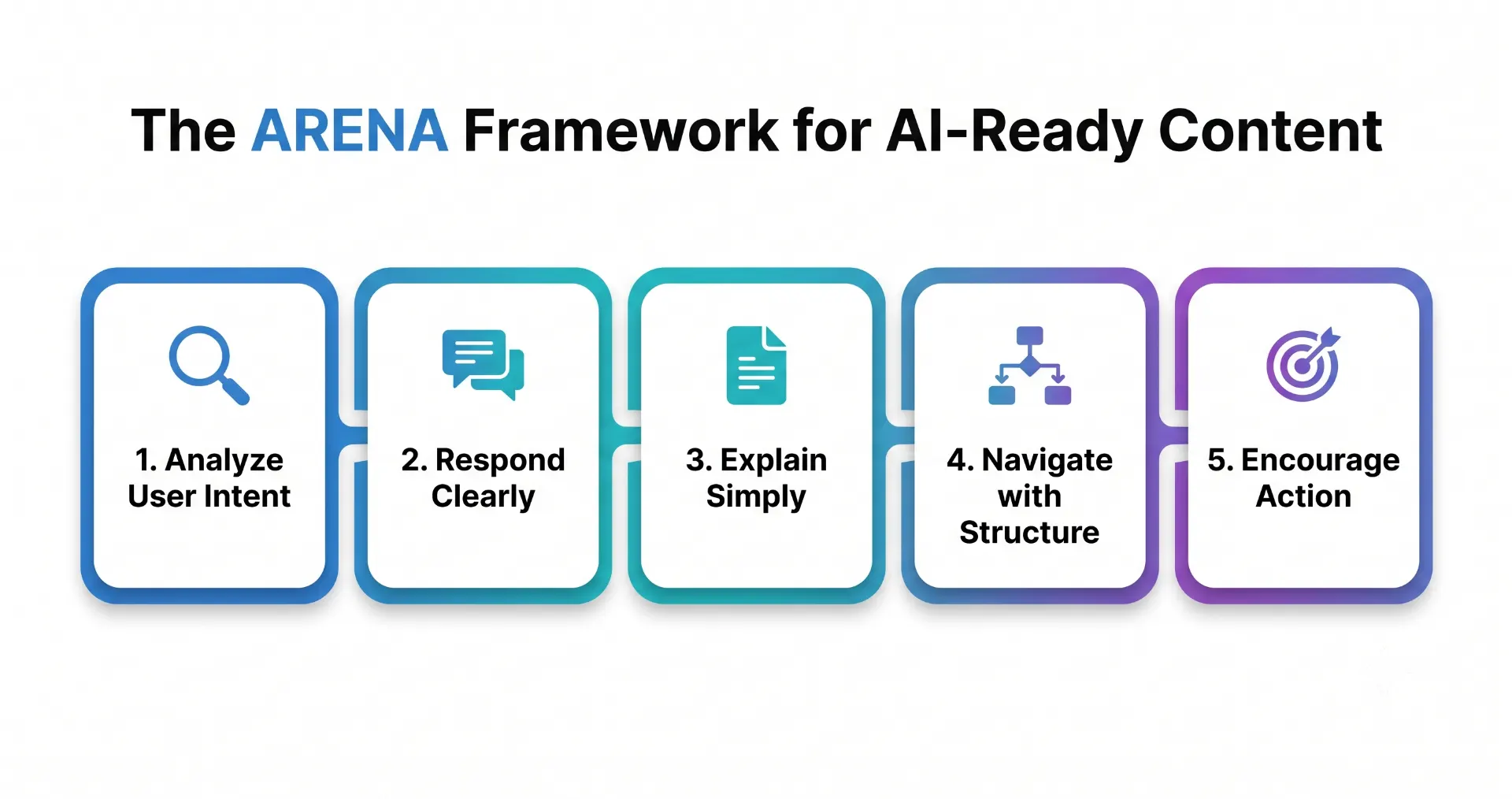
The AWARE Framework for AI-Ready Content
A – Answer Clearly
Start by answering the user's question within the first few paragraphs. AI-powered search platforms prefer content that provides direct and accurate answers.
W – Write with Structure
Use descriptive headings, short paragraphs, comparison tables, bullet points, and FAQs so both readers and AI systems can easily understand your content.
A – Add Authority
Support important claims with trusted sources such as Google Search Central, OpenAI, Microsoft, or other authoritative websites. Cite data whenever possible.
R – Remain Original
Don't just repeat what every other article says. Add original examples, comparison frameworks, checklists, or practical insights that provide unique value.
E – Evaluate Regularly
Review and update your content as search technology evolves. Fresh, accurate, and relevant content is more likely to remain useful for both users and AI systems.
Businesses that consistently follow the AWARE Framework create content that is easier for people to read, easier for AI systems to understand, and more likely to remain valuable as search technology continues to evolve
Best Practices for Optimizing Content for AI Search
Creating content for AI Search isn't about replacing traditional SEO—it's about making your content easier for both people and AI systems to understand. The following best practices can help improve visibility across search engines and AI-powered search platforms while delivering a better experience for your audience.
✅ Answer the user's primary question within the first few paragraphs.
✅ Use clear and descriptive headings to improve readability.
✅ Write short paragraphs and use simple, easy-to-understand language.
✅ Include comparison tables, examples, and FAQs where they add value.
✅ Support important claims with trusted and authoritative sources.
✅ Add original insights, frameworks, or practical examples instead of repeating competitor content.
✅ Review and update content regularly to keep it accurate and relevant.
✅ Optimize content for both Traditional Search and AI Search to maximize visibility.
The most successful content today is designed for both people and AI systems. By answering user questions clearly, using a well-structured format, and supporting key points with trusted sources, businesses can improve their visibility across both Traditional Search and AI-powered search platforms.
Understanding these differences is only the first step. Learning how to apply AI Search and SEO strategies in real-world projects is equally important. Explore Arena Infosolution to gain practical digital marketing knowledge.
Frequently asked questions (FAQs)
What is the main difference between AI Search and Traditional Search?
Traditional Search displays a list of relevant web pages for users to explore, while AI Search provides direct, conversational answers by understanding the user's intent and summarizing information from multiple sources.
Is AI Search replacing Traditional Search?
No. AI Search is changing how people discover information, but it is not replacing Traditional Search. Traditional search engines remain essential for finding official websites, verifying information, and conducting detailed research, while AI Search is ideal for quick explanations and conversational assistance.
Which is better for businesses: AI Search or Traditional Search?
Neither is universally better. Businesses should optimize for both. Traditional Search helps attract website visitors through search engines, while AI Search increases visibility across AI-powered platforms that provide direct answers.
What are some examples of AI Search platforms?
Popular AI Search platforms include ChatGPT, Google AI Overviews, Gemini, Microsoft Copilot, Claude, and Perplexity. These tools generate conversational responses instead of only displaying lists of web pages.
What are examples of Traditional Search engines?
Google Search, Bing, Yahoo, and DuckDuckGo are examples of Traditional Search engines that help users discover information through ranked web pages.
How can businesses optimize for AI Search?
Businesses can improve AI Search visibility by creating clear, well-structured, and trustworthy content, answering user questions directly, using descriptive headings, and supporting information with authoritative sources. Combining these practices with strong SEO creates a more effective long-term strategy.
How can businesses optimize for AI Search?
Businesses improve AI Search visibility by publishing well-structured, helpful content with descriptive headings, FAQs, trusted sources, and original insights while following SEO best practices.
Glossary of Key Terms
AI Search
A search method that uses artificial intelligence to understand user intent and provide direct, conversational answers instead of only listing web pages.
Traditional Search
A search method that displays ranked web pages based on relevance, keywords, and other ranking signals, allowing users to explore multiple sources.
Search Intent
The purpose behind a user's search query, such as finding information, comparing products, or completing a specific task.
SEO (Search Engine Optimisation)
The process of improving a website's visibility in traditional search engine results through high-quality content, technical optimisation, and authority building.
GEO (Generative Engine Optimisation)
The practice of creating content that is easy for AI-powered search platforms to understand, summarize, and reference when generating answers.
References & Trusted Sources
1. Google Search Central
https://developers.google.com/search
Purpose: Official guidance on how Google Search works and SEO best practices.
2. Google AI
https://blog.google/products/search/
Purpose: Official updates on AI Overviews and Google's AI-powered search experience.
3. OpenAI
Purpose: Information about ChatGPT and AI technologies.
4. Microsoft Copilot
https://www.microsoft.com/copilot
Purpose: Official information about Microsoft's AI-powered assistant.
5. Anthropic
Purpose: Official information about Claude and AI safety research.
6. Perplexity AI
Purpose: Official information about Perplexity's AI-powered search platform.
7. HubSpot
Purpose: Best practices for content marketing, SEO, and digital marketing.
Key takeaways
AI Search provides direct, conversational answers, while Traditional Search displays ranked web pages.
Both search methods serve different purposes and work best when used together.
AI Search improves speed and understanding, while Traditional Search helps verify information and access official sources.
Businesses should optimize content for both search engines and AI-powered platforms.
Creating helpful, trustworthy, and well-structured content is essential for the future of search.
Conclusion
Artificial intelligence is transforming how people search for information, but it is not replacing Traditional Search. Instead, AI Search and Traditional Search serve different purposes and complement each other. While Traditional Search remains essential for discovering websites, verifying information, and conducting in-depth research, AI Search makes it easier to understand topics, compare options, and receive quick, conversational answers.
For businesses, content creators, and marketers, the future of search is not about choosing one approach over the other—it's about preparing for both. Creating high-quality, well-structured, and trustworthy content will improve visibility across traditional search engines and AI-powered platforms alike.
As search technology continues to evolve, organizations that focus on user intent, content quality, and authoritative information will be better positioned to succeed in the next generation of search.
Whether you're a business owner, marketer, or content creator, now is the right time to start optimizing your content for both Traditional Search and AI Search. By adapting your content strategy today, you'll be better prepared for the future of digital discovery
Ready to future-proof your digital marketing skills? Contact Arena Infosolution to learn more about AI Search, SEO, and modern digital marketing strategies.
The future of AI Search will continue to evolve through conversational AI, personalized responses, and smarter search experiences, making it essential for businesses to optimize content for both AI platforms and traditional search engines.
Need help implementing AI Search and SEO strategies for your business? Contact Arena Infosolution to learn how modern digital marketing solutions can improve your online visibility.
Ready to grow with AI-powered marketing?
Book a free 30-minute strategy call with the Arena Infosolution team.
Expert Advice
"The future of online visibility isn't about choosing between SEO and AI Search—it's about building content that serves both. Brands that publish trustworthy, experience-driven, and well-structured content will be more likely to rank in traditional search results while also being referenced by AI-powered platforms such as ChatGPT, Google AI Overviews, Gemini, Microsoft Copilot, and Perplexity."
— Digital Marketing Experts at Arena Infosolution
Get a free growth consultation
Tell us what you're working on and a senior strategist will map your next move.