Traditional Marketing vs Digital Marketing 15 Practical Differences Every Business Owner Should Know
Traditional Marketing vs Digital Marketing explained through 15 practical differences, including cost, reach, targeting, analytics, customer interaction, flexibility, and ROI tracking. Learn how businesses can choose or combine both marketing approaches.
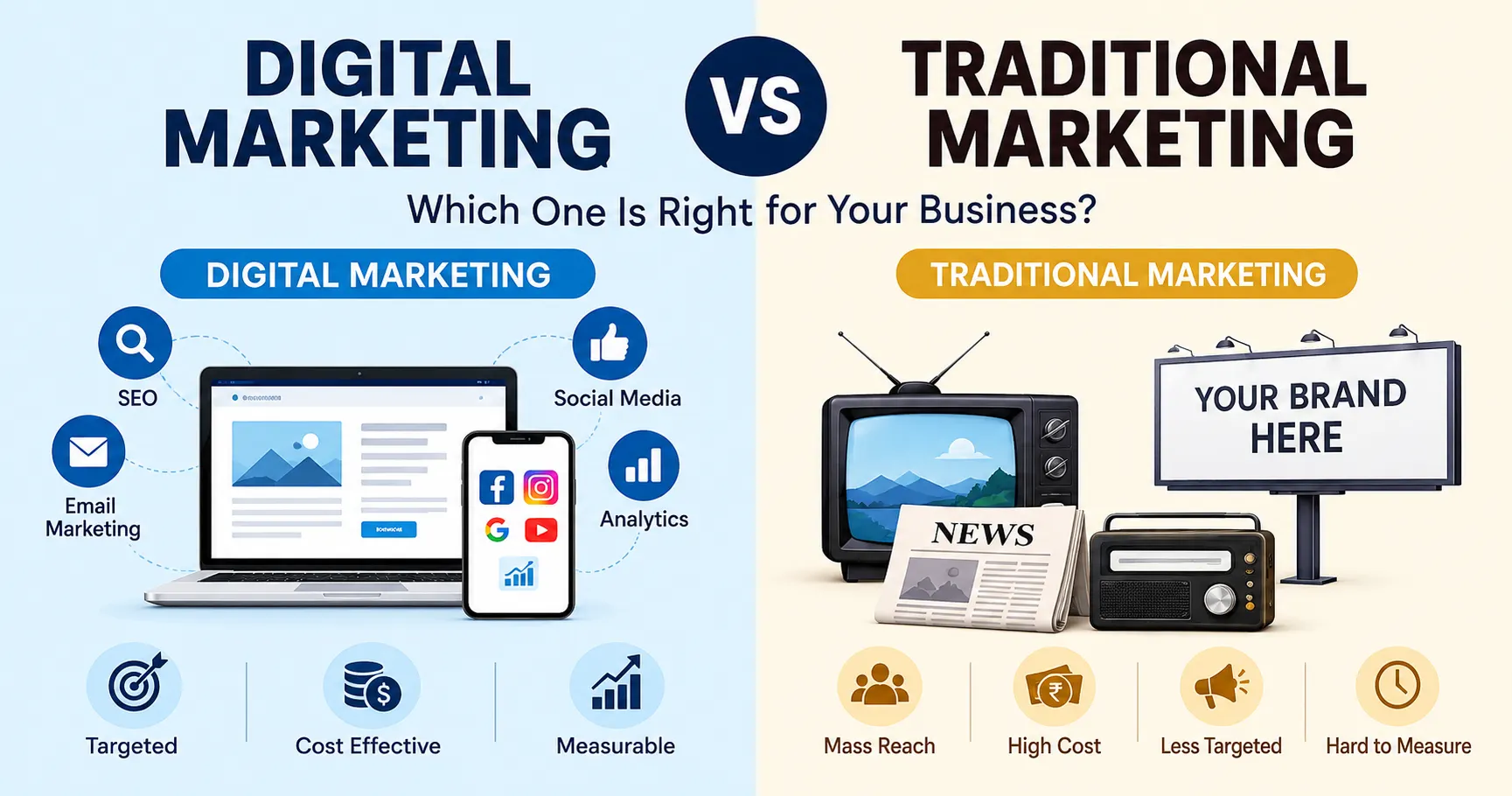
Traditional vs Digital Marketing: Which Approach Fits Your Business?
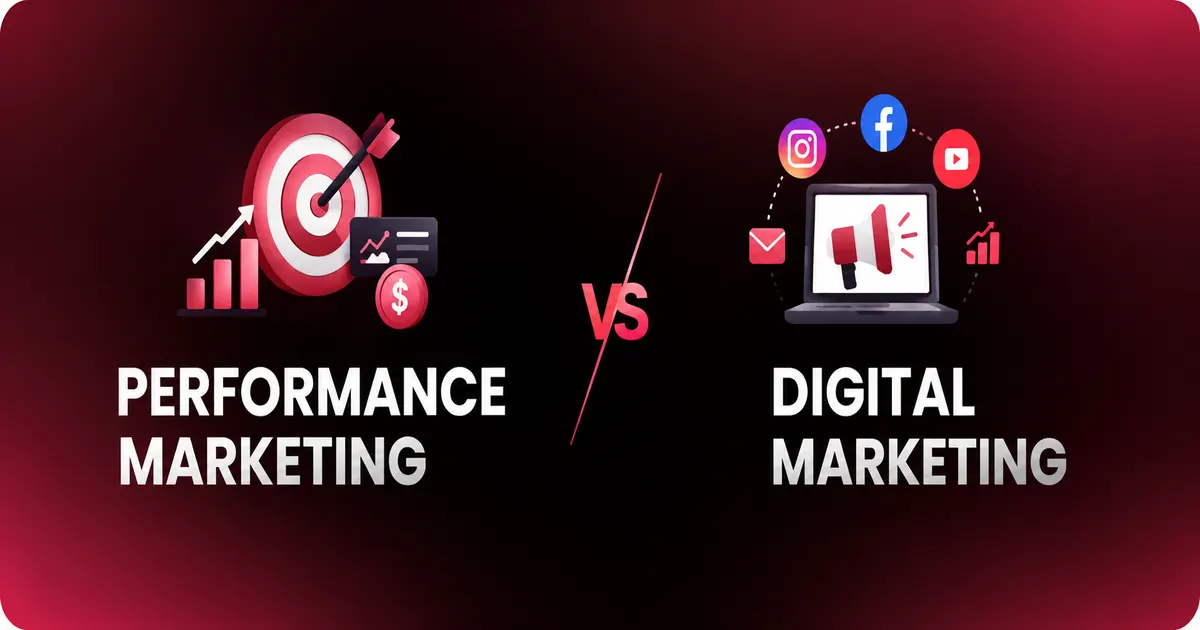
Traditional Marketing and Digital Marketing use different Marketing Channels to reach customers. Offline Marketing includes traditional methods, while Online Marketing uses internet-based channels. Digital Advertising is part of Digital Marketing, and a clear Marketing Strategy and Digital Marketing Strategy help businesses select suitable channels. Understanding Traditional Marketing vs Digital Marketing can help businesses choose the right approach.
Table of contents
What Is Traditional Marketing?
What Is Digital Marketing?
Traditional Marketing vs Digital Marketing: 15 Practical Differences
Traditional Marketing vs Digital Marketing: Comparison Table
Can Businesses Use Traditional and Digital Marketing Together?
which marketing Approach should a business use
Advantages and Disadvantages of Traditional Marketing
When Can Traditional Marketing Be Useful?
Combining Traditional and Digital Marketing
Advantages of Digital Marketing
Disadvantages of Digital Marketing
How Can Businesses Get Better Results from Digital Marketing?
Key takeaways
Frequently Asked Questions
Conclusion
What Is Traditional Marketing?
Offline Marketing helps businesses reach customers through traditional channels such as newspapers, television, radio, billboards, flyers, and direct mail. Some common examples of traditional marketing include:
Newspaper advertisements
Television advertisements
Radio advertisements
Billboards
Magazines
Brochures
Flyers and pamphlets
Direct mail
Posters
Business cards
These traditional marketing methods can be useful for businesses that want to reach customers through offline and local channels.
What Is Digital Marketing?
Digital marketing refers to promoting products, services, or brands through digital channels and internet-based platforms.
Common digital marketing methods include traditional Marketing .
Search Engine Optimization (SEO)
Google Ads
Meta Ads
Social Media Marketing
Content Marketing
Email Marketing
YouTube Marketing
Website Marketing
Influencer Marketing
Online Marketing helps businesses promote their products and services through websites, search engines, social media, email, and other internet-based channels. Digital Advertising is an important part of online marketing, while a clear Digital Marketing Strategy helps businesses select the right Marketing Channels, reach their target audience, and measure campaign performance.
Traditional Marketing vs Digital Marketing: 15 Practical Differences
Understanding traditional vs digital marketing can help businesses compare different marketing channels, costs, targeting options, and customer reach.
1. Marketing Channels
The first major difference is the channels used to reach customers.
Traditional Marketing
Traditional marketing uses offline channels such as:
Television
Radio
Newspapers
Magazines
Billboards
Flyers
Digital Marketing
Digital marketing uses online channels such as:
Google
Websites
Facebook
Instagram
YouTube
Email
Search engines
Therefore, the main difference is that traditional marketing primarily uses offline channels, while digital marketing focuses on online channels.
2. Audience Reach
Traditional marketing can reach a large local or regional audience through television, newspapers, radio, and outdoor advertising.
However, digital marketing can potentially reach audiences across different cities, states, countries, or even globally.
For example, a local newspaper advertisement may mainly reach people who read that newspaper, while a digital campaign can be targeted to users based on location, interests, demographics, and online behavior.
3. Targeting
Targeting is another major difference between traditional and digital marketing.
Traditional advertising generally has limited targeting options. A billboard, newspaper advertisement, or television advertisement can reach many people, but it may be difficult to identify exactly who viewed it.
Digital marketing platforms provide more targeting options.
Businesses can target audiences based on factors such as:
Location
Age
Interests
Search behavior
Demographics
Online activity
This can help businesses show their advertisements to a more specific audience.
4. Cost
Marketing costs can vary significantly depending on the channel, audience, campaign duration, and business goals.
Traditional marketing can involve expenses for:
Printing
Television slots
Radio advertisements
Billboard space
Newspaper placements
Distribution
Digital marketing can start with smaller budgets on platforms such as Google Ads and Meta Ads. Businesses can set campaign budgets and adjust them based on performance.
However, digital marketing is not automatically cheaper in every situation. The actual cost depends on the strategy and competition.
5. Measurement and Analytics
One of the biggest differences is the ability to measure campaign performance.
Traditional marketing can be difficult to measure accurately. For example, a business may know how many newspapers were distributed but may not know exactly how many people purchased a product because of the advertisement.
Digital marketing provides detailed analytics.
Businesses can track metrics such as:
Website visitors
Clicks
Impressions
Leads
Conversion rate
Cost per click
Cost per lead
Sales
Digital marketing platforms and tools such as Google Analytics, Google Ads, Meta Ads, Google Search, and Search Engine Optimization (SEO) help businesses measure website traffic, advertising performance, user engagement, leads, and conversions. These tools provide useful data that marketers can use to improve their digital marketing strategy.
6. Customer Interaction
Traditional marketing is generally more one-way.
For example, a billboard displays a message to people, but customers cannot directly interact with the billboard.
Digital marketing allows two-way communication.
Customers can:
Comment on social media posts
Send direct messages
Ask questions
Leave reviews
Share content
Contact businesses through websites
This creates more opportunities for businesses to communicate directly with their customers.
7. Speed of Campaign Changes
Changing a traditional advertisement can take time.
For example, if a company prints thousands of brochures with an incorrect phone number, the printed material cannot easily be changed.
Digital campaigns can generally be modified much faster.
Businesses can change:
Ad copy
Images
Target audience
Budget
Keywords
Landing pages
This makes digital marketing more flexible when businesses need to respond quickly to market changes.
8. Personalization
Traditional marketing generally delivers the same message to a large audience.
For example, everyone seeing the same billboard receives the same advertisement.
Digital marketing allows businesses to create different messages for different audience segments.
For example, an online store could show different advertisements to:
New visitors
Existing customers
People who viewed a product
People who added products to their cart
This creates more opportunities for personalized marketing.
9. Geographic Targeting
Traditional marketing can be effective for local marketing through newspapers, flyers, radio, and billboards.
Digital marketing provides more precise geographic targeting.
For example, a Jaipur-based business can create an online campaign specifically targeting people in Jaipur or selected areas of the city.
Businesses can use location targeting for:
- Local SEO
- Google Search
- Google Business Profile
- Google Ads
- Meta Ads
- Social Media Marketing
This can be useful for businesses that serve customers in specific locations.
10. Customer Feedback
Getting immediate customer feedback can be difficult with traditional marketing.
For example, after seeing a newspaper advertisement, a customer may or may not contact the business.
Digital marketing provides multiple ways to receive feedback.
Customers can:
Comment on posts
Submit website forms
Send WhatsApp messages
Leave Google reviews
Send emails
Respond to social media content
This allows businesses to understand customer questions and responses more quickly.
11. Brand Engagement
Traditional marketing can create brand awareness through repeated exposure on television, radio, newspapers, and outdoor advertisements.
Digital marketing provides additional opportunities for ongoing engagement.
Businesses can publish:
Blog posts
Videos
Reels
Social media posts
Educational content
Email newsletters
Businesses can also use Content Marketing, Social Media Marketing, Email Marketing, and YouTube Marketing to build ongoing customer engagement and brand awareness.
12. Accessibility
Traditional advertisements are usually available only through the medium where they are published.
For example, a newspaper advertisement is accessible to people who receive or purchase that newspaper.
Digital content can be accessed through internet-connected devices such as smartphones, tablets, and computers.
A website, blog post, or social media profile can remain accessible to users beyond the initial publication period.
13. Return on Investment (ROI) Tracking
Understanding return on investment is important for business owners.
Traditional marketing can make ROI measurement more challenging because it may be difficult to connect a particular advertisement directly to a sale.
Digital marketing provides several measurable data points.
For example, a business can compare:
Advertising Cost → Clicks → Leads → Conversions → Revenue
This helps marketers understand how campaigns are performing.
However, digital attribution is not perfect either, and different tracking methods can produce different results.
14. Flexibility and Scalability
Traditional campaigns often require physical preparation and distribution.
Digital marketing campaigns can usually be scaled by changing budgets, targeting, content, or campaign settings.
For example, a business running Google Ads can adjust its campaign budget based on its marketing goals.
Similarly, SEO and content marketing can be expanded by publishing more useful content targeting relevant search queries.
This provides businesses with different ways to scale their online marketing activities.
15. Long-Term Marketing Potential
Traditional advertising often depends on continued spending to maintain visibility.
For example, once a newspaper advertisement is no longer published, its visibility usually ends.
Some digital marketing activities can continue generating value after publication.
For example, a well-optimized blog post can potentially continue attracting organic search traffic over time.
Similarly, a website can remain available to customers 24/7.
However, long-term results depend on factors such as content quality, competition, search engine algorithms, website performance, and ongoing optimization.
Traditional Marketing vs Digital Marketing: Comparison Table
Factor | Traditional Marketing | Digital Marketing |
|---|---|---|
Channels | TV, Radio, Newspaper, Billboard | SEO, Google Ads, Social Media, Email |
Reach | Mainly local/regional depending on medium | Local, national, or global |
Targeting | Generally limited | More detailed targeting options |
Cost Control | Depends on advertising medium | Flexible campaign budgets |
Analytics | More difficult to measure precisely | Detailed digital analytics available |
Interaction | Mostly one-way | Two-way communication |
Campaign Changes | Usually slower | Generally faster |
Personalization | Limited | More personalization options |
Geographic Targeting | Limited depending on medium | Precise location targeting available |
Feedback | Often slower | Faster through digital channels |
Engagement | Mostly exposure-based | Interactive |
Accessibility | Depends on medium | Available online through digital devices |
ROI Tracking | Can be difficult | More measurable |
Long-Term Potential | Often depends on continued placement | Some content can continue attracting traffic |
Can Businesses Use Traditional and Digital Marketing Together?
Yes. Businesses do not necessarily have to choose only one marketing method.
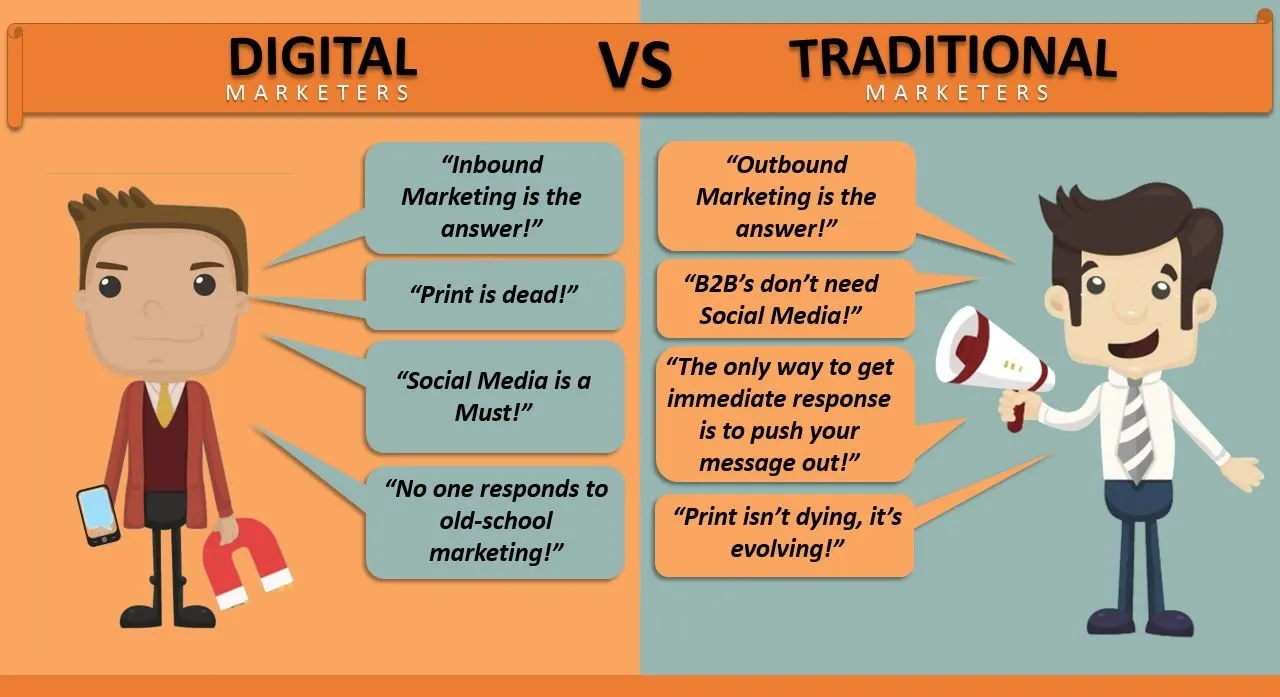
A combined strategy can use both traditional and digital marketing depending on the target audience and business objectives.
For example, a local restaurant could:
Use flyers to reach nearby residents.
Use Google Business Profile for local visibility.
Run Google Ads for relevant searches.
Use Instagram to showcase food and offers.
Collect customer reviews online.
This approach combines offline awareness with online customer acquisition and engagement.
Which Marketing Approach Should a Business Use?
When comparing digital marketing vs traditional marketing, businesses should consider their target audience, marketing budget, location, business goals, and the channels customers use to find products or services. Marketing Channels
Target audience
Business type
Marketing budget
Location
Campaign objectives
Customer behavior
Product or service
Available resources
A local business may use traditional marketing for local awareness while using digital marketing for search visibility, social media engagement, lead generation, and online advertising. Instead of looking at traditional and digital marketing as complete replacements for one another, businesses can evaluate which channels are appropriate for their specific goals.
Why Does Marketing Strategy Matter for Business?
Marketing strategy helps a business understand its audience, choose the right channels, control its budget, and measure results. A clear strategy also helps businesses decide when to use traditional marketing, digital marketing, or a combination of both
Advantages and Disadvantages of Traditional Marketing
Traditional marketing continues to be used by businesses that want to reach customers through offline channels. Newspapers, television, radio, billboards, brochures, flyers, posters, and direct mail can all be part of a traditional marketing strategy. Like digital marketing, traditional marketing has both advantages and limitations.
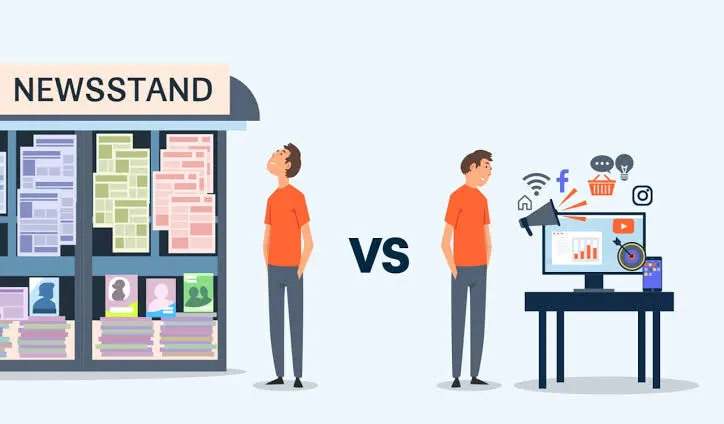
Traditional Marketing
These traditional marketing advantages can be particularly useful for businesses that depend on local customers and offline brand visibility.
1. Physical Presence
Printed materials such as brochures, posters, and business cards give customers something physical that they can keep or refer to later. This can be useful for businesses that meet customers offline.
2. Useful for Mass Awareness
Television, radio, newspapers, and outdoor advertising can expose a marketing message to a large number of people depending on the medium, location, and audience.
3. Familiar Marketing Channels
Many customers are already familiar with traditional advertising formats. Businesses can use established channels to communicate information about their products, services, offers, or events.
5. Effective for Offline Businesses
Businesses such as local restaurants, retail stores, real-estate businesses, educational institutes, and event organizers may use traditional methods to reach people in their service area.
Disadvantages of Traditional Marketing
1. Limited Audience Targeting
Traditional advertising may provide fewer targeting options than many digital advertising platforms. A newspaper or billboard can reach a broad audience, but identifying exactly which people saw the advertisement can be difficult.
2. Measurement Can Be Difficult
It may be challenging to determine exactly how many customers purchased a product because of a particular newspaper advertisement, flyer, billboard, or radio campaign.
3. Changes Can Take Time
Once brochures, posters, newspapers, or other printed materials have been produced and distributed, correcting information can be difficult. A change may require creating and distributing new materials.
4. Repeated Costs
Businesses may need to pay repeatedly for advertising placements to maintain visibility. For example, a newspaper advertisement may need to be published again to reach new audiences.
5. Less Direct Interaction
Traditional advertising is generally designed to communicate a message rather than create immediate two-way interaction. Customers may need to call, visit a store, or use another channel to respond.
When Can Traditional Marketing Be Useful?
Traditional marketing can be considered when a business understands that its customers are strongly connected to local or offline channels. For example, a local restaurant may use flyers or outdoor advertising to create awareness among nearby residents.
An educational institute may use brochures, banners, local newspapers, or events to communicate information about courses and admissions. Similarly, a retail store may use local advertising to inform customers about a new location or special offer.
The effectiveness of a traditional marketing campaign depends on factors such as the target audience, location, advertising medium, campaign message, frequency, and business objective.
Combining Traditional and Digital Marketing
Businesses do not necessarily have to choose between traditional and digital marketing. Both approaches can be used together when they support the same business objectives.
For example, a local restaurant could distribute flyers in nearby areas while using Google Business Profile, social media, SEO, and online advertising to reach customers searching online.
Using multiple channels can help businesses create awareness offline while also giving customers online options to find information, contact the business, read reviews, and engage with the brand.
The most suitable marketing mix depends on the business, its customers, available resources, and specific marketing goals.
Advantages and Disadvantages of Digital Marketing
Digital marketing provides businesses with different ways to reach potential customers, promote products, build brand awareness, and measure marketing performance. However, like traditional marketing, it also has advantages and limitations. Understanding both sides can help businesses make informed marketing decisions.
Advantages of Digital Marketing
1. Wider Audience Reach
Digital marketing allows businesses to reach potential customers in different cities, states, and countries. A business can promote its products or services beyond its immediate geographical area through websites, search engines, social media, and online advertising.
2. Flexible Budget
Businesses can often start digital campaigns with a limited budget and adjust their spending according to their goals and available resources. Platforms such as Google Ads and Meta Ads provide options for setting and managing campaign budgets.
3. Better Performance Tracking
Digital marketing provides measurable data, including clicks, impressions, website visits, leads, conversions, and advertising costs. These metrics help businesses understand campaign performance and identify areas that may need improvement.
4. Audience Targeting
Businesses can use available targeting options to reach relevant audiences based on factors such as location, demographics, interests, and online behaviour. The available options depend on the platform and campaign type.
5. Direct Customer Communication
Customers can communicate with businesses through social media comments, direct messages, website forms, email, and online reviews. This helps businesses respond to questions, understand feedback, and maintain customer relationships.
Disadvantages of Digital Marketing
1. High Competition
Many businesses compete for attention on search engines, social media, and advertising platforms. In competitive industries, businesses may need better content, relevant targeting, and continuous optimization to achieve their objectives.
2. Need for Technical Skills
Digital marketing involves different activities, including SEO, keyword research, content creation, advertising, analytics, and website optimization. Businesses may need training or experienced professionals to manage these activities effectively.
3. Continuous Monitoring
Digital campaigns require regular monitoring. Businesses may need to review performance, test different advertisements, update content, manage budgets, and adjust targeting based on results.
4. Dependence on Digital Platforms
Changes in search engine algorithms, advertising policies, platform features, and competition can affect campaign performance. Businesses should avoid depending entirely on one platform and consider using multiple relevant channels.
5. No Guaranteed Results
Digital marketing does not guarantee immediate traffic, leads, sales, or high search rankings. Results depend on factors such as strategy, competition, content quality, website experience, budget, and customer demand.
How Can Businesses Get Better Results from Digital Marketing?
Businesses can improve their digital marketing activities by setting clear objectives before starting a campaign. For example, an educational institute may want to generate course enquiries, while an online store may focus on product sales.
They should identify their target audience, select relevant marketing channels, create useful content, and monitor performance regularly. Reviewing results helps businesses understand which activities are contributing to their goals and where changes may be necessary.
It is also important to provide accurate information, maintain a user-friendly website, respond to customer questions, and follow advertising platform policies.
Digital marketing works best when businesses treat it as an ongoing process of planning, testing, measuring, and improving rather than expecting instant results.
Frequently asked questions
Key takeaways
Traditional marketing uses offline channels, while digital marketing focuses on online channels.
Digital marketing offers better targeting, analytics, and campaign flexibility.
Traditional marketing can be useful for local businesses and offline brand awareness.
Businesses can combine traditional and digital marketing based on their goals and target audience.
The right marketing strategy depends on budget, audience, location, and business objectives.
Frequently Asked Questions
Is digital marketing better than traditional marketing?
Neither method is universally suitable for every business. The appropriate approach depends on the business's target audience, goals, budget, location, and marketing strategy.
What is the main difference between traditional and digital marketing?
Traditional marketing primarily uses offline channels such as television, radio, newspapers, and billboards. Digital marketing uses online channels such as search engines, websites, social media, email, and digital advertising platforms.
Is digital marketing cheaper than traditional marketing?
Digital marketing can offer flexible budgets and measurable campaigns, but costs vary depending on the platform, competition, industry, and campaign objectives. Traditional marketing costs also vary by medium and placement.
Can small businesses use digital marketing?
Yes. Small businesses can use methods such as SEO, social media marketing, Google Business Profile, content marketing, email marketing, and paid advertising to reach relevant audiences online.
Can traditional and digital marketing be used together?
Yes. Businesses can combine offline methods such as print advertising or events with digital channels such as SEO, social media, Google Ads, and email marketing.
Conclusion
The comparison between Traditional Marketing vs Digital Marketing shows that both approaches use different channels and offer different capabilities.
Traditional marketing can help businesses reach audiences through established offline channels such as television, newspapers, radio, and outdoor advertising. Digital marketing provides online channels such as SEO, social media, Google Ads, websites, and email marketing, along with tools for targeting, interaction, and performance measurement.
For business owners, the important step is to understand their target audience, business objectives, budget, and customer journey before selecting marketing channels.
In many cases, businesses can combine traditional and digital marketing to create a broader marketing strategy and reach customers through multiple touchpoints.
Ready to grow with AI-powered marketing?
Book a free 30-minute strategy call with the Arena Infosolution team.
About the author
The Digital Marketing Team shares practical insights on traditional and digital marketing, SEO, social media, paid advertising, and marketing strategies to help businesses understand different marketing channels and make informed decisions.
Get a free growth consultation
Tell us what you're working on and a senior strategist will map your next move.